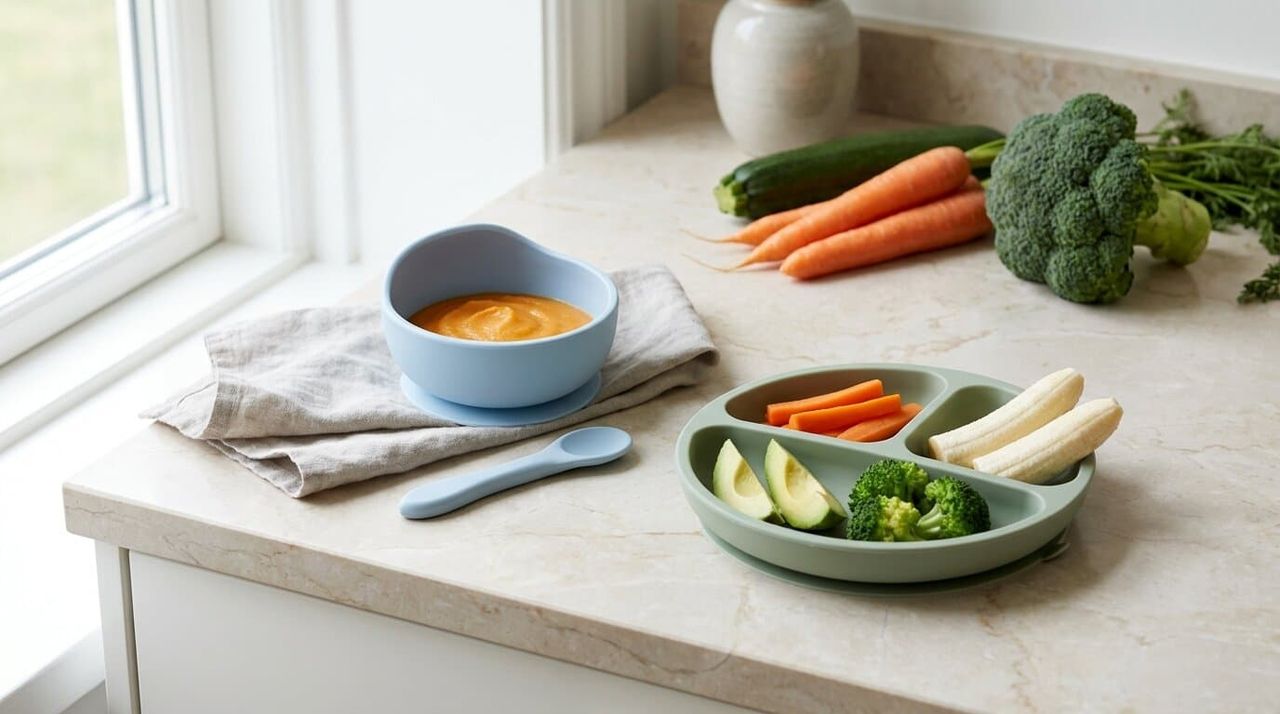
Starting solids is one of the most exciting steps of the first year: your baby tastes something other than milk for the first time, gets to know the spoon, new flavors and textures, and begins to join in at the family table. It also raises a lot of questions. When to start? What to offer first? Purees or finger foods? And what if your baby simply keeps the mouth shut?
This guide answers those questions in order. First comes the right moment, which is set by your baby, not by the calendar. Then a step-by-step first-foods plan, the nutrients that matter now, the foods that are safe and the ones that are off limits, and an FAQ covering the typical stumbling blocks of the first weeks.
Key Takeaways: Starting Solids
- ✓ The timing follows the four readiness signs, not a date on the calendar
- ✓ A good first meal is a vegetable, potato and meat puree at lunchtime
- ✓ Milk stays the main source of nutrition in the first weeks, solids are added step by step
- ✓ Iron, iodine and good fats are the nutrients that matter most now
- ✓ No honey, no salt, no sugar, no raw animal foods, no whole nuts
When to Start Solids? Your Baby Will Show You
The question of when to start solids cannot be answered with a date. Whether a baby is ready for the first spoonful depends on development, and every child develops at an individual pace. That is why organizations like the American Academy of Pediatrics, the CDC, the NHS and the WHO describe readiness signs that should appear together before you begin:
- ▸ Sits with support and holds the head steady: Your baby keeps the head stable and sits upright in a high chair or on your lap with a little support
- ▸ Reaches for food and brings it to the mouth: Objects or food are grabbed on purpose and put in the mouth
- ▸ Shows interest in food: Watches you eat, reaches for your plate, opens the mouth when the spoon comes closer
- ▸ Has lost the tongue-thrust reflex: Food is no longer pushed straight back out with the tongue
Only when all four signs are there can your baby move food around the mouth and swallow it safely. Chewing on fists, seeming hungrier or waking more at night are not readiness signs, they are part of normal development. Our guide to the readiness signs shows how to spot them in everyday life and what to do if only some are present. If people around you push for a very early start, take a look at our analysis of starting solids at 4 months.
What Changes in Your Baby's Body
Why introduce solids at all when milk works so well? Because three things change during the second half of the first year:
Iron stores
The iron reserves built up during pregnancy are gradually used up. Breast milk and formula alone no longer cover the rising need, which is why meat and other iron-rich foods come so early in the plan.
Digestion
Gut and kidneys keep maturing and can now handle nutrients other than milk. Starting too early puts unnecessary strain on this system.
Immune system
During the first months of solids the immune system learns to treat foods as harmless. That is why today's advice is not to delay allergens but to introduce them and keep offering them.
Oral motor skills and chewing, on the other hand, develop through practice. Every spoonful and every soft piece of finger food trains the movements your baby will later need for family meals.
A Simple First-Foods Plan, Step by Step
In Germany and Austria, a simple plan is recommended by the national network Gesund ins Leben: three puree meals replace one milk feed each, roughly a month apart. Between the puree meals you keep breastfeeding or giving formula for as long as your baby wants. In the US and UK many families start with iron-fortified infant cereal or soft finger foods instead. The readiness signs, the nutrients and the safety rules are the same whichever way you go.
| Step | Meal | Replaces | Typical ingredients |
|---|---|---|---|
| 1. Start | Lunch: vegetable, potato and meat puree | One milk feed at midday | Carrot, parsnip or pumpkin, potato, meat or fish, rapeseed oil, a little fruit puree |
| 2. About a month later | Evening: milk and cereal porridge | The evening milk feed | Whole milk, cereal flakes, fruit puree |
| 3. Another month later | Afternoon: cereal and fruit porridge | One milk feed in the afternoon | Whole grain flakes, water, fruit, rapeseed oil |
| 4. After that | Transition to family foods | All puree meals, one by one | Soft pieces, bread, unsalted family meals |
Typical portion sizes are covered in our guide to how much puree a baby needs. The individual meals are explained in our vegetable guide for the first puree, the evening porridge guide and the cereal porridge guide.
The First Two Weeks in Practice
- ▸ Days 1 to 3: A few spoonfuls of plain vegetable puree (carrot or parsnip, for example) around midday, then breastfeed or give the bottle as usual
- ▸ From day 4: Add potato and a tablespoon of rapeseed oil, the amount grows with your baby's appetite
- ▸ From about day 8: Meat (or fish once or twice a week) completes the puree, a spoonful of vitamin C rich fruit puree improves iron absorption
- ▸ Always: At midday, when your baby is awake, relaxed and a little hungry, sitting upright
Whether your baby takes two spoonfuls or twenty on the first day does not matter. This phase is about getting to know food, and milk remains the main source of nutrition for now. If your baby refuses to open the mouth, that is common too, see the FAQ below.
Your companion for the whole journey into solids
Purees, baby-led weaning or a mix of both: the app guides you with a readiness check, recipes for every stage and a tracker for iron, iodine and allergen introduction.
Purees, Baby-Led Weaning or Both?
Alongside the puree plan, baby-led weaning (BLW) has become popular: the baby gets soft pieces to hold from the very beginning and eats independently instead of being spoon-fed. Both approaches work once the readiness signs are there, and each has its strengths:
Purees on a plan
- ✓Iron and iodine can be planned deliberately
- ✓Amounts are easy to keep track of
- ✗Texture has to be thickened on purpose, otherwise it stays smooth for too long
Baby-led weaning
- ✓Builds fine motor skills, chewing and self-regulation
- ✓Baby eats at the family table from day one
- ✗Iron intake needs conscious planning, and gagging is more visible in the first weeks
Many families do best with a mix: purees for reliable nutrition, plus soft finger foods for exploring. Our comparison BLW vs purees helps you decide, and the finger foods guide shows suitable first pieces.
The Nutrients That Matter Now
- ▸ Iron: Meat provides well-absorbed heme iron, which is why it belongs in the lunch puree. Plant iron from oats, millet or legumes is absorbed better with vitamin C. More in our guide to meat in baby food and our overview of iron-rich foods for babies.
- ▸ Iodine: Important for the thyroid and the brain. Sea fish once or twice a week instead of meat and the milk and cereal porridge both contribute.
- ▸ Fat: A tablespoon of rapeseed (canola) oil in the lunch puree and a teaspoon in the cereal and fruit porridge provide energy and omega-3 fats. Which oil and why is covered in our oil guide for baby food.
- ▸ Vitamin D: Still comes from the drops, not from the puree. Details in our vitamin D guide.
What Babies Can Eat and What Is Off Limits
Suitable
- ✓Vegetables, steamed and soft: carrot, parsnip, pumpkin, zucchini, broccoli, sweet potato
- ✓Fruit, ripe or steamed: apple, pear, banana, peach
- ✓Potato, whole grains, millet, oats
- ✓Meat, boneless fish and egg, each cooked through
- ✓Whole milk in porridge, rapeseed oil, a little butter
Off limits in the first year
- ✗Honey: risk of infant botulism
- ✗Raw meat, raw fish, raw egg, raw milk: infection risk
- ✗Salt and sugar: strain the kidneys and shape taste preferences, see our salt guide and sugar guide
- ✗Whole nuts, whole grapes, raw carrot, whole cherry tomatoes: choking risk, see choking hazards for babies
- ✗Juice and sweetened teas: unnecessary, water is enough
Nitrate-rich vegetables such as spinach, fennel or beetroot should be prepared fresh and not reheated. For every single ingredient you will find the recommended age, allergen status and preparation in our food library.
Allergens: Early and Regularly Rather Than Late
For a long time the advice was to hold off egg, fish, peanut and wheat for as long as possible. Today's guidance is the opposite. Once solids are underway, the most common allergens can and should be added in baby-safe forms: well-cooked egg, fish in a puree, peanut butter thinned and stirred into puree. What matters is to keep offering them regularly afterwards, not just once.
Which foods belong on that list and how to introduce them one at a time is covered in our guide to the top 10 allergens for babies. How to recognize a reaction is explained in our article on the signs of an allergic reaction. If your baby has eczema or there are allergies in the family, talk to your pediatrician before you start.
Drinks When Starting Solids
As long as your baby eats only one solid meal a day, no extra water is needed, milk covers the fluid requirement. Once several solid meals a day have been added, offer tap water or still water in an open cup with meals. Juice, diluted juice and sweetened teas are not needed. How milk intake changes over the course of weaning is described in our article on how long babies drink formula.
Typical Stumbling Blocks in the First Weeks
- ▸ The mouth stays shut: No pressure, offer again on another day. Ongoing disinterest is covered in our guide to a baby not interested in food.
- ▸ Gagging: Loud, red-faced, coughing, usually the normal protective reflex of learning to eat. Read more in baby gagging during feeding, and learn to recognize true choking in gagging vs choking.
- ▸ Firmer stools: Digestion is adjusting. Pumpkin, zucchini, pear, enough oil in the puree and water with meals help, banana and lots of carrot tend not to.
- ▸ Less milk: Normal once solid meals are added. How much milk still makes sense is covered in will my baby drink less milk when starting solids.
- ▸ Stress at the table: You decide what and when, your baby decides whether and how much. This principle is explained in our division of responsibility guide.
What Comes After the Start
Once the three puree meals are in place, textures get coarser, finger foods increase and your baby eats more and more from the family table. Our guides to baby food at 8 months, baby food at 9 months and transitioning from purees to solids show what that looks like month by month. The move to family foods is described in our article on baby nutrition at 1 year.
Build the feeding plan for your baby
Every baby eats differently. The app creates a personal daily plan with suitable portions, recipes for every stage and a shopping list, matched to your baby's development and preferences.
FAQ: Common Questions About Starting Solids
Does the first food have to be carrot?
No. Carrot, parsnip and pumpkin are mild and well tolerated, which is why they are popular. You can start with any steamed, soft vegetable, or with iron-fortified infant cereal. Stick to one food for the first few days so you can tell what caused a reaction if one occurs.
Should I offer food before or after a milk feed?
In the beginning it often works best when your baby is neither very hungry nor full: some time after a milk feed, or after a small amount of milk. Once the solid meal replaces a feed, it comes first and milk only follows if your baby still wants it.
How much does my baby have to eat?
There is no target in the first weeks. Some babies take two spoonfuls, others half a bowl. Your baby sets the amount, you set the offer. Typical amounts for later are covered in our guide to how much puree a baby needs.
Does my baby need teeth for finger foods?
No. Babies mash soft pieces with their gums. What matters is that the food squashes easily between your thumb and index finger and is cut into a safe shape, see our guide to cutting food safely.
Is store-bought baby food worse than homemade?
Both are fine. With jars and pouches it is worth reading the label: no salt or sugar, with rapeseed oil, and meat in the lunch puree. Homemade puree can be cooked in batches, our guide to freezing baby food shows how to do that safely.
Conclusion: Starting Solids at Your Baby's Pace
Starting solids stays relaxed when you keep three things in mind:
- ✓The four readiness signs set the timing, not the calendar
- ✓Iron, iodine and good fats come from meat, fish, grains and rapeseed oil
- ✓Safe foods, no bans on allergens and a table without pressure
Purees, BLW or both: this is how the first spoonfuls become the start of a relaxed food culture.
Sources & Scientific Recommendations
- ▸ American Academy of Pediatrics: Starting Solid Foods
- ▸ CDC: When, What, and How to Introduce Solid Foods
- ▸ NHS: Your baby's first solid foods
- ▸ WHO: Infant and young child feeding
- ▸ Netzwerk Gesund ins Leben (Germany): Ready for complementary feeding
- ▸ EFSA: Appropriate age range for introduction of complementary feeding (2019)