If you've ever paused with a spoon halfway to the pot, wondering whether tonight's dinner is really fine for your baby's portion too, you're asking exactly the right question. Salt for babies is one of those topics that sounds like it should have an easy answer, a pinch here and there surely can't matter much, but the real answer is more specific than that, and more reassuring once you understand it. How much salt is actually safe for your baby comes down to a straightforward physiological fact: their kidneys are still under construction, and asking them to process an adult's sodium intake is a genuine physical burden, not an old habit your grandmother invented.
This guide walks through why your baby's kidneys handle salt so differently from yours, the general amount of sodium considered safe under age one and how that shifts through toddlerhood, where sodium hides in everyday foods that don't taste salty at all, and how to build genuine flavor into your baby's meals without reaching for the salt shaker, so this becomes a practical habit rather than one more thing to worry about.
Babies under 12 months should get well under 1 gram of salt a day, roughly under half a gram of sodium, because their kidneys can't yet filter out excess sodium the way an adult's can. Most of the real risk isn't the salt shaker at your table, it's the hidden sodium in bread, cheese, deli meats, stock cubes, and packaged baby snacks.
Why a Baby's Kidneys Can't Handle Salt Like Yours Can
Every structure your body relies on to keep sodium in balance is present in a newborn, but it isn't yet working at full capacity. The tiny filtering units inside each kidney, the structures responsible for clearing waste and excess minerals out of the blood, continue maturing throughout the first couple of years of life. An adult kidney can respond to a salty meal by efficiently flushing the extra sodium out in urine within hours. A baby's kidney can't do this nearly as well yet. The plumbing isn't missing, it's simply still coming online, gradually building the capacity to handle bigger swings in what comes in.
That matters because sodium doesn't just pass through harmlessly when it isn't cleared efficiently. Extra sodium in the bloodstream pulls water along with it, and a baby's kidneys, heart, and fluid balance are all operating with a much smaller margin than an adult's. Over time, a diet that regularly delivers more sodium than an immature kidney can comfortably process is thought to place unnecessary strain on organs that are still developing. It may also help set a taste preference for salty food that carries into childhood, which is a separate concern in its own right. None of this means the small, naturally occurring sodium in ordinary foods, vegetables, meat, dairy, does any harm. Babies are meant to get some sodium from food, just a small fraction of what an adult needs. The real concern is specifically added salt and the concentrated sodium found in processed and packaged foods, stacked on top of what's already naturally present in a normal diet.
It's also worth noticing why this becomes a live issue right around the time you start solids and not before. Breast milk and formula are both naturally low enough in sodium that a young baby's kidneys handle them with room to spare. Solid food, especially the moment your baby starts sharing bites of family meals, is what actually introduces the risk of a genuinely excessive sodium load for the first time, which is exactly why the transition covered in our general infant feeding guidelines is the moment this starts to matter in practice.
How Much Salt Is Actually Safe for a Baby?
The general guidance published by pediatric and public health bodies is consistent on this point, even when the exact wording varies slightly from source to source: babies under 12 months should get well under 1 gram of salt a day, which works out to roughly under half a gram of sodium. It helps to know that salt and sodium aren't quite the same measurement, salt is sodium chloride, and sodium makes up a bit under half of its weight, which is where that rough conversion comes from. In practical terms, this is a genuinely small amount, well below what a single slice of processed cheese or a couple of savory crackers can already contain on their own. This isn't a number you need to track to the milligram at every meal. It's a general benchmark that explains why added salt has no real place in food made specifically for a baby under one, and why store-bought foods deserve just as much attention as anything you season yourself.
General Daily Sodium Guidance by Age
- ▸Under 12 months: well under 1 gram of salt a day, roughly under half a gram of sodium, almost entirely from what naturally occurs in food. No added salt.
- ▸1 to 3 years: gradually rising toward roughly double the infant allowance, still a small fraction of an adult's typical intake.
- ▸Adults: commonly cited public health targets sit around 6 grams of salt a day, a ceiling most adults exceed without noticing.
This is general published guidance, not an individual prescription. A baby with a specific medical condition, particularly a kidney or heart condition, should follow their pediatrician's individual advice rather than a general benchmark like this one.
Why "Just a Little Seasoning" Adds Up Faster Than You'd Think
Here's where most families actually run into trouble, and it's rarely the salt shaker at the dinner table. Sodium hides in foods that don't taste salty at all, and because they don't taste salty, it's easy to assume they're a safe, neutral choice for a baby. A slice of ordinary bread can carry a surprisingly high amount of sodium, not because anyone salted it heavily at the table, but because salt is baked into most commercial bread recipes for texture, structure, and shelf life. Two or three slices across a day can already use up a meaningful share of your baby's entire daily allowance. Cheese is another one that regularly catches parents off guard, some of the mildest, most kid-friendly cheeses are also among the saltiest foods in a typical kitchen, gram for gram, because salt is added during production both for flavor and as a preservative.
Deli and cured meats, ham, salami, bacon, bologna, are salted and cured specifically as a preservation method, which makes them some of the most concentrated sodium sources you're likely to put in front of a baby, even in small amounts. Stock cubes, bouillon, and ready-made stocks are a quieter culprit, a single cube can carry close to a full day's sodium allowance for a baby all on its own, which matters a great deal if you're using one to flavor a pot of soup, rice, or pasta that your baby will also eat from. Canned foods, canned vegetables, beans, and soups especially, are frequently preserved with a meaningful amount of salt unless the label specifically says low-sodium or no-salt-added. And store-bought baby snacks and pouches deserve a specific mention of their own: puffs, crackers, and savory pouches marketed directly at babies and toddlers look plain and mild, but plenty of them are formulated with far more added sodium than their soft packaging and gentle branding would suggest. Plain-looking is not the same thing as low-sodium.
It's worth remembering this list doesn't stop at your own kitchen. A meal at a grandparent's house, a restaurant high chair, or a well-meaning caregiver's home-cooked lunch can all carry far more sodium than anything you'd serve at home, simply because most cooking for adults is seasoned for an adult's palate by default. It's a reasonable thing to mention out loud to anyone who regularly feeds your baby, not because you don't trust their cooking, but because "a little salt" means something very different to an adult kitchen than it does to a one-year-old's kidneys. Added sodium in packaged snacks also tends to travel together with added sugar, so if you're already reading labels closely, our guide to added sugar and babies is worth reading alongside this one.
Spot Hidden Sodium Before It's a Problem
Grubsy's food database flags high-sodium foods so you can catch hidden salt in packaged snacks and everyday staples like bread and cheese before it quietly adds up across your baby's day.
Cook Baby's Portion Before You Salt the Family's
The most reliable habit for managing all of this isn't a special baby cookbook, it's a simple sequencing trick: cook your baby's portion first, before you add salt to the rest of the pot for everyone else. Once a stew, a soup, a sauce, or a pan of vegetables has been salted, there's no way to un-salt the portion that goes to your baby, so setting a serving aside before that step happens is the only reliable way to keep it genuinely low-sodium. This matters most for the kinds of dishes that come together in one pot, a meat-based stew or braise, a batch of rice or pasta cooked in stock, a pan of roasted vegetables finished with a sprinkle of salt right at the end. Pull baby's share aside before the salt goes in, and everyone at the table still gets a properly seasoned dinner.
It's worth saying directly: tasting your own cooking is not a reliable guide to what's safe for your baby. Your palate is calibrated to an adult's sense of what tastes properly seasoned, which means food that tastes only pleasantly savory to you, not even oversalted by your own standards, can still be well beyond what's appropriate for your baby's portion. A stew that tastes perfectly balanced to you was very likely seasoned to an adult's threshold, not a baby's, so "it doesn't taste salty to me" isn't useful information here. Trust the sequencing of setting a portion aside, not the taste test.
This is also a good habit to build early, since iron-rich foods like meat are a genuine cornerstone of your baby's diet across this first year, and low iron stores are common once breast milk alone is no longer enough to meet your baby's needs. The plain, home-cooked version of that meat, set aside before salting, gives you the full iron benefit without the sodium load that comes with cured, smoked, or heavily processed versions of the very same cut.
How to Season Without Salt
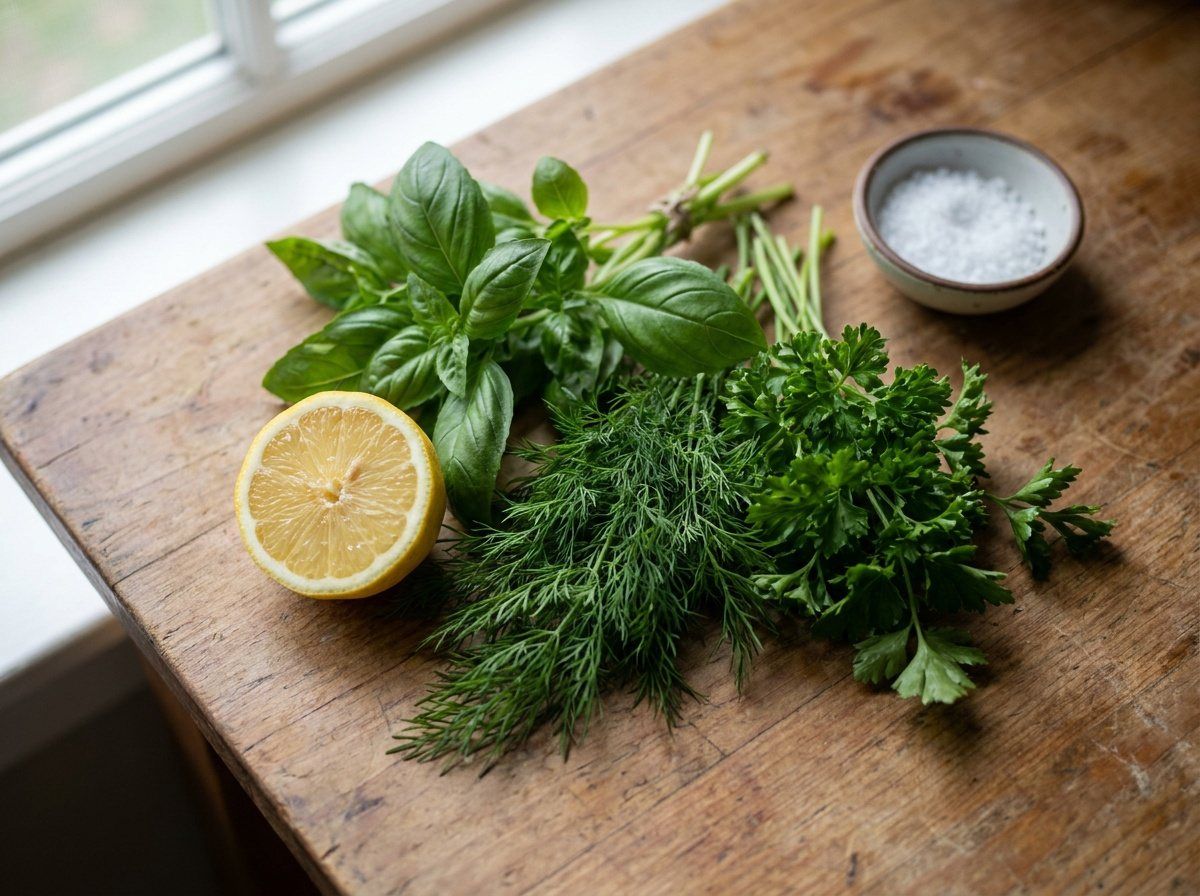
Skipping added salt doesn't mean your baby is stuck eating bland food, and it's worth reframing this as an opportunity rather than a restriction. Herbs and spices are entirely fine for babies, and introducing them early is one of the better-kept secrets of raising a flexible, adventurous eater later on. Garlic, onion, cumin, cinnamon, paprika, basil, ginger, a light touch of black pepper, all of these build genuine flavor and introduce your baby to the tastes your family actually eats, rather than handing them a separate, muted "baby version" of every meal. A squeeze of lemon juice does something salt does, it brightens a dish and makes other flavors pop, without contributing any sodium at all.
A finishing drizzle of good olive oil adds richness and rounds out a dish the same way a pinch of salt would, while also contributing healthy fats your baby needs in real quantity at this stage. Unsalted butter, stirred through vegetables or mashed potato, brings much of the same comforting richness as salted butter without the sodium load, and most babies genuinely can't tell the difference at this age, since they haven't yet developed a learned preference for salty food the way older children and adults have. Babies who grow up eating real, herb-and-spice-forward food, rather than a separate track of bland purees, tend to be more willing to try new flavors later on, which makes skipping the salt shaker less of a sacrifice and more of a head start.
Reading Food Labels for Sodium, Without Overthinking It
Once your baby starts eating more packaged foods, toddler snacks, crackers, cereal, jarred sauces, label-reading becomes a genuinely useful skill, and it's simpler than it looks. Sodium is listed on nutrition labels per 100 grams of the food, and a rough rule of thumb many parents find useful works like a traffic light: under roughly 0.3 grams of sodium per 100 grams is a lower-sodium choice you can offer freely, over roughly 1.5 grams of sodium per 100 grams is a high-sodium food worth limiting or skipping for a baby, and anything in between is a moderate amount worth keeping an eye on rather than offering constantly. You don't need to calculate this at the shelf every time. A quick glance at where a number falls relative to those two rough markers is usually enough to decide whether something belongs in your baby's everyday rotation or stays an occasional food.
It's worth scanning the ingredients list too, not just the nutrition panel, since sodium doesn't always show up under a name that's obviously salt. Watch for salt itself, but also for sodium bicarbonate, sodium citrate, and monosodium glutamate, all of which contribute to the same daily total even though none of them look like "salt" on a label at first glance.
What Changes as Your Baby Grows Into Toddlerhood
The under-1-gram guidance for babies under 12 months isn't permanent. It reflects how immature a baby's kidneys are at that specific stage, and the daily amount considered appropriate rises gradually as your child's kidneys mature and their overall food intake grows alongside them. By the time your toddler is somewhere between one and three years old, general guidance allows for roughly double the infant allowance, which is still a small fraction of what's considered acceptable for an adult. This gradual rise continues through the preschool and early school years, only inching close to adult-level guidance once a child is well into the school-age years. Our guide to nutrition for babies around their first birthday walks through how the whole diet shifts at this stage, sodium included, as purees and baby-specific meals give way to modified versions of family food.
What doesn't change nearly as fast is the underlying taste habit. A toddler who spent their first year eating without added salt tends to keep a lower preference for salty food than one who was introduced to heavily salted food early, and that preference tends to persist well beyond the toddler years. So even as the numeric limit rises, holding off on the salt shaker at your toddler's plate for as long as reasonably possible is still doing your child a genuine favor, not just following an outdated rule left over from their baby days.
None of this adds up to a life of bland food, for your baby or for your family's dinner table. What it actually means in practice is narrower and far more manageable than it sounds: skip added salt specifically in the portion you serve your baby under one, lean on herbs, spices, garlic, and citrus to do the flavor work salt would otherwise do, and build a habit of checking labels on the specific packaged foods that quietly carry the most sodium. Everything else on your baby's plate, the herbs, the spices, the genuine variety of real food, can stay exactly as flavorful as the rest of the family's meal.
This is general guidance reflecting mainstream pediatric consensus, not a substitute for individual medical advice. A baby with a kidney condition, a heart condition, or another specific medical need may have different sodium requirements entirely, and should follow their pediatrician's individual guidance rather than the general benchmarks in this article.
Final Thoughts
Salt for babies really does come down to one physiological fact worth remembering: their kidneys are still maturing, and keeping added salt off their plate for the first year gives those kidneys room to develop without unnecessary strain. Well under 1 gram of salt a day for babies under 12 months, rising gradually through toddlerhood, is the general benchmark worth keeping in mind, and hidden sodium in bread, cheese, deli meats, stock, and packaged snacks matters far more day to day than anything you'd ever add with a spoon.
Cook your baby's portion before salting the rest of the meal, lean on herbs and spices to build real flavor, and check labels on the packaged foods most likely to carry a hidden sodium load. That's genuinely the whole system, and it leaves plenty of room for a baby who eats well, eats widely, and grows into a toddler who was never dependent on salt to enjoy a meal in the first place.