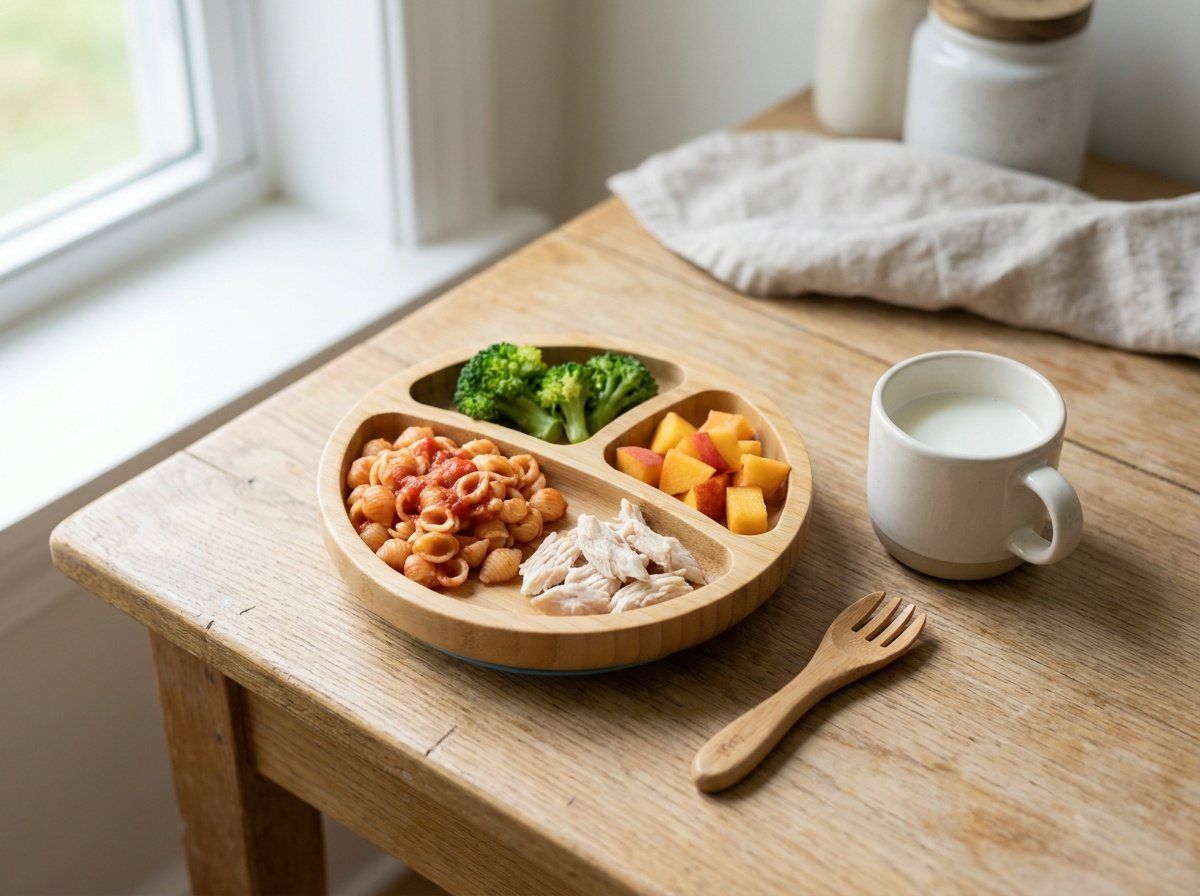
A 15 month old does best on three meals and two snacks, spaced about 2.5 to 3 hours apart, with 16 to 24 oz (475 to 710 ml) of whole milk served in a cup at mealtimes and water in between. Portions are small: a good rule of thumb from the American Academy of Pediatrics is about one tablespoon of each food per year of age, so one to two tablespoons per food at 15 months, with more offered when your toddler asks for it.
That is the skeleton. Below you will find two complete sample days as tables, one for a daycare day and one for a day at home, followed by portion guidance for every food group, where the milk goes, what makes a snack useful, and how to handle the timing questions that come with the move from two naps to one.
Key Takeaways
- ▸ 3 meals + 2 snacks, roughly every 2.5 to 3 hours, all at the table
- ▸ 16 to 24 oz of whole milk a day in a cup with meals; yogurt and cheese count toward it
- ▸ A 15 month old needs roughly 700 to 1,000 calories a day, and appetite swings from meal to meal are normal
- ▸ Serve about 1 to 2 tablespoons per food and let your toddler ask for more
- ▸ Water between meals, no bottle at bedtime, iron rich food at most meals
What a 15 Month Old Needs in a Day
The Dietary Guidelines for Americans give toddlers aged 12 to 23 months a daily pattern of about 700 to 1,000 calories, spread across the food groups below. You do not need to measure any of this; it simply shows what a full day adds up to when meals and snacks are varied.
| Food group | Per day (12 to 23 months) | What that looks like |
|---|---|---|
| Vegetables | 2/3 to 1 cup | A few tablespoons of soft cooked vegetables at lunch and dinner |
| Fruit | 1/2 to 1 cup | Half a banana at breakfast, a few pear wedges at a snack |
| Grains | 1.75 to 3 oz equivalents | 1 oz equivalent is one slice of bread or half a cup of cooked oatmeal, rice or pasta |
| Dairy | 1 2/3 to 2 cups | Two to three small cups of milk, or two cups plus yogurt or cheese |
| Protein foods | 2 oz equivalents | 1 oz equivalent is 1 oz of meat or fish, one egg, 1/4 cup of cooked beans or 1 tablespoon of peanut butter |
| Oils and fats | About 2 to 3 teaspoons | Olive or canola oil in cooking, butter on toast, avocado |
Growth slows sharply in the second year, so the same toddler who ate everything at 10 months may now eat a big breakfast and ignore dinner. Judge intake over a week rather than a meal. If the eating pattern itself worries you, our guide on toddler mealtime behavior explains what is typical at this age.
Sample Day 1: Daycare Day
On a daycare day, breakfast and dinner happen at home and everything in between is served by the center. Centers on the USDA Child and Adult Care Food Program serve 1 year olds 4 oz (1/2 cup) of unflavored whole milk at breakfast and lunch and offer milk at snack, so you already know roughly how much milk arrives there.
| Time | Meal | What to serve | Drink |
|---|---|---|---|
| 6:45 | Breakfast at home | Oatmeal cooked with milk, half a banana in slices | 4 to 5 oz milk in a cup |
| 9:30 | Morning snack (daycare) | Thin slices of cheese, soft pear wedges | Water |
| 11:30 | Lunch (daycare) | Shredded chicken, soft cooked carrot coins, rice | 4 oz milk (the center's serving) |
| 12:30 to 2:30 | Nap | ||
| 3:00 | Afternoon snack (daycare) | Plain yogurt, quartered berries | Water |
| 5:30 | Dinner at home | Flaked salmon (if fish is already tolerated) or lentils, broccoli florets, mashed potato | 5 to 6 oz milk in a cup |
| 7:00 | Bedtime routine | Teeth brushed after dinner milk, no bottle | Water if thirsty |
Milk on this day: about 13 to 15 oz from the cup plus the yogurt and cheese, which brings the dairy total to 2.5 to 3 cups. If your center serves milk at snack as well, drop the dinner cup to 4 oz. Ask the center what your child actually drank; most keep a daily sheet.
Sample Day 2: Home Day
At home the day can start a little later and the meals can be the family's own food, cut and cooked for a toddler. This day assumes one nap after lunch, which is where most 15 month olds land.
| Time | Meal | What to serve | Drink |
|---|---|---|---|
| 7:30 | Breakfast | Scrambled egg (if egg is already tolerated), toast strips with butter, orange segments with membranes removed | 4 to 6 oz milk in a cup |
| 10:00 | Morning snack | Hummus with soft steamed carrot sticks, a few whole grain crackers | Water |
| 12:00 | Lunch | Lentil and vegetable stew over rice, peas | 4 to 6 oz milk in a cup |
| 12:45 to 2:30 | Nap | ||
| 3:00 | Afternoon snack | Toast fingers with a thin smear of peanut butter (if peanut is already tolerated), apple sauce | Water |
| 5:45 | Dinner with the family | Soft pasta with tomato sauce and grated cheese, finely chopped beef or tofu, steamed green beans | 4 to 6 oz milk in a cup |
| 7:00 | Bedtime routine | Bath, teeth, book | Water if thirsty |
Milk on this day: three cups of 4 to 6 oz, which lands between 12 and 18 oz, plus the cheese at dinner. The foods marked "if already tolerated" are common allergens. Once an allergen has been introduced without a reaction, keeping it on the menu regularly is what maintains tolerance, which is why they belong in a normal week rather than on a list to avoid.
Portion Sizes by Food Group
The serving sizes below follow the AAP's guidance for toddlers, where a serving is roughly a quarter of an adult portion. Start with one serving of each food on the plate and offer seconds when your child clears it and asks for more. The number of servings per day is what a typical day adds up to, not a target to hit every day.
| Food group | One toddler serving | Servings a day |
|---|---|---|
| Grains | 1/4 to 1/2 slice of bread, 1/4 cup cooked oatmeal, rice or pasta, 2 to 3 crackers | About 6 |
| Vegetables | 1 to 2 tablespoons, cooked soft and chopped | 2 to 3 |
| Fruit | 1/4 to 1/2 piece of fresh fruit, 2 to 4 tablespoons cooked or mashed | 2 to 3 |
| Dairy | 1/2 cup (4 oz) milk, 1/2 oz cheese, 1/3 cup yogurt | 2 to 3, up to 24 oz of milk in total |
| Protein foods | 1 oz meat, poultry or fish, 1 egg, 2 to 4 tablespoons cooked beans or lentils, 1 tablespoon nut butter thinly spread | 2 |
Iron is the nutrient most likely to fall short at this age, so make one of the two protein servings an iron rich one (red meat, beans, lentils, fortified cereal) and pair plant sources with fruit or vegetables that carry vitamin C. The iron rich foods guide has combinations that work.
A daily plan that fits your toddler, not a template
The app builds a meal plan with age appropriate portions, safe cuts for every food and a shopping list, and adjusts it to what your child actually eats.
Where the Milk Goes
Both sample days place milk at the three meals and nowhere else. That is deliberate. A 15 month old should drink 16 to 24 oz of whole milk a day, and three cups of 5 to 6 oz get there without a single bottle. Milk poured half an hour before a meal becomes the meal; milk in bed sits on the teeth all night. If your toddler eats yogurt or cheese, the cups can be smaller. The reasoning behind the range, and what happens above it, is in how much milk a 15 month old should drink; the month by month view for the whole second year is in how much milk a toddler should drink from 12 to 24 months. If your child is still partly on formula at 15 months, the formula to milk guide shows how to finish the switch.
Snacks That Actually Help
Snacks are small meals, not treats. They fill the long gaps between meals so that your toddler arrives at lunch and dinner hungry but not frantic. Three rules make them work:
- ▸ Seated, at the table, at a set time. Grazing from a snack cup all afternoon is the fastest way to a toddler who "never eats dinner".
- ▸ Two food groups. Fruit plus cheese, yogurt plus oats, hummus plus soft vegetables, bread plus nut butter, cottage cheese plus peach.
- ▸ Water, not milk or juice. The milk allowance is spent at meals; juice is unnecessary at this age.
Crackers, puffs and pouches are fine occasionally, but a snack of only refined starch does little for the afternoon. For more ideas, see our snack and finger food guide.
Timing Tips for 15 Months
Build the day around the nap
Most toddlers drop to one nap somewhere between 12 and 18 months. Serve lunch before the nap, even if that means 11:30, and move the afternoon snack to right after waking.
Keep 2.5 to 3 hours between eating times
Shorter gaps mean a toddler who is never quite hungry; longer gaps mean a toddler who is too upset to eat.
Eat dinner early
Between 5:00 and 6:00 works for most 15 month olds. A tired toddler at 7:00 eats little and fights the chair.
End the meal after 20 to 30 minutes
You decide what, when and where; your toddler decides whether and how much. This division of responsibility takes the pressure out of every meal, and it is explained in our division of responsibility guide.
Safety at the Table
Toddlers can eat most family foods, but the way food is cut still matters. Round, firm and slippery foods are the ones that block a small airway: whole grapes and cherry tomatoes (quarter them lengthwise), hot dogs and sausages (split lengthwise, then chop), whole nuts, popcorn, hard raw vegetables, big chunks of cheese or meat, and sticky spoonfuls of nut butter. Serve nut butter as a thin spread, cook vegetables until a fork goes in easily, and cut meat across the grain into small, thin pieces. Your toddler should sit upright in a high chair with an adult at the table, every time. Our choking hazards guide goes through each food.
Frequently Asked Questions About a 15 Month Old Feeding Schedule
My 15 month old barely eats dinner. Is that a problem?
Usually not. Many toddlers eat most of their food before 2 pm and treat dinner as optional. Look at the whole week, keep serving a normal dinner without pressure, and make sure the afternoon snack is not too late or too big.
How much water should a 15 month old drink?
About 1 to 4 cups a day, offered in a cup between meals and with snacks. More on hot days or when your child is very active.
Does my toddler still need a bedtime bottle?
No. The bedtime bottle is the one to retire first for the sake of the teeth. A cup of milk with dinner, then teeth brushing, then the bedtime routine covers the comfort and the nutrition.
Can I skip the snacks?
Small stomachs empty fast, so two snacks help most 15 month olds. If your child eats large meals and is content between them, one snack is fine. Watch mood and appetite rather than the clock.
My daycare serves different foods than we do. Does that matter?
Not as long as the day adds up. Check the center's menu, then balance at home: if lunch was pasta and fruit, make dinner the meal with vegetables and an iron rich protein.
Is my 15 month old eating less than at 12 months?
Very possibly, and it is expected. Growth slows in the second year and appetite follows. Milk staying under 24 oz and a steady weight curve at checkups are the reassurance you need.
Can my toddler just eat what we eat?
Yes, with three adjustments: cook the toddler's portion with little or no added salt, cut it safely, and keep hard, round and sticky foods off the plate. Honey is no longer a concern after 12 months; raw milk products and undercooked meat, fish or eggs still are.
Final Thoughts
- ✓ Three meals and two snacks, 2.5 to 3 hours apart, at the table
- ✓ 16 to 24 oz of whole milk in a cup with meals, water in between
- ✓ Small portions offered, seconds on request, iron rich food most days
- ✓ Judge the week, not the meal
A schedule gives a 15 month old predictability. Within it, appetite is allowed to do what it wants.
Sources
- ▸ American Academy of Pediatrics (HealthyChildren.org): Serving Sizes for Toddlers
- ▸ American Academy of Pediatrics (HealthyChildren.org): Recommended Drinks for Children Age 5 and Younger
- ▸ Dietary Guidelines for Americans, 2020 to 2025: Healthy Dietary Pattern for Toddlers Ages 12 Through 23 Months
- ▸ USDA MyPlate: Toddlers
- ▸ USDA Child and Adult Care Food Program: Meal Patterns
- ▸ CDC: Choking Hazards
- ▸ NHS: What to Feed Young Children