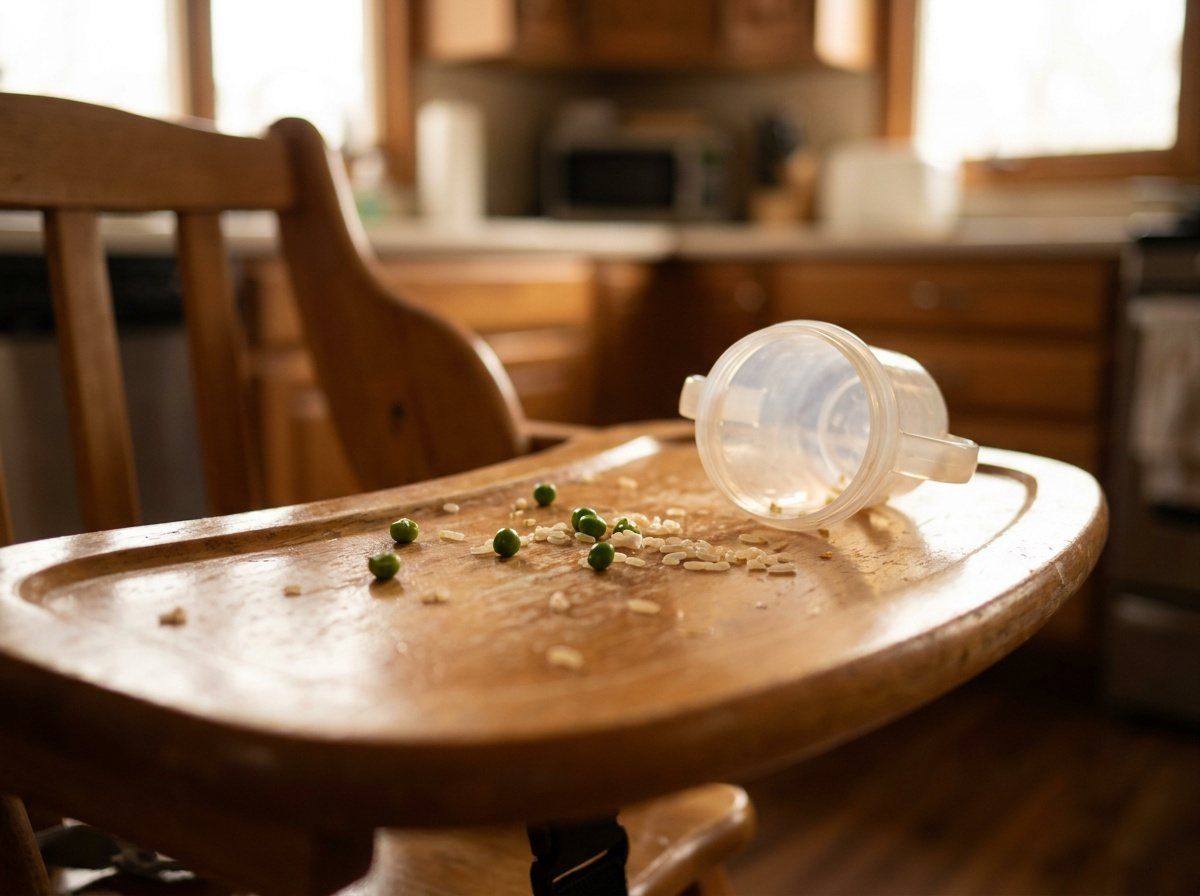
If dinner regularly ends with peas on the floor, a fistful of rice crammed into both cheeks, or your toddler pushing the spoon away and looking at you expectantly to do the feeding yourself, you have landed in one of the most common, and most misunderstood, stretches of early childhood. Toddler throwing food, stuffing too much into their mouth at once, and suddenly refusing to self-feed are three of the most frequently asked-about pieces of toddler mealtime behavior, and almost none of it is what it looks like on the surface.
None of these behaviors mean your toddler is spoiled, manipulative, or being deliberately difficult. At this age, mealtime behavior is doing a job: communicating something words cannot yet carry, testing how the physical world works, or working through a completely normal stage of asserting independence. This guide walks through why each of these three behaviors happens, how to respond calmly and consistently in the moment, how to set boundaries without punishing or shaming a toddler for a developmental stage, and how to tell an ordinary rough patch from something worth a closer conversation with your pediatrician.
Most toddler mealtime behavior that looks like defiance is actually communication, experimentation, or a normal developmental stage. Your job is not to win the moment. It is to respond the same calm, predictable way every time, so the behavior stops being effective long before it becomes a habit.
Why Toddler Mealtime Behavior Isn't What It Looks Like
Between roughly one and three years old, toddlers are working with a huge gap between what they understand and what they can say. Comprehension races ahead of expressive language for most of this stretch, which means a toddler who fully grasps that they are done eating, or that they would rather feed themselves, often has no reliable way to say so in words yet. The behavior fills the gap. Throwing a bowl, stuffing a handful of crackers in at once, or batting away a spoon are not sophisticated plans, they are the most efficient tools currently available. Our infant feeding milestones guide walks through how eating skills and communication typically develop side by side over these early years, which is useful context for almost everything in this guide.
This is also the exact developmental window where toddlers are building a sense of themselves as separate people with their own preferences, the same stage that produces an enthusiastic "no" to nearly everything for a while. Mealtimes sit right in the middle of that project, because eating is one of the only areas where a toddler has genuine, legitimate control over their own body. Seen this way, refusing the spoon or dropping a cup off the tray for the fifth time in a row is less a battle of wills and more a toddler exercising the one kind of control that is actually theirs to exercise.
None of this means anything goes. It means the most useful response rarely looks like a bigger reaction, a stricter rule, or a punishment. A predictable, calm response from you, offered the same way whether today is a good day or a hard one, teaches a toddler what to expect far more effectively than an occasional dramatic reaction ever could. That idea sits underneath a well-known feeding framework called the division of responsibility, which draws a clear line between what you are responsible for at meals and what belongs to your child, and it explains why calm consistency works better than punishment throughout everything below.
Food Throwing: What It's Really Telling You
Food throwing usually shows up somewhere between nine months and two years, and it tends to peak right around the same time toddlers are gaining real hand strength and a satisfying overhand throw. Three overlapping reasons explain most of it.
A "Done Eating" Signal Before the Words Are There
Before a toddler has reliable words for "I'm finished," pushing a plate away or flinging what is left on it is often functionally identical to a shrug or a headshake. If throwing consistently starts only after several minutes of normal eating, that is usually exactly what is happening: appetite has run out, and the tray has become uninteresting rather than appealing.
Cause-and-Effect Experimentation
This reason is a genuine cognitive milestone rather than misbehavior. It is the same age and stage that makes dropping a spoon from a highchair, over and over, endlessly fascinating: your toddler is actively testing gravity, trajectory, and your reaction, and food happens to be within reach. A piece of banana lobbed off the tray is doing the same job as a toy pushed off the same ledge five times in a row.
A Search for a Reaction
If a thrown handful of rice reliably produces a big laugh, a dramatic gasp, or a chase around the kitchen, a toddler will repeat whatever reliably gets a response, since positive and negative attention both count as attention at this age. This one is usually the easiest of the three to spot, because it tends to happen more when there is a clear audience and less when there is not.
You rarely need to diagnose which of the three is driving a particular Tuesday dinner, since the calm, consistent response works whichever one it turns out to be.
A Calm Response to Food Throwing
- ▸Say it once, neutrally: "Looks like you're all done," without anger or a long explanation
- ▸End the meal: remove the tray or plate rather than replacing thrown food or negotiating for a few more bites
- ▸Keep your own reaction flat either way, no big laugh and no dramatic scolding, since both reward the behavior with attention
- ▸Once your toddler is old enough, offer a small role in cleanup, wiping the tray or dropping a napkin in the bin, so the meal ends on a cooperative note instead of a punished one
What you are aiming for is boring, on purpose. A meal that ends the same quiet way whether three bites were eaten or the whole plate was thrown gives a toddler nothing interesting to repeat for. That takes real repetition to work, sometimes weeks of it, and it will not stop a single throwing episode in the moment it is happening. What it does, reliably, is make the behavior less rewarding over time, which is a far more durable fix than any single reaction ever could be.
Mouth-Stuffing: When Excitement Crosses Into a Safety Issue
Mouth-stuffing, cramming in bite after bite before swallowing the last one, often looks like enthusiasm, and a lot of the time that is exactly what it is. A toddler who loves a food, who is genuinely hungry, or who has just discovered a favorite new texture will sometimes load up faster than they can process. Some of it is also still a developing skill rather than a personality trait: pacing bites and judging how much fits safely in a small mouth are things toddlers are still practicing, not things they arrive already knowing how to do.
It is worth being direct here: mouth-stuffing is a genuine safety issue, not just a messy habit to shrug off. A mouth packed with more food than a toddler can manage raises real choking risk, especially if any of that food is a shape or texture that is still risky at this age. Our guide to choking hazards and guide to cutting food safely by age are worth revisiting around this stage, since the same shapes that were risky at nine months, round, hard, sticky, or tough, are still risky at two and three years old, and a mouth already crowded with three bites has far less room to manage a grape or a chunk of cheese safely than one working through a single piece at a time.
In the moment, a calm reminder works better than a dramatic one: a simple "one bite at a time" or "let's chew that one first," said the same way each time, rather than a sharp "stop" that spikes the tension at the table. Offering smaller portions at a time, two or three pieces on the tray instead of a full mound, and refilling as your toddler clears it, removes much of the temptation to grab a handful at once. What you should not do is force-remove food from your toddler's mouth with your fingers when they are calm and simply overloaded. A finger sweep can push food further back rather than out, and it is a step meant for genuine choking emergencies, not ordinary overenthusiastic bites.
Persistent, severe mouth-stuffing, not an occasional overexcited bite, but a near-daily pattern that does not ease with smaller portions and calm reminders held consistently over several weeks, is worth mentioning to your pediatrician, and the same is true if it is paired with real difficulty managing textures in general. Most mouth-stuffing is simply enthusiasm outrunning skill, and it fades as pacing improves with practice, but it is a specific enough safety concern that it belongs on the short list of toddler eating behaviors worth flagging rather than only waiting out.
Log What's Working, Across Every Caregiver
Grubsy lets you log mealtime notes, like which portion size keeps stuffing in check or exactly how small a grape needs to be cut, so what works with you doesn't get lost between grandparents, daycare, and everyone else feeding your toddler.
"Won't Self-Feed": Troubleshooting by Likely Cause
A toddler who was self-feeding happily last month and now wants to be fed bite by bite can feel like a step backward, but it is rarely a regression worth worrying about. It almost always traces back to one of a few ordinary causes.
Too Tired or Overstimulated for a Hard Skill Right Now
Self-feeding is genuinely hard work, and a tired, overstimulated, teething, or simply hungry-right-now toddler often has no patience left for effortful new skills. The same toddler who confidently spears food with a fork at a calm lunch may fall apart trying to do it at a noisy restaurant, at the end of a long day at daycare, or during a growth spurt when patience for anything slow is in short supply. That is not a skill your toddler has lost, it is bandwidth they simply do not have available at that particular moment.
The Food Itself Is Hard to Grasp or Manage
Sometimes the cause is mechanical rather than emotional: the food may be cut in a way that is genuinely hard to grasp or manage right now. A slippery piece, a portion too small for small hands, or a shape that keeps sliding off a fork can turn an eager toddler into a frustrated one within a minute. Our guide to finger foods covers shapes and sizes that are genuinely easy for small hands to manage, and it is worth revisiting periodically, since what worked at fourteen months is not necessarily what still works at twenty-two.
Simply Preferring to Be Fed, Which Is Normal
Toddlers sometimes prefer being fed, and that preference comes and goes for reasons that have nothing to do with skill. Independence and closeness are not a straight line for a toddler, they swing back and forth, especially around a new sibling, an illness, a big transition, or just an unusually long day. Wanting a few bites handed over by someone they trust is not a step backward from the self-feeding skills built through baby-led weaning or any other approach, it is a completely normal toddler wanting some independence and some connection at the same meal, sometimes bite by bite.
A few practical fixes cover most of this. Adjusting food shape and size to match what small hands can actually manage removes a whole category of frustration before it starts. Offering a pre-loaded spoon alongside a piece your toddler can pick up themselves lets both preferences exist at the same meal, some bites handed over, others managed independently, without turning it into a negotiation. Patience beats pressure here just as it does everywhere else at the table: a toddler gently allowed to feed themselves when ready, rather than pushed to prove independence on a schedule, tends to get there faster than one who feels rushed toward it.
Calm, Consistent Boundaries Without Punishment
Food throwing, mouth-stuffing, and refusing to self-feed all respond to the same underlying approach: calm, predictable boundaries, held the same way every time, without punishment or shame layered on top.
A predictable end-of-meal routine does a lot of this work on its own. Wiping hands, using the same short phrase, and moving on communicates that the meal is over without needing a debate to get there. Our guide to pressure-free, screen-free mealtimes covers building that kind of predictable rhythm in more depth, and the same routine that keeps pressure off eating also keeps behavior boundaries calm and consistent, since both rely on the same steady, low-drama close to every meal.
Extensive negotiating rarely helps, and it is worth naming why: a toddler mid-experiment or mid-communication is not in a state to weigh a counteroffer the way an older child might. "If you stop throwing food I'll give you dessert," or a long explanation of why throwing is not okay, mostly extends the moment rather than resolving it. A short, calm acknowledgment paired with a consistent consequence works better than a negotiation ever will at this age.
Shaming has no real place here either. Labeling a toddler "naughty" or "bad" for throwing food, stuffing their mouth, or refusing a spoon attaches a moral judgment to a developmentally normal behavior, and it tends to add stress to mealtimes without changing the behavior itself. The same goes for punishing by withholding food or skipping straight to the next meal as a consequence. The goal is a calm, predictable boundary, not a punishment, and the two often look similar on the surface but land very differently for a toddler.
Normal Phase or Time for a Feeding Therapy Conversation?
For the overwhelming majority of toddlers, food throwing, mouth-stuffing, and resisting self-feeding are ordinary, temporary parts of this age, and they ease on their own over weeks and months as language catches up, as fine motor skills mature, and as your calm, consistent response does its slow work in the background.
Worth a Conversation With Your Pediatrician
- ▸Mouth-stuffing that stays persistent and severe despite smaller portions and calm reminders held consistently for several weeks
- ▸Any of these behaviors paired with a very limited range of accepted foods overall, rather than ordinary day-to-day pickiness
- ▸Signs of a broader feeding difficulty, such as falling off their growth curve or ongoing distress at nearly every meal
- ▸A toddler who cannot manage age-appropriate textures at all, rather than one who is simply still practicing
None of these signs on their own is an emergency, and plenty of toddlers show one or two of them for a stretch without anything being wrong. What they have in common is that they describe a pattern rather than a single hard week, which is exactly what a pediatrician or feeding specialist is trained to sort through. If a narrow, shrinking list of accepted foods is part of the picture, our guide to picky eating is a useful next stop, since food refusal and mealtime behavior often show up together and respond to a lot of the same low-pressure, consistent approach.
For most families, though, this stage simply runs its course. The toddler who stuffed both cheeks and refused every spoon at two is, for the vast majority of children, eating independently and without drama well before starting school, and the calm, boring, consistent response you are giving tonight is exactly what gets them there.
Final Thoughts
Food throwing, mouth-stuffing, and refusing to self-feed can feel like a referendum on your parenting during an already exhausting stretch of toddlerhood, but almost none of it is. It is communication before the words are ready, curiosity about how the world works, a normal push for independence, and occasionally a genuine safety habit worth a closer look, not defiance aimed at you.
Respond the same calm way tonight that you did last night. Keep food cut safely and portions manageable. Skip the punishment and the negotiation both. Most toddlers grow through this exact stretch of mealtime behavior on a totally ordinary timeline, one quiet, consistent meal at a time.