If dinner most nights ends with a plate of untouched broccoli, a meltdown over the wrong cup, or a toddler who will only eat foods that are beige and crunchy, you are not doing anything wrong, and you are not alone. Picky eating in babies and toddlers is one of the most common concerns parents raise at pediatric visits, and for good reason: it can feel deeply personal, even though it almost never is.
What most parents call "picky eating" has a name in developmental research: food neophobia, a normal wariness of new or unfamiliar foods that intensifies as babies grow into toddlers. It is not a sign that you have done something wrong, it is not a preference your child invented to test you, and for the vast majority of children it is a predictable, temporary stage rather than a lasting trait.
This guide walks through why picky eating in babies and toddlers happens in the first place, how to tell an ordinary picky phase from something worth mentioning to your pediatrician, which common parenting responses tend to backfire even though they feel logical in the moment, and what the research actually shows helps, plus how to build a toddler plate that quietly raises the odds of a bite.
Picky eating is not a parenting failure. It is one of the most well-documented stages of early childhood development, and the approach that actually shifts it, repeated, low-pressure exposure and a calm, unbothered response to refusal, is almost the opposite of what feels most natural to do in the moment.
Why Picky Eating in Babies and Toddlers Is Developmentally Normal
Babies typically start solids with genuine openness. Many six, seven, and eight month olds accept a wide variety of new flavors and textures with barely a pause, which is one reason mainstream feeding guidance encourages offering a broad range of foods, including the common allergens, early and often; our infant feeding milestones guide walks through how eating skills and preferences shift across those first two years. Picky eating in the sense most parents mean, the sudden refusal of a food a child ate happily last month, the insistence on a narrow rotation of "safe" foods, the suspicious side-eye toward anything new on the plate, tends to show up later, and it follows a fairly predictable arc.
If your baby is younger, closer to six or seven months, and seems generally uninterested in solids rather than selectively resistant to specific foods, that is usually a different pattern rooted in still-developing feeding skills rather than true pickiness. Our guide to a 6 month old not interested in food covers that earlier stage in detail. This guide focuses on the food neophobia that typically emerges toward the end of the first year and then intensifies, commonly peaking somewhere in the second and third year of life, a stage nearly every toddler moves through to some degree.
Researchers who study food neophobia tend to describe it as adaptive rather than random. Right around the same age that food refusal typically ramps up, toddlers are also becoming mobile, curious, and increasingly able to pick things up and put them in their mouths without a caregiver's direct involvement. A built-in caution toward unfamiliar foods, especially ones with an unusual smell, color, or bitterness, would have offered real protection at a point in human history when a wandering toddler might just as easily reach for something genuinely harmful as for dinner. Seen this way, your toddler's suspicious sniff-and-refuse routine toward a new vegetable is not defiance. It is a very old safety instinct doing exactly what it evolved to do, just at a moment when you already know the broccoli is perfectly safe.
An Ordinary Picky Phase vs. When to Get Support
The overwhelming majority of picky eating falls squarely within normal, and most children broaden their diet gradually over months and years without any formal intervention at all. Still, it is worth knowing what would be reasonable to mention to your pediatrician or a feeding specialist, calmly and without alarm, rather than assuming every mealtime battle is simply a phase to wait out.
Worth a Calm Conversation With Your Pediatrician
- ▸A very limited number of accepted foods overall, think fewer than a small handful across all food groups combined, rather than simply disliking a few individual vegetables
- ▸Falling off their growth curve or losing weight, rather than simply growing a little more slowly than a sibling did
- ▸Extreme distress at mealtimes well beyond ordinary fussing, such as prolonged crying, gagging, or vomiting at the sight or smell of food
- ▸Gagging or choking on textures well beyond what is typical for their age, especially if it persists for months rather than easing with practice
None of these signs on their own means something is seriously wrong, and plenty of children with a genuinely narrow diet turn out to be perfectly healthy. But this pattern of signs together, rather than one isolated bad week, is what feeding specialists look for when deciding whether a child needs closer support, and getting that support early tends to be far easier than waiting. For most families, though, picky eating looks much more ordinary: a child who eats well at breakfast and stonewalls dinner, or who loved pasta on Tuesday and refuses it on Thursday, which is exactly the kind of inconsistency that defines this stage rather than something to fix.
What Commonly Backfires, and Why
When a child stops eating something they used to enjoy, most parents' instincts point toward more effort: more encouragement, more incentive, more insistence. Unfortunately, several of the most common responses to picky eating are also the ones most likely to make it worse over time.
Bribing and Dessert as a Reward
Offering dessert, a sticker, or screen time in exchange for eating vegetables feels harmless, and in the short term it sometimes even works. The problem shows up over time: rewarding a child for eating one food with a more exciting one teaches, quite clearly, that the reward food is the good one and the eaten food is something to be endured. Research on children's food preferences consistently finds that this kind of contingent reward tends to lower a child's liking of the food they were bribed to eat, and raise their desire for the reward food, the opposite of what most parents are hoping for.
Forcing a Bite
Insisting on or requiring a bite before a child can leave the table is one of the most common instincts at a stressful mealtime, and one of the most consistently counterproductive. Forcing a bite does not typically build tolerance the way repeated, gentle exposure does. It tends to increase resistance, turn a single disliked food into a source of dinner-table conflict, and make a child warier of that food, and of mealtimes in general, the next time it appears.
Short-Order Cooking a Separate Meal
Making a second, separate meal the moment a child rejects what is on the table is one of the most understandable responses (nobody wants a hungry, hysterical toddler at 6pm), but it quietly removes any reason to try the family meal at all. If buttered noodles are always waiting in reserve, there is little incentive to risk the unfamiliar vegetable next to them. This does not mean every meal needs to be a standoff over one shared plate. It means keeping at least one familiar, reliably eaten food on the table alongside the new one, rather than cooking a whole alternate menu.
Pressure and "One More Bite"
"Just one more bite," repeated praise for eating, and visibly monitoring exactly how much a child has eaten all fall under what feeding researchers call pressure, and pressure is one of the most studied variables in childhood eating behavior. The findings are remarkably consistent: pressure to eat, even well-intentioned, encouraging pressure, is associated with worse long-term acceptance of foods, not better, along with a reduced ability to self-regulate how much to eat. It is one of the clearest cases in child feeding research where the instinct to try harder is precisely the thing to ease off.
What Actually Helps
If bribery, force, separate meals, and pressure do not work, what does? The research on picky eating converges on a small set of approaches that are less dramatic, slower, and considerably more effective than most quick fixes.
Repeated, Low-Pressure Exposure
The single most consistently supported strategy is also the simplest to describe and the hardest to stick with: offering a new food again and again, without requiring a bite each time, and without giving up after the first, second, or fifth refusal. Studies on food acceptance in young children commonly find that it can take somewhere in the range of eight to fifteen exposures, sometimes more, before a child accepts a new food, and "exposure" does not have to mean eating it. Seeing it on the table, watching a sibling or parent eat it, touching it, or helping serve it all count as meaningful exposure, and each one chips away at the unfamiliarity that food neophobia is built on. The mistake most parents make is concluding that a food has been "rejected" after two or three tries, right around the point where persistence actually starts to pay off.
Turn Repeated Exposure Into a Simple Weekly Plan
Grubsy lets you log which foods you have offered and how often, so "keep trying" becomes an actual visible plan instead of a vague hope you are keeping track of in your head.
Serve New Foods Alongside Familiar, Safe Ones
A new or previously rejected food lands very differently next to something a child already trusts than it does sitting alone in the middle of an otherwise empty plate. Pairing one unfamiliar item with foods you already know your child will eat lowers the stakes of the whole meal, because there is no pressure riding on the new food when dinner is not at risk either way.
Let Them Touch It, Serve Themselves, and Be Messy
Sensory exploration, touching, squishing, smelling, and yes, occasionally throwing, is part of how young children gather information about a new food long before it reaches their mouth. Letting a toddler serve themselves from a shared bowl, use their hands, or simply poke at a piece of food on their tray builds familiarity on their own timeline rather than yours. A certain amount of mess at this stage is not a sign that mealtimes are going badly. It is often a sign that real exploration is happening.
Model Eating the Food Yourself
Toddlers are watching far more than they are listening, and one of the most reliable ways to make a new food feel safe is to be seen eating and enjoying it yourself, at the same table, without commentary or encouragement directed at them. Children consistently show more willingness to try foods they have watched a trusted adult or older sibling eat with apparent enjoyment, which is one more reason a shared family meal tends to outperform a separate kids' plate.
The Division of Responsibility
Underneath all of these individual tactics sits a broader feeding philosophy that many pediatric dietitians recommend, often called the division of responsibility: the parent decides what food is offered and when and where it is served, while the child decides whether to eat it at all and how much. Handing that second half of the decision fully to your child removes the tug-of-war that fuels so much mealtime pressure in the first place. Our guide to the division of responsibility feeding method walks through exactly how to put this into practice, including how it shifts at different ages.
Building a Toddler Plate That Actually Gets Tried
A few small choices about how you build the plate itself can quietly raise the odds of a bite, without turning dinner into a project.
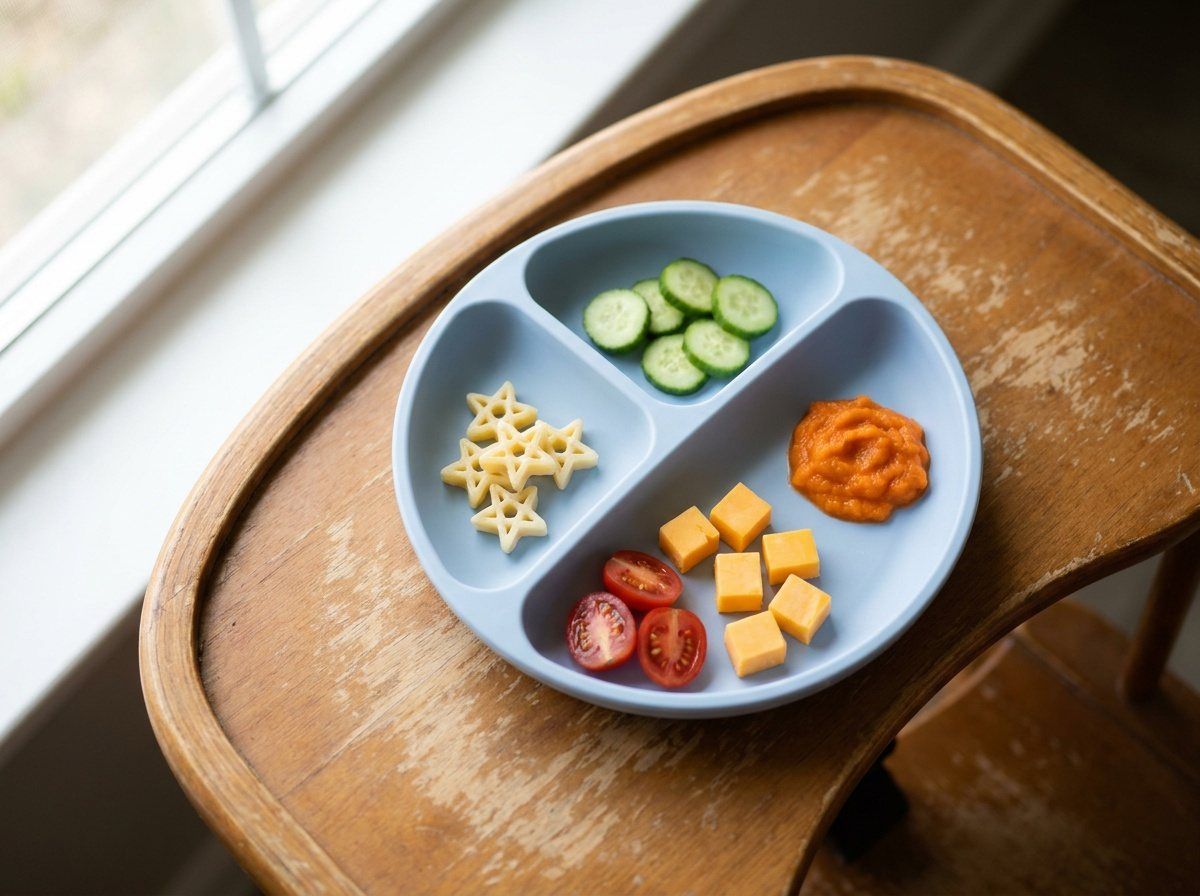
Rather than reinventing the whole meal around what you hope your toddler will eat next, build each plate around one familiar anchor food you already know they will eat, buttered pasta, rice, or soft sweet potato wedges are reliable anchors for a lot of toddlers, alongside one small, low-pressure exploratory item: a few florets of broccoli or a handful of berries set quietly on the side. The exploratory item does not need to be eaten to count as a win. It just needs to be present, unpressured, and available if curiosity strikes mid-meal.
Choosing new foods that resemble something a child already eats comfortably, in texture, shape, or temperature, is the idea behind a technique called food chaining, which builds a bridge from familiar foods toward a genuinely varied diet one small, related step at a time. Our guide to food chaining for toddlers walks through exactly how to find those bridges when your child's list of accepted foods feels especially narrow.
It also helps to remember that variety adds up across days, not single meals. A toddler who eats almost nothing new at dinner but tries one unfamiliar food at breakfast or nibbles something new at snack time is still making progress, even on a day that felt, in the moment, like a complete mealtime failure. If you want a wider rotation of realistic, kid-tested meal ideas to build these plates around, our lunch ideas for a 12 month old is a useful starting point.
The Timeline, and Why Your Calm Matters
Perhaps the most reassuring thing to know about picky eating in babies and toddlers is also the simplest: for the overwhelming majority of children, it is a phase, not a trajectory. Diets that feel alarmingly narrow at two or three years old typically broaden gradually through the preschool years and beyond, especially when mealtimes stay low-pressure and new foods keep quietly reappearing on the table.
One of the most consistent findings across feeding research has less to do with any single technique and more to do with tone: children whose parents stay relatively calm and neutral about food refusal, treating a rejected vegetable as simply information rather than a crisis, tend to move through picky phases more smoothly than children whose mealtimes are charged with visible parental anxiety or frustration. Your child is watching your reaction to the rejected bite at least as closely as you are watching their plate, and a shrug and a "maybe next time" does more long-term work than it feels like it should in the moment.
That does not mean picky eating stops being frustrating day to day. Scraping the same untouched broccoli into the compost for the tenth week running is genuinely tiring, and it is fair to feel that way. But the underlying trend, for almost every child, points toward a wider, more varied diet over time, built one low-pressure exposure, one shared family meal, and one ordinary Tuesday dinner at a time.
Final Thoughts
Picky eating in babies and toddlers is not evidence of a parenting mistake, and it is not a preview of how your child will eat for the rest of their life. It is a well-documented, near-universal stage built on an old, protective kind of caution, and it responds best to strategies that feel far less dramatic than they get credit for: repeated, low-pressure exposure, a familiar anchor food alongside something new, a shared and reasonably calm table, and a parent willing to let go of exactly how much gets eaten at any single meal.
Keep offering the food. Keep the pressure low. Keep your own reaction boring. Most children get there, in their own time, one ordinary meal at a time.