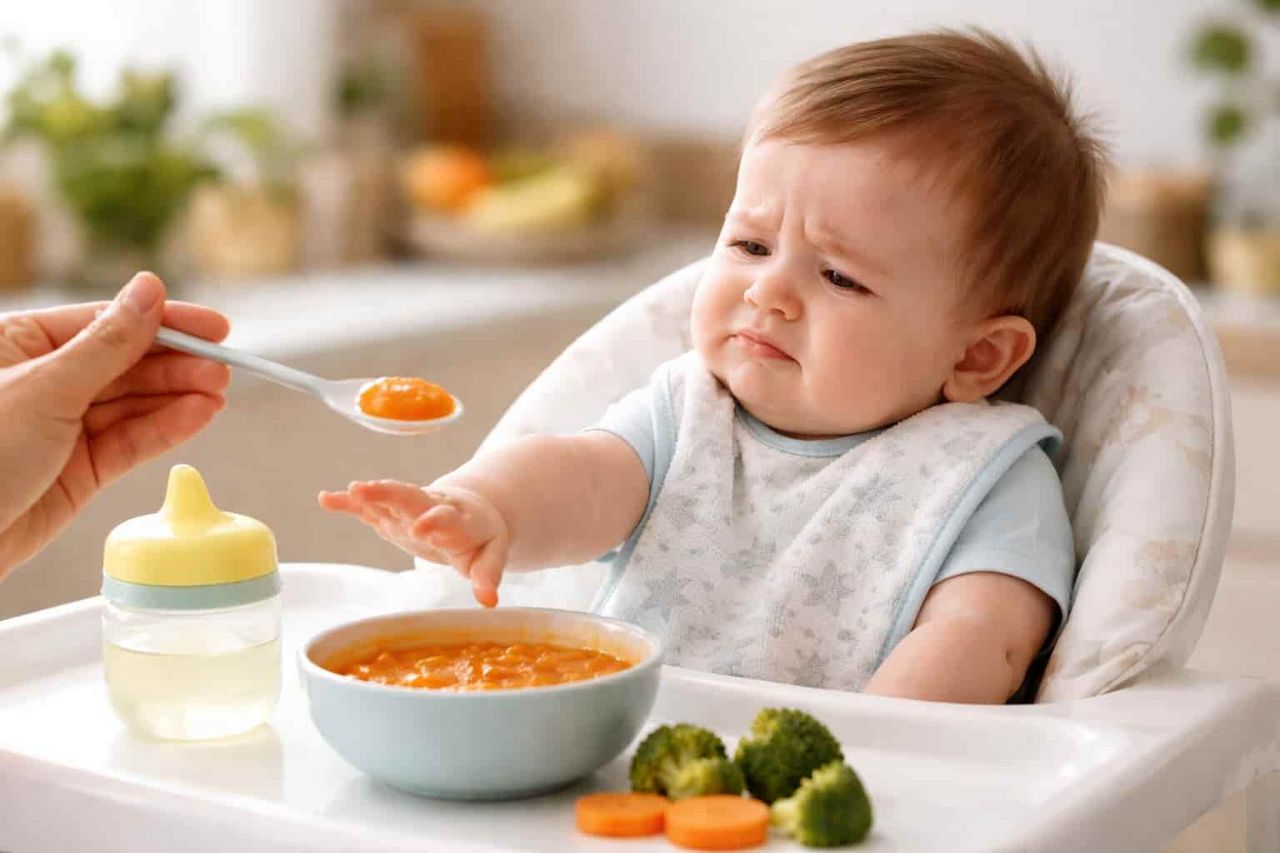
You have set up the high chair, cooked the first puree, spoon at the ready, and your baby turns away, presses the lips together or just looks at you, puzzled. If your 6 month old is not interested in food, you are in good company. And in the vast majority of cases it is exactly what it looks like: a baby who is only just learning what food is.
This guide explains why babies refuse solids, what changes from month to month, which pressure-free strategies really help and how to tell when it is worth getting a medical opinion. It covers the whole first phase of solids, so it applies just as much when your baby is 7, 8, 9 or 10 months old and barely eating.
Key Takeaways: Baby Not Interested in Food
- ✓ Milk stays the main source of nutrition in the first weeks of solids, food is practice, not a duty
- ✓ Check the four readiness signs first: if one is missing, disinterest is completely normal
- ✓ The most overlooked reason: your baby is simply full from milk
- ✓ Pressure, distraction and "just one more bite" make it worse, not better
- ✓ See the pediatrician when weight, fluid intake or wellbeing suffer, not because of empty spoons
Why a Baby Shows No Interest in Food: The Most Common Reasons
Until now, food for your baby has always been liquid, warm and delivered straight from you or the bottle. Puree from a spoon is something completely different: new mouth movements, new texture, new temperature, a new feeling in the tummy. A baby meeting that with skepticism is not a problem, it is the rule. The typical reasons:
- ▸Not all readiness signs are there yet: the body is simply not ready, whatever the calendar says
- ▸No appetite: lots of small milk feeds through the day leave no room for solids
- ▸Wrong moment: tired, overstimulated or just fed, and no spoon will work
- ▸Teething or a cold: sore gums or a sore throat make eating unpleasant
- ▸Texture or temperature: too thick, too thin, too cold, too hot, or a lump that surprises
- ▸Pressure at the table: a spoon that keeps chasing, distraction with toys or screens, a tense parent face
- ▸Baby wants to do it alone: some refuse being fed but grab finger foods immediately
Check First: Is Your Baby Really Ready?
Before you tweak recipes or strategies, take an honest look at the readiness signs. Whether a baby is ready is decided by development, not by age, and development differs from child to child. Your baby is ready when they:
- ✓sit upright with support and hold the head steady
- ✓reach for food and bring it to the mouth on purpose
- ✓show interest: watch you eat, reach for your plate, open the mouth
- ✓have lost the tongue-thrust reflex and no longer push puree straight back out
If one of these signs is missing, "not interested" is your baby's honest answer, and the best response is to wait a week or two and offer again. Our guide to the readiness signs shows how to spot them in everyday life. If all four are there and your baby still refuses, the reason is usually in the sections below.
What Changes From Month to Month
Refusing solids looks different at 6 months than at 10. The table shows what is typical in each phase and what tends to help:
| Age | Typical reason | What helps |
|---|---|---|
| 6 to 7 months | Food is brand new, readiness signs are fresh, milk is preferred | Offer once a day, a few spoonfuls, no expectations, milk as before |
| 8 to 9 months | Wants to self-feed, puree gets boring, distraction, teething | Soft finger foods, preloaded spoon, lumpier textures, a calm table |
| 10 to 12 months | Own will, tests limits, throws food, dislikes certain textures | Eat together at the family table, a choice of two or three things, remove pressure completely |
Playing, squishing and throwing are part of learning at every stage: your baby explores food with the hands first, then with the mouth. What an age-appropriate meal can look like later is shown in our guide to baby food at 8 months. If refusal continues into the second year and targets specific foods, it is usually food neophobia, covered in our guide to picky eating in babies and toddlers.
The Most Common Reason: Full From Milk
This reason is overlooked most often because it is so unspectacular. A baby who nurses or takes a bottle a little every hour or two throughout the day simply has no appetite for puree. The signs: short gaps between milk feeds, "milk snacks" for comfort or for falling asleep, and little interest in anything that is not milk.
What helps:
- ▸Offer solids when some time has passed since the last milk feed, but before your baby is fussing with hunger
- ▸Gradually move solids ahead of milk: the spoon first, then breast or bottle to top up
- ▸Find a rough daily rhythm in which milk and solids each have their place
Milk intake dropping as solids grow is intended. How much milk still makes sense is explained in will my baby drink less milk when starting solids.
Teething, Illness and Developmental Leaps
If your baby used to eat happily and suddenly refuses, look for physical reasons first: swollen gums and lots of drooling from teething, a blocked nose that makes swallowing hard work, a sore throat, constipation, or simply a leap in which everything is more exciting than the spoon. In these phases appetite drops, milk is preferred and solids are refused for a few days. It passes. Keep offering without pushing, and above all make sure your baby drinks enough.
Pressure Makes It Worse: Share the Responsibility
When babies do not eat, parents naturally try harder: chase with the spoon, distract with toys or a screen, negotiate "just one more bite". From the baby's point of view this feels like losing control. The lesson learned is that food means stress. And a stressed baby eats less, not more.
The alternative is Ellyn Satter's division of responsibility: you decide what, when and where food is offered. Your baby decides whether and how much to eat. That takes the burden of counting spoonfuls off you and gives your baby the trust that nothing has to be fought over at the table. How this works in practice is explained in our division of responsibility guide and our article on pressure-free, screen-free mealtimes.
Keep track of what has already worked
In the app you log which foods your baby has tried and how they reacted. You see progress that gets lost in everyday life and get ideas that match where your baby is right now.
Eight Strategies That Really Help
- 1. Set expectations to zero. Think "practice session", not "meal". Two spoonfuls are a success, a closed mouth is information.
- 2. Pick the right moment. Well rested, a little hungry, not straight after a feed, not right before a nap.
- 3. Eat together. Babies learn by imitation. Put your baby at the table when you eat, even if they only watch.
- 4. Offer soft finger foods. A strip of steamed carrot or a piece of ripe banana in their own hand is more exciting to many babies than any spoon. Our finger foods guide has ideas, and our BLW guide explains the approach behind them.
- 5. Preloaded spoon. You fill the spoon, your baby brings it to the mouth. That hands control back without changing the texture.
- 6. Allow the mess. Hands in the puree, puree in the hair: that is exploring, and exploring comes before eating.
- 7. Remove distractions. No screen, no toys, a calm table. Babies this age can focus on one thing at a time.
- 8. Keep offering. A refused food is not a finished food. It often takes many offers over weeks before a baby accepts something new. Varying temperature, texture and shape helps.
Which cues show that your baby wants more or is done, and when it is time for coarser textures, is explained in our guide to baby puree and stage 1. And if your baby gags while eating and that makes you hesitate, baby gagging during feeding helps you put it in perspective.
Fluids First: What Really Matters
As long as your baby drinks well, an empty spoon is not an emergency. Breast milk or formula covers everything important in the first weeks of solids. It becomes more serious when a baby who is teething or unwell also refuses milk. Then watch for enough wet diapers, moist lips and an alert, content baby. If your baby drinks noticeably less than usual or seems listless, call your pediatrician the same day.
When to Worry
Little interest in food is normal in this phase. Get a medical opinion in these cases:
- ▸Your baby is not gaining weight or is losing weight
- ▸They refuse milk as well as solids, or drink noticeably less
- ▸They gag or cough hard at every meal, or food regularly comes out through the nose
- ▸They have accepted no solids at all for months despite all readiness signs being present
- ▸They show a rash, vomiting or strong distress after eating
One point belongs in a conversation with your pediatrician even if your baby seems perfectly healthy: in the second half of the first year babies need iron from food, because the stores built up during pregnancy run low. If your baby has eaten hardly anything for weeks, ask how to secure their iron intake. Which foods qualify is covered in our guide to iron-rich foods for babies.
FAQ: Common Questions When a Baby Will Not Eat
My baby only plays with the food and eats nothing. Does that count?
Yes. Touching, squishing, licking and dropping are the first steps of learning to eat. A baby who explores food is on the way. Stay with it, let them do it and offer again every day.
Should I replace purees with finger foods?
You do not have to choose. Many babies who refuse the spoon grab finger foods enthusiastically, and many families combine both: purees for nutrients, soft pieces for exploring. What matters is that the finger foods are soft and cut safely.
How long can I pause solids?
A break of one to two weeks is no problem if your baby drinks well. Then offer again, ideally in a different form: another vegetable, finger food instead of puree, a different time of day. Do not stop altogether, because the windows for iron and allergen introduction fall right in this phase.
My baby only eats fruit and refuses vegetables. What now?
Sweet is familiar to babies, breast milk is sweet. Keep offering vegetables, ideally first when hunger is greatest, and mix in a little fruit at the start. Acceptance grows with repeated offers, even if it takes weeks.
Does my baby need supplements if they hardly eat?
Vitamin D drops are given anyway. Whether extra iron is needed is decided by your pediatrician based on age, weight and diet. Please do not supplement on your own.
Conclusion: A Learning Phase, Not a Test
A 6 month old who is not interested in food is, in the vast majority of cases, a baby who is still practicing, not one who is missing out. What helps:
- ✓Check the readiness signs and, when in doubt, wait a few days
- ✓Time milk feeds so that appetite for solids can develop
- ✓Eat together, offer finger foods, drop pressure and distraction
- ✓Keep offering and measure progress in weeks, not spoonfuls
If you are right at the beginning, our starting solids guide walks the whole path from readiness signs to the first puree.
Sources & Scientific Recommendations
- ▸ American Academy of Pediatrics: Starting Solid Foods
- ▸ CDC: When, What, and How to Introduce Solid Foods
- ▸ NHS: Your baby's first solid foods
- ▸ Ellyn Satter Institute: The Division of Responsibility in Feeding
- ▸ WHO: Infant and young child feeding
- ▸ Netzwerk Gesund ins Leben (Germany): Ready for complementary feeding