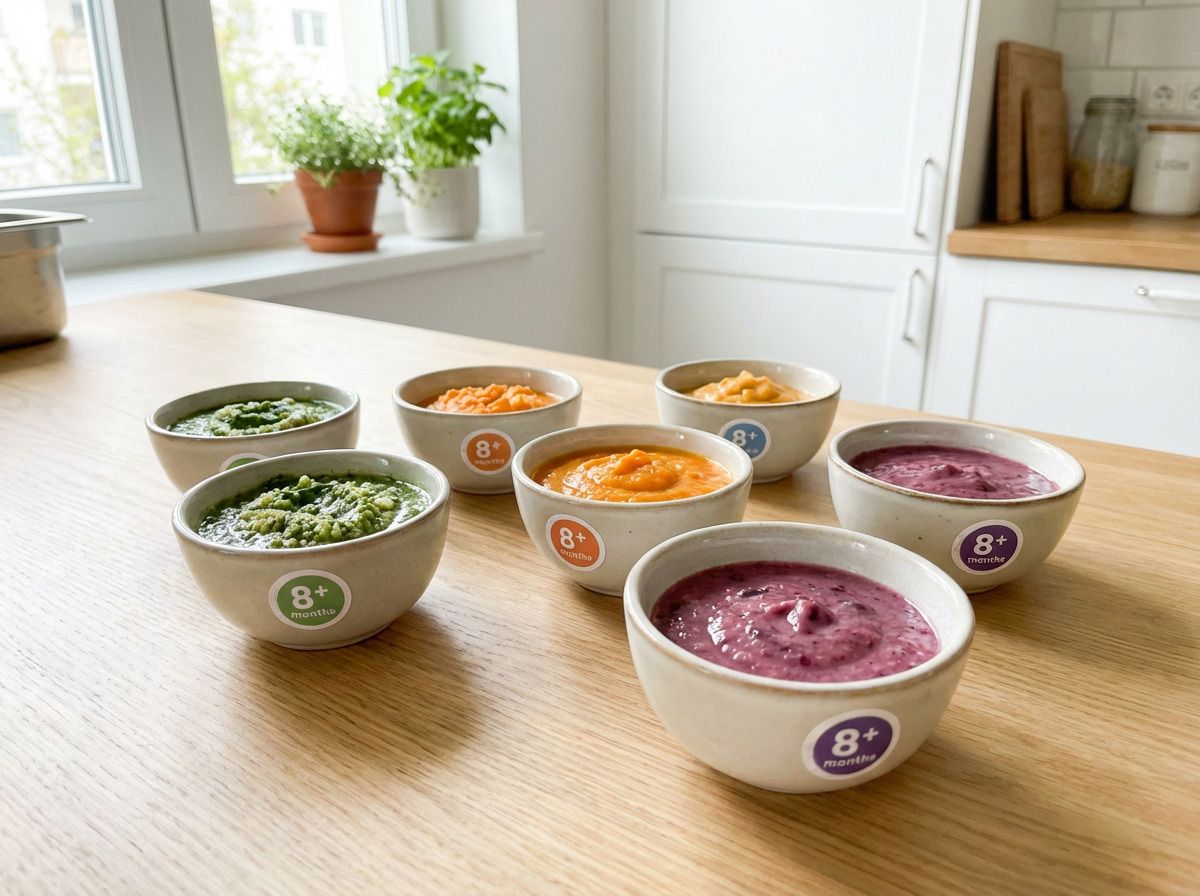
The 8th month is an exciting developmental phase: babies are no longer just eating purees, but beginning to actively participate at the family table. Nutrition becomes more varied, chunkier, and more nutrient-rich. This comprehensive guide shows you what babies can eat at 8 months, what weaning at 8 months looks like, and how to structure a typical daily meal plan.
At a Glance: What Do 8-Month-Old Babies Eat?
- ✓ 2 solid food meals + 4–5 milk feeds
- ✓ Purees (breakfast and lunch)
- ✓ First soft finger foods
- ✓ Fish, meat, grains, fruit, vegetables
- ✓ Breastfeeding or formula continues on demand
Motor Development & Eating Skills at 8 Months
For babies to eat properly at 8 months, they need certain readiness signs. Most babies develop these naturally around this age, as shown below.
- ▸ Secure sitting with light support: Important for safe swallowing
- ▸ Pincer grasp (beginning to develop): Baby can pick up small soft pieces
- ▸ Tongue thrust reflex disappearing: Food is no longer automatically pushed out
- ▸ Chewing motions (without teeth): Gums + tongue are sufficient
These abilities make it possible for babies at 8 months to eat chunky purees, soft-cooked vegetables, or BLW finger foods.
What Can Babies Eat at 8 Months?
Here's an overview of allowed and recommended foods. For detailed information about individual ingredients, visit our Food Library.
Vegetables (steamed, soft)
- ✓ Carrot, pumpkin, zucchini
- ✓ Parsnip, sweet potato
- ✓ Broccoli, cauliflower
Find more vegetable varieties and preparation tips in our vegetable guide for babies.
Fruit (ripe, soft or steamed)
- ✓ Banana, avocado
- ✓ Pear, peach
- ✓ Apple (steamed)
Learn when and how to introduce fruit in our article When to Give Fruit to Baby.
Grains & Starches
- ✓ Oats, millet, spelt, wheat
- ✓ Pasta (soft-cooked)
- ✓ Rice, potatoes
Animal Products
- ✓ Meat: Beef, lamb, poultry
- ✓ Fish: Salmon, trout (1–2×/week)
- ✓ Egg: Yolk + white, well-cooked
- ✓ Milk: Whole milk in porridge (not as a drink!)
Fats
- ✓ Rapeseed oil (best choice for Omega-3)
- ✓ Butter in small amounts
Learn why oil is important and what alternatives exist in our Oil Guide for Baby Food.
Which Foods Are Forbidden at 8 Months?
- ✗ Honey: Botulism risk until the 1st birthday
- ✗ Whole nuts & hard foods: Acute choking hazard
- ✗ Sugar & heavily salted foods: Kidney strain
- ✗ Raw milk, raw milk cheese, raw meat/fish: Infection risk
- ✗ Whole grapes, raw carrots, cherry tomatoes: Only finely cut or soft-steamed
Weaning at 8 Months: The 2 Key Puree Meals
1. Breakfast: Milk-Grain Porridge
A gentle, sating start to the day with grains and milk.
Example:
- ▸ 200 ml whole milk (3.5%)
- ▸ 20 g grain flakes
- ▸ 2 tbsp fruit puree
2. Lunch Puree: Vegetable-Potato-Meat/Fish
Ideal for iron & energy – the most important solid food meal of the day.
Standard portion:
- ▸ 100 g vegetables
- ▸ 50 g potatoes
- ▸ 30 g meat or 20 g fish
- ▸ 1 tsp–1 tbsp rapeseed oil
- ▸ 1 tbsp fruit puree for vitamin C (improves iron absorption)
Daily Schedule: Sample Meal Plan for 8-Month-Olds
| Time | Meal | Example |
|---|---|---|
| 07:00 | Breakfast | Milk-grain porridge |
| 10:00 | Milk feed | Breastfeeding or formula |
| 12:00 | Lunch puree | Vegetable-potato-meat + water |
| 15:00 | Milk feed | Breastfeeding or formula |
| 19:00 | Milk feed | Breastfeeding/formula before bed |
Build the meal plan for your baby
Every baby eats differently. The Starting Solids app creates a personalized daily plan with exact portions, matching recipes and a shopping list, tailored to your baby's age and preferences.
How Much Should an 8-Month-Old Baby Drink?
- ▸ 4–5 milk feeds (breastfeeding or formula)
- ▸ Approx. 200 ml water additionally with 2 solid food meals
Recommended drinking vessels:
- ✓ Open cup (promotes oral motor development)
- ✓ 360° cup
Less suitable:
- ✗ Bottle with nipple (for water)
- ✗ Hard spout cups
Finger Food & Baby-Led Weaning (BLW) at 8 Months
BLW can wonderfully complement purees from 8 months. For a comprehensive introduction, read our complete BLW guide.
Suitable Finger Foods
Everything that passes the squish test: easily mashed between your fingers.
- ✓ Steamed vegetable sticks (carrot, zucchini, broccoli)
- ✓ Ripe banana pieces
- ✓ Avocado strips
- ✓ Soft-cooked potato wedges
- ✓ Soft-cooked pasta (fusilli are easy to grip)
- ✓ Soft millet or oat balls
Important rules for finger food:
- ➡ Baby must be able to sit securely
- ➡ Food soft & large enough to grip
- ➡ Always supervise during eating
Safety: Gagging Is Normal – Choking Is Not
Babies often gag when learning to eat solid foods. It looks dramatic but is an important protective reflex and learning process. Learn more in our detailed article: Baby Gagging During Feeding – What to Do?
✓ Gagging (normal):
Baby is loud, turns red, has tears, actively coughs/gags
✗ Choking (emergency):
Baby is silent, turns blue, cannot breathe → act immediately!
Not sure if a food is safe?
For every ingredient, the Starting Solids app shows the right age, allergen status, choking risk and how to prepare it safely, plus an allergen-introduction tracker.
What Comes After 8 Months?
At 9 months, nutrition becomes even chunkier and more independent. The pincer grasp is better developed, and your baby will want to eat more and more from the family table. Read our guide to baby food at 9 months for the next steps.
Want the whole month in one place, including development, sleep and a sample daily routine? Read our overview 8 Month Old Baby: Development, Feeding, Sleep & Daily Routine.
For an overview of the entire first year, we recommend our article on nutrition in the first year of life.
Summary: What 8-Month-Old Babies Should Eat
The 8th month brings variety, taste, and important developmental steps. A good mix of:
- ✓ Nutrient-rich purees (breakfast and lunch)
- ✓ Soft finger foods for exploration
- ✓ Early introduction of potential allergens
- ✓ Adequate milk intake (4–5 feeds)
creates the best foundation for healthy eating habits and optimal development.
Sources & Scientific Recommendations
- ▸ AGES – Austrian Complementary Feeding Recommendations
- ▸ Richtig essen von Anfang an (REVAN)
- ▸ Kindergesundheit-info.de – Introducing Complementary Foods
- ▸ German Nutrition Society (DGE)
- ▸ Gesund ins Leben – Complementary Feeding Guidelines
- ▸ World Health Organization (WHO) – Complementary feeding guidelines