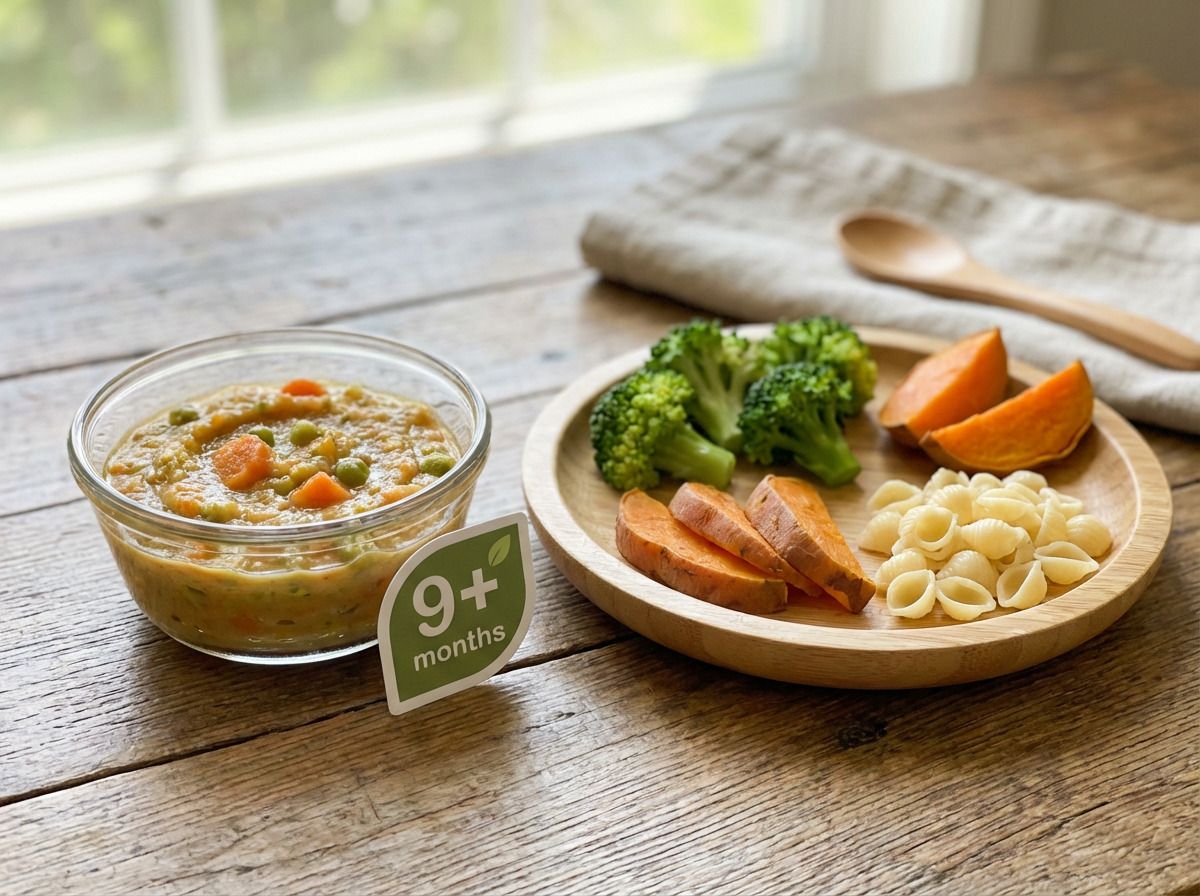
At 9 months, your baby reaches an important developmental milestone. Motor skills have significantly improved, the first teeth may have appeared, and interest in family meals is growing. But what should baby food at 9 months actually look like? Which textures are appropriate now? And how do you manage the transition from smooth purees to chunkier foods?
This comprehensive guide shows you how to optimally prepare baby food for 9 months – with recipes, nutrient tips, and practical everyday recommendations.
Development at 9 Months: What Can Your Baby Do?
The 9th month of life brings significant changes that directly impact nutrition. Health organizations emphasize that this phase is crucial for developing eating behaviors.
Motor Milestones
- ▸ Pincer grasp develops: Your baby can now pick up small pieces between thumb and index finger
- ▸ Lateral tongue movements: Food is purposefully moved toward the gums
- ▸ Stable sitting: Hands-free sitting enables independent eating
- ▸ Chewing motions: Even without teeth, soft pieces are mashed
These developmental steps mean your baby is ready for more texture and independence while eating, building on the same readiness signs that guided you at the start of solids.
Baby Food at 9 Months: What Consistency Is Right?
Unlike the start of weaning, where smooth puree is recommended, baby food at 9 months should be noticeably chunkier. Health authorities recommend:
Texture Recommendation for 9 Months:
- ➡ Only mash food with a fork, don't puree
- ➡ Small, soft pieces (pea-sized) are ideal
- ➡ Offer finger foods alongside purees
Chewing and mashing soft pieces is important for developing oral muscles, which are also relevant for speech development later. If your baby gags while eating, this is often a normal protective reflex – read more about it in our article.
The Optimal Daily Plan: Baby Food 9 Months Meal Times
At 9 months, most babies have already established a structured meal rhythm. According to pediatric recommendations, a typical day looks like this:
| Meal | Recommendation | Example |
|---|---|---|
| Morning | Milk feed | Breastfeeding or approx. 200-240 ml formula |
| Lunch | Vegetable-Potato-Meat Puree | 180-200 g with chunks + finger food |
| Afternoon | Grain-Fruit Puree | Approx. 150 g or fruit finger food |
| Evening | Milk-Grain Porridge | Approx. 200 g milk-grain porridge |
| Before Sleep | Milk feed (optional) | Breastfeeding or bottle as needed |
Nutrients in Focus: What Does Your 9-Month-Old Need?
By the 9th month, the body's iron stores built up during pregnancy are largely depleted. Nutrition must now specifically provide nutrients.
Important Nutrients for Baby Food at 9 Months
| Nutrient | Importance | Best Sources |
|---|---|---|
| Iron | Critical for brain development and blood formation | Beef, lamb, millet, red lentils |
| Iodine | Thyroid function, cognitive development | Seafish (salmon, cod) 1-2x/week |
| Zinc | Immune system, growth | Meat, whole grains, egg |
| Omega-3 Fatty Acids | Brain and eye development | Rapeseed oil, fatty fish |
| Vitamin C | Improves iron absorption | Fruit, bell pepper, broccoli |
Tip: Always combine iron-rich foods with vitamin C! A splash of orange juice or some fruit puree with meat puree significantly improves iron absorption.
Recipes: Making Baby Food for 9 Months
Here you'll find tried-and-tested recipes perfectly suited to the needs of a 9-month-old baby. All recipes can be prepared in advance and frozen.
Recipe 1: Lentil-Sweet Potato Mash with Chunks
A vegetarian power recipe with lots of iron – perfect as an alternative to meat.
Ingredients:
- ▸ 100 g sweet potato
- ▸ 30 g red lentils
- ▸ 50 g zucchini
- ▸ 1 tbsp rapeseed oil
- ▸ 3 tbsp orange juice (for vitamin C)
Preparation:
- 1. Peel sweet potato and cut into small cubes.
- 2. Simmer lentils with sweet potato in a little water for about 15 minutes.
- 3. Add zucchini for the last 5 minutes.
- 4. Roughly mash with a fork (don't puree!).
- 5. Stir in oil and orange juice.
Recipe 2: Salmon-Broccoli-Potato with Dill
Rich in omega-3 and iodine – ideal for brain development.
Ingredients:
- ▸ 30 g salmon (boneless, fresh or frozen)
- ▸ 80 g broccoli
- ▸ 50 g potatoes
- ▸ 1 tsp fresh dill (finely chopped)
- ▸ 2 tsp rapeseed oil
Preparation:
- 1. Steam potatoes and broccoli or cook in a little water.
- 2. Cook salmon separately for at least 10 minutes at 70-80°C.
- 3. Mash salmon with a fork and check for bones.
- 4. Mix everything, mash with fork, add oil and dill.
Recipe 3: Oat-Pear Porridge (Afternoon Snack)
A gentle grain-fruit porridge, perfect as a snack.
Ingredients:
- ▸ 20 g fine oat flakes
- ▸ 100 g ripe pear
- ▸ 100 ml water
- ▸ 1 tsp rapeseed oil
Preparation:
- 1. Bring oat flakes to a boil with water and let swell.
- 2. Peel pear, remove core, and cut into small pieces.
- 3. Fold in pear – leave chunky for 9 months.
- 4. Stir in oil.
More Recipes for Month 9
These three recipes are just the start. The app keeps delivering new recipe ideas matched to your baby's iron, iodine, and omega-3 needs, plus an automatic shopping list.
Finger Foods for 9-Month-Old Babies
Alongside purees, you should now increasingly offer finger foods. This promotes independence and hand-mouth coordination. If you're interested in Baby-Led Weaning (BLW), you'll find a comprehensive guide there.
Suitable Finger Foods from 9 Months
- ✓ Vegetable sticks: Steamed carrots, zucchini, broccoli florets
- ✓ Fruit: Soft pear slices, banana pieces, ripe avocado
- ✓ Starch: Soft potato sticks, well-cooked pasta (fusilli are easy to grip)
- ✓ Protein: Soft meatballs, fish pieces, omelet strips
- ✓ Bread: Soft whole grain bread (without hard crust), rice cakes
Not Suitable – Choking Hazard!
- ✗ Whole grapes, cherries, or cherry tomatoes (quarter lengthwise!)
- ✗ Whole nuts or large nut pieces
- ✗ Raw hard vegetables like carrots or apples
- ✗ Popcorn, hard candies
- ✗ Sausage pieces (cut round)
Which Vegetables Are Suitable for Baby Food at 9 Months?
At 9 months, you can significantly expand the vegetable repertoire. Varieties that weren't previously recommended are now possible in moderation:
| Vegetable | Recommendation from 9 Months | Notes |
|---|---|---|
| Carrot, Pumpkin, Parsnip | Still ideal | Offer chunkier now |
| Broccoli, Cauliflower | Very well suited | Small florets as finger food |
| Spinach, Chard | Now possible (in moderation) | High in nitrates – discard cooking water |
| Beetroot | OK from 9 months | Cook well, small amounts |
| Peas | Well suited | Lightly press or puree |
Freezing Baby Food at 9 Months: How to Do It Right
Many parents cook baby food in advance. This saves time and ensures fresh meals are always available. Keep these points in mind:
- 1. Cool quickly: Bring hot puree to refrigerator temperature within 2 hours
- 2. Add oil later: Freeze puree without oil – add oil fresh after thawing
- 3. Portion: Freeze in ice cube trays or small jars
- 4. Shelf life: Up to 2 months at -18°C
- 5. Thawing: In the refrigerator or water bath – never at room temperature
Don't freeze: Mashed potatoes (becomes grainy), milk porridge (can curdle)
Transition to Family Foods: What Comes After 9 Months?
The 9th month is the ideal time to slowly prepare for the transition to the family table. Soon your baby will be ready to eat the same dishes as the rest of the family – just adapted in size and seasoning.
More about nutrition in the first year of life and the transition to family foods can be found in our detailed article.
Preparations for the Family Table:
- ▸ Seat baby at the table during family meals
- ▸ Share small portions from your own plate (unseasoned)
- ▸ Set aside baby's portion before seasoning family food
- ▸ Introduce open training cups
Frequently Asked Questions About Baby Food at 9 Months
How much should my 9-month-old baby eat?
Main meals should be about 150-200g, but every baby is different. Follow your child's hunger cues, not fixed gram amounts.
My baby only wants puree and no finger food – is that normal?
Yes, that's completely normal. Some babies need longer to get used to new textures. Offer both and let your child decide.
Can I give my 9-month-old baby salt?
No. The kidneys are not yet fully developed. Until the 1st birthday, baby food should be salt-free or very low in salt. Ready-made products for adults often contain too much salt.
How often should my baby still be breastfed?
At 9 months, 3-4 breastfeeding sessions (or bottle feeds) per day are common. The exact amount depends on how much solid food your baby accepts.
Conclusion: Baby Food at 9 Months – Variety and Texture Are Key
At 9 months, your baby is ready for new culinary adventures. Baby food at 9 months should:
- ✓ Be chunkier and more textured than at the start
- ✓ Be supplemented with finger foods
- ✓ Combine iron-rich foods with vitamin C
- ✓ Contain diverse flavors and vegetable varieties
- ✓ Prepare for the transition to family foods
Every baby develops at their own pace. Trust your child's signals and enjoy this exciting phase together!