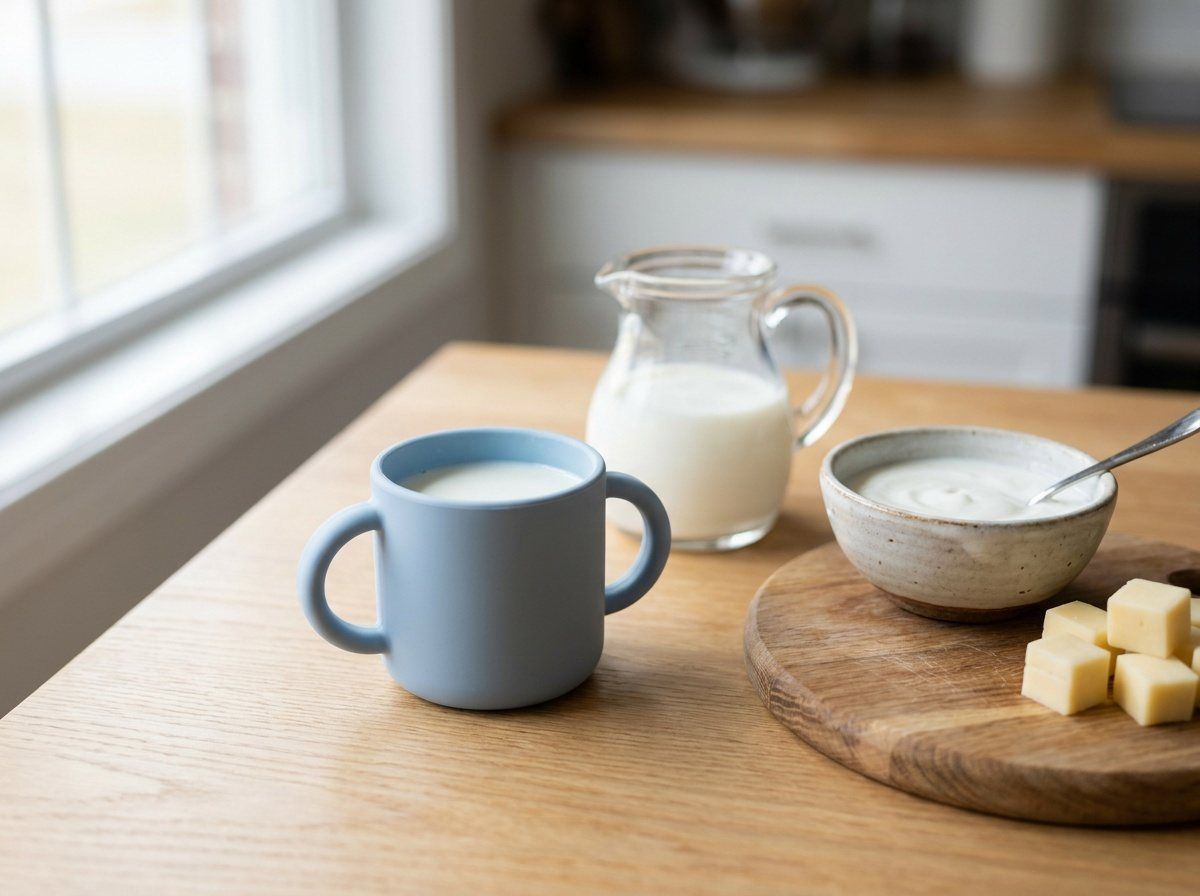
A toddler between 12 and 24 months should drink about 16 to 24 oz of whole milk a day, which is 2 to 3 cups or roughly 475 to 710 ml. Yogurt and cheese count toward that total, so a child who eats dairy foods needs less from the cup. More than 24 oz a day crowds out solid food and is the most common cause of iron deficiency in this age group; less than 16 oz is fine as long as other dairy or fortified foods fill the gap.
The rest of this guide shows how the amount plays out month by month, what counts as milk, how to tell when your toddler drinks too much or too little, and what happens to milk at daycare.
Key Takeaways
- ▸ 16 to 24 oz (475 to 710 ml) of whole milk a day from 12 to 24 months; the range does not change with each month
- ▸ Yogurt, cheese and kefir count: a cup of yogurt or 1.5 oz of hard cheese equals a cup of milk
- ▸ Over 24 oz a day: poor appetite, constipation and iron deficiency become likely
- ▸ Whole milk until age 2, then reduced fat milk at 16 to 20 oz a day
- ▸ Count the milk your child gets at daycare, and serve milk in a cup with meals, never in bed
Where the 16 to 24 oz Guideline Comes From
In 2019, the American Academy of Pediatrics, the Academy of Nutrition and Dietetics, the American Academy of Pediatric Dentistry and the American Heart Association published joint drink recommendations for children under 5 through the Healthy Eating Research program. For 12 to 24 months they recommend 2 to 3 cups (16 to 24 oz) of whole milk a day plus 1 to 4 cups of water, and for ages 2 to 5 about 2 to 2.5 cups of low fat or skim milk.
The NHS approaches it from the other direction. It states that children aged 1 to 3 need about 350 mg of calcium a day, and that roughly 300 ml (about 10 oz) of milk would supply it. Read together, the two sources tell you what the range really means: 16 oz is comfortably enough for a toddler who also eats dairy foods, 24 oz is the ceiling, and nobody needs to drink to the top of it.
Milk Amounts Month by Month, 12 to 24 Months
Parents search for "how much milk for a 13 month old", "14 month old", "18 month old" as if the number changed every few weeks. It does not. What changes is where in the range your child usually lands, because the plate does more of the work as the months pass.
| Age | Milk per day | In ml | What is typical |
|---|---|---|---|
| 12 months | 16 to 24 oz | 475 to 710 ml | The transition month. Formula and whole milk count together while you phase one out; see the formula to milk guide. |
| 13 to 14 months | 16 to 24 oz | 475 to 710 ml | Three meals and two snacks are settling in. Milk moves to the cup at meals and bottles go. |
| 15 months | 16 to 24 oz | 475 to 710 ml | Usually 3 cups of 5 to 8 oz with breakfast, lunch and dinner. Details in how much milk a 15 month old should drink. |
| 16 to 18 months | 16 to 24 oz | 475 to 710 ml | Appetite for food grows and many toddlers settle in the lower half of the range, with yogurt or cheese making up the rest. |
| 19 to 21 months | 16 to 24 oz | 475 to 710 ml | Growth is slower than in the first year, so appetite swings from day to day are normal. Keep milk steady, let food vary. |
| 22 to 24 months | 16 to 24 oz | 475 to 710 ml | Still whole milk. From the second birthday most children move to reduced fat milk. |
| From 24 months | 16 to 20 oz | 475 to 590 ml | 2 to 2.5 cups of low fat milk, unless your pediatrician advises whole milk for longer. |
For conversions: 1 US fluid ounce is about 30 ml, so 4 oz is 120 ml, 6 oz is 180 ml and 8 oz (one cup) is 240 ml. A standard toddler cup holds 4 to 6 oz, which is why three cups a day lands neatly inside the range.
What Counts Toward the Milk Total
The guideline is really about dairy, not about liquid milk. Nutrition guidance in the US uses cup equivalents, and the conversions below come from the USDA MyPlate dairy group. If your toddler eats yogurt and cheese, subtract those from the cup.
| Food | Counts as |
|---|---|
| 1 cup (8 oz) whole milk | 1 cup of dairy |
| 1 cup plain yogurt or kefir | 1 cup of dairy (a typical 4 oz toddler tub is half a cup) |
| 1.5 oz hard cheese (cheddar, gouda, swiss) | 1 cup of dairy (a thin slice is about 0.75 oz, so half a cup) |
| 1/3 cup shredded cheese | 1 cup of dairy |
| 2 cups cottage cheese | 1 cup of dairy (cottage cheese is low in calcium, so a few spoonfuls barely count) |
| 1 cup fortified unsweetened soy milk | 1 cup of dairy (the only plant drink that counts) |
| Butter, cream cheese, cream | Do not count, they carry almost no calcium |
A worked example: 6 oz of milk with breakfast, a 4 oz yogurt at snack time, 5 oz of milk with lunch, a slice of cheese and 6 oz of milk with dinner add up to about 3 cups of dairy, the top of the range, without a single big bottle. Cottage cheese and kefir have their own food library pages.
Signs Your Toddler Drinks Too Much Milk
Pediatricians have a name for the pattern: milk anemia. A toddler who drinks 30 or 40 oz a day is full of a food that contains almost no iron, and the protein in cow's milk also reduces iron absorption from the rest of the diet. Watch for these signs:
- ✗ More than 24 oz a day, or still 4 or more bottles a day
- ✗ Meals are picked at or refused, but milk is always accepted
- ✗ Hard, infrequent stools
- ✗ Pale skin, tiredness, irritability or frequent infections, which can point to low iron and deserve a blood test
The fix is mechanical rather than dramatic: measure what goes into the cup for a week, cap it at 24 oz, serve it with meals instead of before them, and put iron rich foods on the plate first (our iron rich foods guide lists the best options). If you suspect anemia, ask your pediatrician for a blood test.
Signs Your Toddler Gets Too Little
Too little is rarer and easier to miss, because a toddler who refuses milk often eats well otherwise. The concern is not milk itself but the calcium and vitamin D it carries: children aged 1 to 3 need about 700 mg of calcium and 600 IU of vitamin D a day, and without milk, yogurt or cheese, calcium comes up short quickly. Options, roughly in order of usefulness:
- ▸ Yogurt, kefir and cheese at snacks and in cooking (cheese sauce, yogurt dips, grated cheese on vegetables)
- ▸ Fortified unsweetened soy milk as the drink
- ▸ Calcium set tofu, canned salmon with bones, white beans, fortified oat cereal
- ▸ A vitamin D supplement, which the NHS recommends for all children aged 1 to 4 anyway and which many US pediatricians suggest for children who drink little fortified milk
See how milk fits next to real meals
The app plans age appropriate meals and snacks for your toddler and shows how dairy, iron rich foods and drinks add up over the day.
Whole Milk Until 2, Then Reduced Fat
Between 12 and 24 months the milk should be whole: toddlers need the fat for brain development and to absorb vitamins A and D. From the second birthday, most guidelines move to low fat or skim milk at 16 to 20 oz a day. Some pediatricians suggest reduced fat milk earlier when there is a family history of obesity or heart disease, others keep whole milk longer for a child who gains weight slowly; both are individual decisions. Choose pasteurized milk only and skip flavored milk, which carries several teaspoons of added sugar per cup. Our cow's milk page covers the details.
Milk at Daycare
If your toddler is in childcare, a good share of the daily milk arrives there, and it is easy to double up at home. Centers in the USDA Child and Adult Care Food Program serve 1 year olds unflavored whole milk in portions of 1/2 cup (4 oz) at breakfast, lunch and supper, and 4 oz at snack when milk is the chosen component, so a toddler who has breakfast, lunch and a snack at daycare may already have 8 to 12 oz before pickup.
- ▸ Ask for the numbers. Most centers record what each child drank, which tells you what is left for home.
- ▸ Plan the home share. If daycare served 8 oz, one cup at dinner and yogurt at breakfast complete the day.
- ▸ Ask for water between meals and for milk in a cup rather than a bottle, which most centers already do.
- ▸ Send a note about allergies. For a cow's milk allergy, provide the substitute your allergist recommends; centers can serve fortified soy milk with a written request.
A full daycare day and a full home day, with milk placed at each meal, are laid out in our 15 month old feeding schedule.
Water, Juice and Other Drinks
The same expert consensus recommends 1 to 4 cups of water a day for 12 to 24 months, offered between meals and with snacks. Juice is not needed; if you serve it, the AAP caps 100 percent juice at 4 oz a day for ages 1 to 3, never in a bottle. Sweetened drinks and flavored milks are out, and the AAP concluded in 2023 that toddler milks offer no advantage over whole milk and a varied diet. Plant drinks other than fortified soy are too low in protein and fat to replace milk. Milk in the first year is a different topic; our guides on how long babies drink formula and whether babies drink less milk when starting solids cover that period.
How to Serve Milk So It Stays a Side Dish
Serve milk in a small open cup or straw cup of 4 to 6 oz, with meals rather than before them (a cup of milk 30 minutes before lunch is lunch), never in bed, where it pools around the teeth overnight and becomes the leading cause of early tooth decay, and keep a water cup within reach between meals. Bottles make 8 oz disappear without anyone noticing, which is one reason the AAP advises weaning from the bottle by 12 to 15 months.
Frequently Asked Questions About Toddler Milk Amounts
Is 30 oz of milk too much for a 1 year old?
Yes. 30 oz is well over the 24 oz ceiling and leaves little room for food. Bring it down over a week or two by shrinking each cup and offering water in between, and make sure iron rich foods are on the plate.
How much milk should an 18 month old drink?
The same 16 to 24 oz. By 18 months most toddlers eat well enough that the lower half of the range, with yogurt or cheese making up the rest, is the more common picture.
Can my toddler have milk before bed?
A cup of milk with dinner or as part of the wind down is fine, as long as teeth are brushed afterwards and the milk is not in a bottle in the crib.
What if my toddler refuses milk entirely?
Cover calcium with yogurt, cheese, kefir or fortified soy milk and ask your pediatrician about vitamin D. No child needs liquid milk as such; they need what is in it.
Should I water milk down?
No. Diluting milk makes every cup less nutritious without teaching anything. If the problem is volume, serve smaller cups; if it is refusal, see the tips in the transition guide.
Key Takeaways
- ✓ 16 to 24 oz (475 to 710 ml) of whole milk a day from 12 to 24 months
- ✓ Yogurt, cheese and kefir count toward the total
- ✓ Over 24 oz means less food and less iron; under 16 oz is fine with other dairy
- ✓ Count daycare milk, serve it in a cup with meals, and keep water within reach
Milk is a useful part of a toddler's day. It just should not be the biggest part.
Sources
- ▸ American Academy of Pediatrics (HealthyChildren.org): Recommended Drinks for Children Age 5 and Younger
- ▸ CDC: Cow's Milk and Milk Alternatives
- ▸ NHS: What to Feed Young Children
- ▸ USDA MyPlate: Dairy Group and Cup Equivalents
- ▸ USDA Child and Adult Care Food Program: Meal Patterns
- ▸ AAP Policy Statement: Fruit Juice in Infants, Children, and Adolescents (Pediatrics, 2017)
- ▸ AAP Clinical Report: Older Infant and Young Child Formulas (Pediatrics, 2023)
- ▸ NIH Office of Dietary Supplements: Calcium Fact Sheet