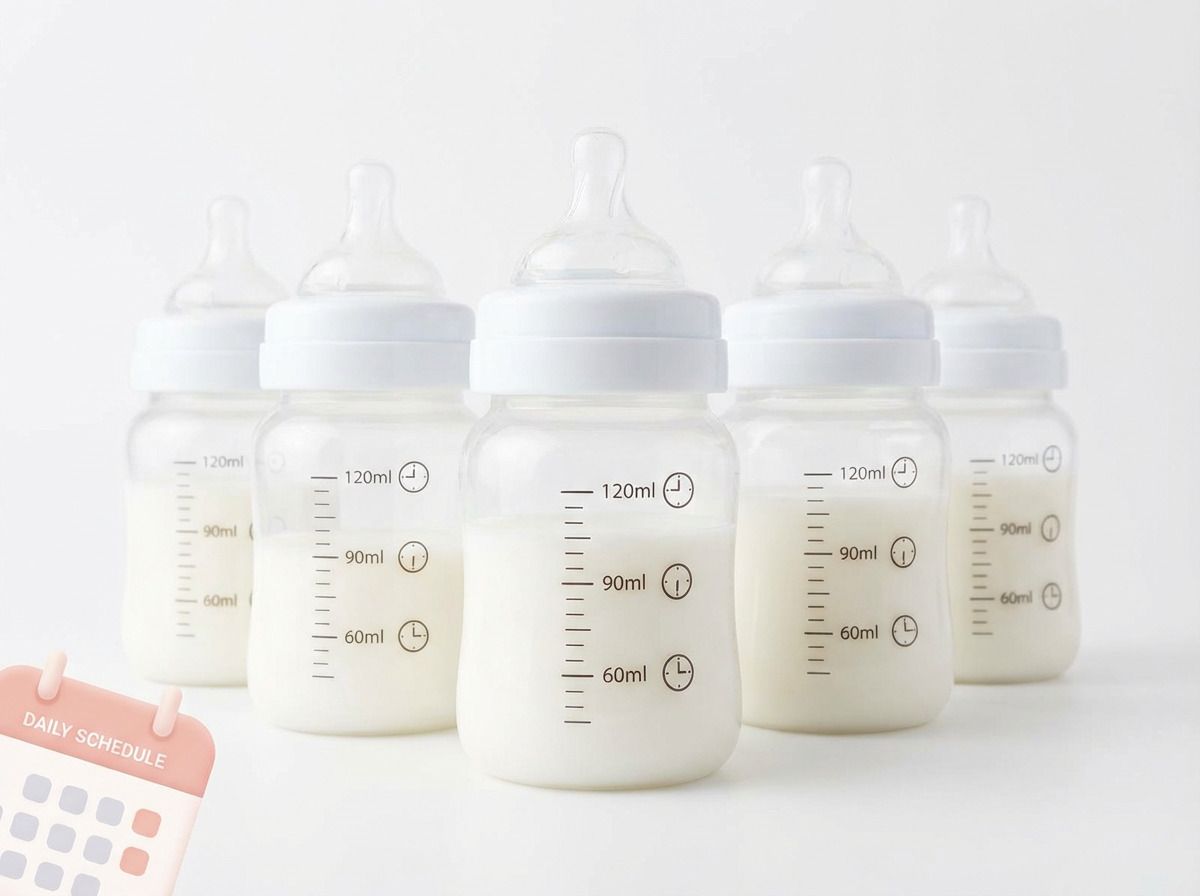
If you're wondering "how often does a 3-month-old baby drink?" or "how much ml does a 3-month-old baby drink?", you're far from alone. Almost all parents search for a baby feeding amount table at some point or wonder how often they should breastfeed or give their baby a bottle.
⚠️ Important Note
These are guidelines only. Every child has their own pace, their own milk quantity needs, and their own rhythm. This article can provide orientation but does not replace medical or midwife advice. If you're unsure, your baby seems unusual, or is gaining weight poorly, always consult your pediatrician or midwife.
1. Basic Principle: Feeding on Demand, Not Strict Rules
Professional societies clearly recommend for the first months: Breastfeeding (or formula) on demand – meaning feed when the baby shows hunger cues, not strictly by the clock.
Typical Hunger Cues:
- ▸ Rooting, smacking lips, sticking tongue out
- ▸ Sucking on hands or clothing
- ▸ Restlessness before crying even begins
Crying is often already a late hunger signal.
2. "How Often Does a 3-Month-Old Baby Drink?" – Rough Guidelines
By around 3 months, many babies have established a somewhat recognizable rhythm for parents.
2.1 Breastfed Babies (3 Months)
Many guides and pediatricians describe for fully breastfed babies at this age:
- ▸ About 6–8 breastfeeding sessions in 24 hours
- ▸ Intervals usually every 2.5–4 hours, sometimes longer at night
- ▸ Some babies drink more often, some less
- ▸ Some have cluster feeding phases in the evening (very frequent drinking in short time)
2.2 Bottle-Fed Babies (3 Months, Formula)
For bottle-fed babies, many baby feeding tables show:
- ▸ 5–6 bottles per day
- ▸ About 150–170 ml (5–6 oz) per feeding, depending on weight and baby
- ▸ Daily amount approximately 600–900 ml (20–30 oz)
✓ Important to Know:
These are guidelines, not rules. As long as your baby is growing well, has enough wet diapers, and seems healthy, they're usually well-fed.
3. Baby Feeding Amount Table – From Birth to 4 Months
Many parents want a baby feeding amount table to have a framework. Various guides and manufacturers provide similar orientations:
Baby Feeding Amount – Rough Guidelines (Bottle or Estimated Breastfeeding)
1st Week
30–60 ml (1–2 oz) per feeding | 8–12 feedings | 200–400 ml (7–14 oz)/day
2nd–4th Week
60–90 ml (2–3 oz) per feeding | 8–12 feedings | 400–600 ml (14–20 oz)/day
2nd Month
90–120 ml (3–4 oz) per feeding | 6–8 feedings | 500–700 ml (17–24 oz)/day
3rd Month ⭐
120–180 ml (4–6 oz) per feeding | 5–7 feedings | 600–900 ml (20–30 oz)/day
4th Month
150–220 ml (5–7 oz) per feeding | 4–6 feedings | 750–1000 ml (25–34 oz)/day
Please remember:
- ▸ These are average values, not "must" numbers
- ▸ Breastfed babies often drink more frequently, but each feeding is shorter/smaller
- ▸ For breast milk there are estimates, but in reality every baby drinks very individually
Keep Track of Feeding Amounts Automatically
Instead of checking a table every time, log breastfeeding and bottle feeds in the app and see at a glance whether the frequency and amount match your baby's age.
4. How Much ml Does a 3-Month-Old Baby Drink? (Weight-Based)
Many professional sources suggest roughly orienting the daily amount to body weight:
📊 Guideline:
About 120–170 ml per kg body weight per day (approximately 2.5 oz per pound, or about 1/6 of body weight in ml for 0–3 months)
Examples:
Baby weighing 4.0 kg (8.8 lbs):
→ 480–680 ml/day (16–23 oz) → 80–135 ml (3–5 oz) per feeding (at 5–6 feedings)
Baby weighing 5.0 kg (11 lbs):
→ 600–850 ml/day (20–29 oz) → 100–145 ml (3–5 oz) per feeding (at 5–6 feedings)
Baby weighing 6.0 kg (13.2 lbs):
→ 720–1000 ml/day (24–34 oz) → 120–170 ml (4–6 oz) per feeding (at 5–6 feedings)
Many professional sources advise that babies in the first months should not regularly exceed 1000 ml/day (34 oz) to avoid unnecessary strain on the kidneys.
5. "How Often to Breastfeed Per Day?" – Sorted by Month
Because searches about this are so frequent, here's a rough overview of what many guides describe. Important: All just orientation!
5.1 How Often Does a 1-Month-Old Baby Breastfeed?
- ▸ Often 8–12 breastfeeding sessions in 24 hours
- ▸ Intervals frequently every 2–3 hours, including at night
5.2 How Often Does a 2-Month-Old Baby Breastfeed?
- ▸ Frequently still 7–10 breastfeeding sessions per day
- ▸ Intervals may stretch to 2.5–3.5 hours
- ▸ Some babies have cluster feeding phases in the evening
5.3 How Often Does a 3-Month-Old Baby Breastfeed?
- ▸ Many babies settle at 6–8 breastfeeding sessions in 24 hours
- ▸ Intervals usually 2.5–4 hours, sometimes shorter during day, longer at night
- ▸ Due to developmental leaps (e.g., 12-week growth spurt), intervals can temporarily shorten
5.4 How Often Does a 4-Month-Old Baby Breastfeed?
- ▸ Often 5–7 breastfeeding sessions
- ▸ More babies have somewhat longer night stretches, others don't – both are normal
5.5 How Often Does a 6-Month-Old Baby Breastfeed?
- ▸ Before or despite starting solids: usually still 4–7 breastfeeding sessions, depending on baby
- ▸ Many children continue to breastfeed frequently at night, which isn't automatically "wrong"
How Long to Breastfeed Per Session?
Almost all sources agree here: extremely individual.
- ▸ Newborns: often 20–40 minutes
- ▸ 2–3 month old babies: sometimes only 5–15 minutes, but still get enough
- ▸ What matters is effective feeding (audible swallowing, content baby) – not the stopwatch
6. How Often to Feed a Newborn (Breast & Bottle)?
For completeness, because many search terms revolve around this: Many tables recommend for the first days:
- ▸ Days 1–3: very small amounts (2–40 ml/0.1–1.5 oz per feeding), but 8–12 times in 24 hours
- ▸ By end of 1st week: about 30–60 ml (1–2 oz) per feeding, still very frequent
- ▸ Weeks 2–4: 60–90 ml (2–3 oz), about 8–12 feedings per day
7. Breastfeeding vs. Bottle: Differences in Drinking Behavior
7.1 Breast Milk
- ▸ Milk quantity at the breast is difficult to measure exactly
- ▸ Many sources estimate for the first months a daily amount of about 480–900 ml (16–30 oz), depending on baby and age
- ▸ Breastfeeding should be on demand – it doesn't have to always last the "same number of minutes"
7.2 Formula (Bottle)
Professional organizations recommend for the first months formula, with most formulas being designed to resemble breast milk.
- ▸ For feeding amount: 120–170 ml/kg body weight/day (about 2.5 oz/pound) total
- ▸ Divided into 5–8 bottles – depending on age and baby
- ▸ Newborns rather 8–12 times, 3-month-old baby rather 5–7 times per day
Even with bottle feeding: better to orient to your baby than rigidly to the package, as long as weight gain, output, and general condition are good.
8. How Do I Know If My Baby Is Drinking Enough?
Because tables are only half the truth, professionals mainly look at:
8.1 Weight Development
- ▸ After initial weight loss, birth weight should be regained by about 10 days
- ▸ In the first months, babies gain on average about 140–170 g (5–6 oz) per week – large individual variations are possible
- ▸ If the growth curve roughly parallels a percentile, that's usually a good sign
8.2 Wet Diapers & Output
Many midwives give as rough orientation:
- ▸ About 6 wet diapers per day with light, relatively odorless urine
- ▸ Your baby seems alert, interested, and generally content
With significantly fewer wet diapers, very dark urine, dry mucous membranes, or sunken fontanel, you should seek medical advice directly.
9. When Should You Definitely See a Doctor?
Please have your baby medically examined if, for example:
- ⚠ They drink very poorly for several days
- ⚠ They seem unusually lethargic while feeding or tire quickly
- ⚠ They have significantly fewer wet diapers
- ⚠ They vomit frequently or have diarrhea
- ⚠ You feel your child isn't gaining weight or is losing weight
This article is not a diagnosis and not a treatment recommendation. Only pediatricians and other qualified professionals can assess what makes medical sense in your situation.
10. Quick Summary for 3-Month-Old Babies
So you have everything about "how often does a 3-month-old baby drink" bundled together:
- ✓ Breastfed babies: usually 6–8 breastfeeding sessions/day, sometimes more, sometimes less
- ✓ Bottle-fed babies (formula): usually 5–6 bottles/day, about 150–170 ml (5–6 oz) per feeding
- ✓ Rough daily requirement: about 120–170 ml per kg body weight per day (not regularly significantly over 1000 ml/34 oz per day)
- ✓ Most important criteria: growth, wet diapers, alert/content baby – not perfect adherence to a table
Sources (Selection)
- ▸ DGKJ (German Society for Pediatric and Adolescent Medicine) – parent information on breastfeeding and infant nutrition
- ▸ DRK-Elterncampus – overview of stomach size and drinking amounts for newborns and babies
- ▸ Babyartikel.de – baby feeding amount table with guidelines per month
- ▸ Aptaclub – guidelines for calculating feeding amount (ml/kg body weight)
- ▸ Kindergesundheit-info.de (BZgA) – weight development of babies in the first year of life
- ▸ Kinderärzte im Netz – frequency and duration of breastfeeding sessions
- ▸ Babymarkt – feeding amounts for babies
- ▸ Wochenbettbetreuung.ch – feeding amounts for newborns