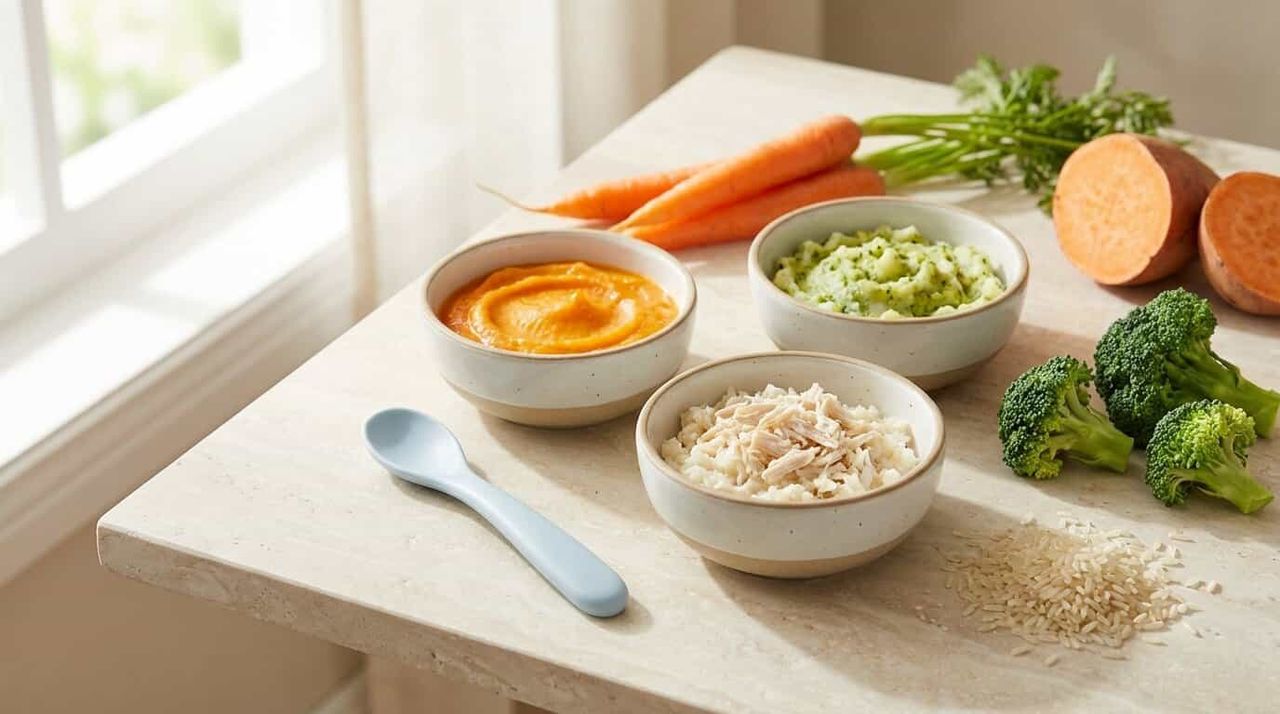
Introducing solid foods marks a central developmental milestone in the first year of life. When parents search for lunch recipes for their 8-month-old baby, they're usually not just looking for individual dishes, but for safety, nutritional guidance, and orientation. This article provides science-based guidelines for lunchtime meals at 8 months and beyond – with clear structural recommendations for infants and toddlers.
Key Highlights at a Glance
- ✓ 3 solid meals per day – Lunch puree as central nutrient source
- ✓ Texture: Increasingly coarsely mashed instead of finely pureed
- ✓ Iron & Zinc particularly important from 8 months
- ✓ Transition to family foods from the first year
Physiological Foundations: Why Lunch from 8 Months Is So Important
Between the 5th and 7th month of life, the complementary feeding phase begins. By around 8 months, lunch is usually already established as a complete puree meal. At this age, the need for iron, zinc, high-quality proteins, essential fatty acids, and energy for growth and motor development particularly increases.
Most Important Nutrients at 8 Months:
- ▸ Iron: Body's own stores are now largely depleted
- ▸ Zinc: For immune system and growth
- ▸ High-quality proteins: From meat, fish, or plant sources
- ▸ Omega-3 fatty acids: For brain development
Leading institutions such as national pediatric nutrition organizations recommend a structured approach to introducing and developing complementary foods.
Structure of Lunch at 8 Months
At 8 months of age, lunch typically consists of a combination of vegetables, potatoes or other complex carbohydrates, meat or fish (alternatively vegetarian iron sources), and high-quality vegetable oil. Learn more in our comprehensive guide to what babies eat at 8 months.
Standard Lunch Portion (8 Months):
- ▸ 100 g vegetables (steamed)
- ▸ 50 g potatoes, pasta, or rice
- ▸ 30 g meat or 20 g fish
- ▸ 8-10 g rapeseed oil (approx. 1 tbsp)
- ▸ Optional: 1 tbsp fruit puree for vitamin C
Important Characteristics at 8 Months
- ➡ Texture: No longer completely finely pureed, but increasingly coarsely mashed – actively promoting the development of chewing muscles
- ➡ Fat addition: About 8-10 g rapeseed oil per meal for energy enrichment and omega-3 fatty acid supply
- ➡ Vitamin C: Improves iron absorption from plant sources
From Formula to Finished Recipe
Now that you know the ideal nutrient balance for lunch, want actual recipes to match? The app turns these guidelines into ready-to-cook lunch recipes for your 8-month-old, with a shopping list included.
Development Between 8, 9, and 10 Months
Many parents search for baby recipes for 9 months or recipes for baby at 10 months. The differences mainly lie in the consistency and variety of foods.
| Age | Development | Nutrition |
|---|---|---|
| 8 Months | Three puree meals daily typical | Beginning with coarser texture, first soft finger food elements |
| 9 Months | Increasing independence while eating | More structure in food, expansion of food variety |
| 10 Months | Transition to chunky foods | Approaching family meals, combination of puree and finger food |
During this phase, not only nutrient intake is in the foreground, but also oral motor skills and sensory experience. For detailed information, read our article on baby food from 9 months.
Diversification: Which Foods Are Suitable?
According to recommendations from pediatric nutrition networks, almost all mild vegetable varieties should be introduced from 8 months.
Vegetables (steamed, soft)
- ✓ Carrot, pumpkin, zucchini
- ✓ Parsnip, sweet potato
- ✓ Broccoli, cauliflower
- ✓ Fennel, peas, kohlrabi
Carbohydrates & Grains
- ✓ Potatoes, sweet potatoes
- ✓ Whole grain pasta, rice
- ✓ Millet, couscous, oats
Protein Sources
- ✓ Meat: Beef, lamb, poultry (prefer lean meat)
- ✓ Fish: Salmon, trout 1-2×/week (rich in omega-3 and DHA)
- ✓ Vegetarian options: Millet, oats, lentils – combined with vitamin C-rich components
Particularly fatty sea fish provides DHA, which is significant for brain development.
Safety Aspects at Lunchtime
Regardless of whether parents are searching for baby food 8 months recipes or baby food 9 months recipes – safety is essential.
Avoiding Choking Hazards
Dangerous are:
- ✗ Whole nuts
- ✗ Uncut grapes
- ✗ Hard raw vegetable pieces
- ✗ Fish with bones
Hygiene Rules
Off-limits throughout the first year:
- ✗ Raw milk products
- ✗ Raw meat or raw fish
- ✗ Raw eggs
- ✗ Honey (botulism risk until 12 months)
Baby-Led Weaning (BLW) in Context
The concept of baby-led weaning is increasingly discussed. Here, babies independently eat soft pieces instead of puree. Professional organizations often recommend a combined form:
- ▸ Nutrient security through puree meals
- ▸ Motor skill promotion through accompanying finger food
Adequate iron supply remains important, which can be more difficult to ensure with pure BLW.
Transition to Family Foods from the First Year
Search queries like baby recipes from 1 year or dishes for babies show that parents want to manage the transition to family foods well. The concept of optimized mixed nutrition is based on three principles:
- ✓ Plenty: Plant-based foods (vegetables, fruits, grains)
- ✓ Moderate: Animal products (meat, fish, eggs, milk)
- ✓ Sparingly: High-fat and high-sugar foods
From the first birthday onwards, lunch increasingly follows family meals – but without added salt, without added sugar, and in child-appropriate texture. Learn more in our comprehensive guide to nutrition in the first year of life.
Eating Behavior and Autonomy
Besides all baby recipes searches, one central point must not be forgotten: The goal is not just nutrient intake, but the development of healthy eating behavior.
Parents should:
- ➡ Respect hunger and satiety signals
- ➡ Avoid "clean plate" pressure
- ➡ Enable repeated offering of new foods
- ➡ Create a relaxed atmosphere
The phase of neophobia (rejection of new foods) is normal and part of development.
Conclusion
Whether lunch recipes baby 8 months, baby puree 10 months, or recipes baby 9 months – behind all search queries stands the desire for guidance.
Lunch between 8 and 10 months is:
- ✓ Main source for iron and zinc
- ✓ Motor training space
- ✓ Sensory learning environment
- ✓ Foundation for later family foods
A science-based, gradual introduction, combined with patience and respect for the child's needs, forms the foundation for long-term health.