At 11 months, the first birthday is around the corner, and your baby is already showing you where things are heading. They zip across the room, pull up on everything, point at whatever they want and have opinions about food, clothes and bedtime. The baby is turning into a toddler.
This guide covers what is typical at 11 months, the move to family meals, sleep and what a day can look like. Everything here is a range, not a deadline: babies develop at their own pace.
Key Takeaways: Your 11 Month Old
- ✓ Movement: Crawling, pulling up, cruising along furniture, and first independent steps for some
- ✓ Feeding: Three meals from the family table in soft, small pieces, one or two snacks, plus 2 to 3 milk feeds
- ✓ Sleep: Usually 12 to 14 hours a day with 2 naps
- ✓ Communication: Pointing, waving, following simple requests, first words for some
- ✓ Health: The 12 month checkup and vaccines ahead, first molars for some, protection from falls and poisoning
Development at 11 Months: What Is Typical Right Now
Motor Skills: From Crawling Toward Walking
Most 11 month olds get around confidently, usually crawling. They pull up on furniture and cruise sideways along it. Some already stand alone or take first steps; others need several more months. The WHO motor development study puts standing alone between roughly 7 and 17 months and walking alone between roughly 8 and 18 months, with the average for both right around the first birthday. An 11 month old who is not walking is the rule, not the exception.
The hands are skilled now. The pincer grasp is solid, small pieces get picked up precisely, and objects go into containers and come back out. Many babies hold a spoon (mostly to stir rather than eat), drink from an open cup with help and turn the pages of board books.
Thinking and Imitation
Your baby understands cause and effect and tests it: the cup drops, you pick it up, the cup drops again. They use objects more and more correctly, holding a phone to their ear or a brush to their head, and they imitate you, from coughing to waving. Hidden things get searched for in the right place, and when you name an animal in a picture book, they point at it.
Communication and Language
Pointing is one of the most important steps at this age, because it is how your baby shares attention with you. Many babies wave, shake their head, clap and follow simple requests, especially with a gesture attached ("give me the ball"). They know family members' names and respond to "no". Some say first words with meaning, usually "mama", "dada" or "uh-oh"; many others only after the first birthday. Comprehension runs well ahead of speech now, and that is normal.
Social and Emotional
Separation anxiety and wariness of strangers peak for many babies between 10 and 12 months. At the same time a will of their own shows up: the head turns away at mealtimes, getting dressed is protested, the toy has to be the one they chose. Your baby loves repetition games, hands you things and wants them straight back, and checks your face whenever something new happens to read whether it is safe.
Feeding at 11 Months: The Move to Family Meals
Breast milk or formula is a supplement now rather than the main event. Typical is 2 to 3 milk feeds, usually morning and evening, sometimes still once at night. Breastfeeding continues as long as you both want, well past the first birthday if you like; see our how long to breastfeed guide. Many formula-fed babies are down to 2 to 3 bottles, roughly 16 to 24 oz (500 to 700 ml) a day. Cow's milk as a drink waits until the first birthday, though it is fine in cooking and cereal now. Our guide to switching from formula to milk walks through the handover.
What and How Your Baby Eats Now
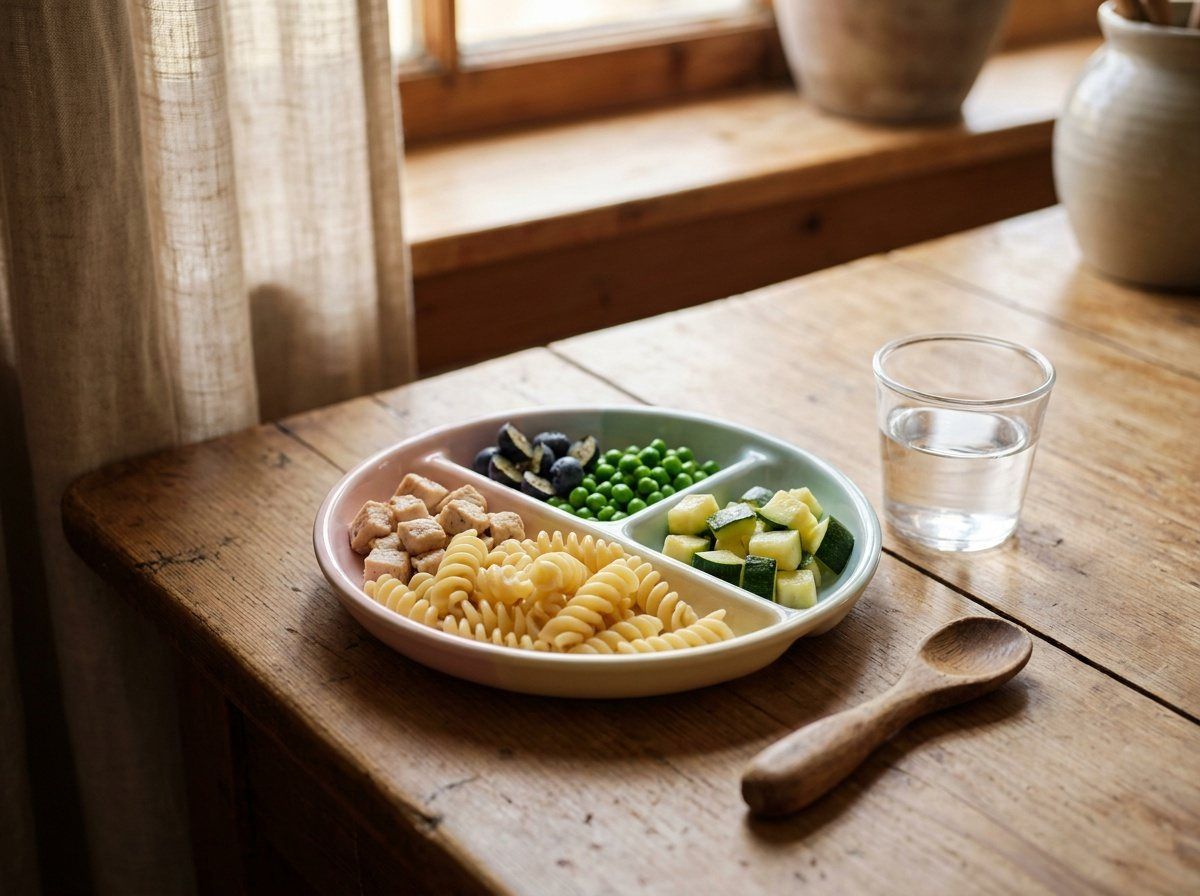
By 10 to 12 months, NHS guidance expects three meals a day plus around three milk feeds, and the AAP describes babies this age eating mostly table foods. Most 11 month olds are mid-shift: breakfast, lunch and dinner with one or two small snacks, and what lands on the tray is what the family eats, without added salt or sugar, cooked soft and served in a safe shape. Texture is coarse now: mashed, chopped, with soft pieces to chew. A baby with a working pincer grasp can handle soft pea-sized pieces; for sticks, finger length still applies. Table food examples include soft-cooked potato, broccoli, lightly mashed peas, soft lentils, finely chopped chicken, well-cooked rice and quartered blueberries. The safe size and shape for each food at each age is on its page in the food library.
Your baby wants to feed themselves now, with hands and increasingly a spoon, and they should; mess is part of learning. You decide what is served and when; your baby decides whether and how much to eat. That split takes pressure off everyone, and our guide to the division of responsibility in feeding explains it. For a full schedule with amounts, see the 11 month old feeding schedule and how much an 11 month old should eat; the path from purees to pieces is in transitioning from purees to solids.
Water, Iron and Allergens
Water goes with every meal and in between, ideally from an open cup. If your baby drinks milk from a bottle, start offering it in a cup too, so bottles can be gone between 12 and 18 months, as the AAP and the NHS both recommend for the sake of teeth. Iron still matters: meat, beans, lentils and iron-fortified cereal, paired with vitamin C rich fruit or vegetables, and milk should not crowd out meals because it contains almost no iron. Vitamin D drops continue. By now your baby has ideally met the common allergens such as egg, peanut, cow's milk, wheat, fish and sesame; the job now is to keep serving them regularly. If one is still missing, introduce it one at a time and observed, as described in our top 10 allergens guide.
Still off the menu: honey until the first birthday, salt and sugar in any real amount, and hard, round or slippery foods such as whole grapes, raw carrot, whole nuts and hot dogs. The reasons are in our guides to choking hazards for babies, salt and sodium for babies and sugar for babies.
Sleep at 11 Months
Most 11 month olds sleep a total of about 12 to 14 hours in 24: roughly 10 to 12 hours at night and two naps, often a shorter one in the morning and a longer one after lunch. Wake windows run about 3 to 4 hours. The switch to a single afternoon nap usually happens between 12 and 18 months, though a few early birds start skipping the morning nap now.
Night waking at this age usually has three causes: separation anxiety, which does not switch off at night; new skills like standing up in the crib, practiced half asleep; and the first molars, which bother some babies already. What helps: a reliable bedtime routine, plenty of movement during the day and lots of small separations with happy reunions, and short, calm responses at night. For safe sleep, keep the mattress at its lowest setting, no pillows or bumpers, a sleep sack instead of a blanket, and as soon as your baby tries to climb over the rail, it is time for a lower sleep space.
Sample Daily Routine at 11 Months
A day with two naps and three family meals can look like this; the times are examples, the order is what counts:
| Time | What happens | Example |
|---|---|---|
| 6:30 AM | Wake up, milk | Breastfeed or bottle |
| 7:30 AM | Breakfast | Oatmeal with fruit or toast fingers with a soft spread, water |
| 9:30 AM | Nap 1 | About 45 minutes to 1 hour |
| 10:30 AM | Awake time | Playground, playgroup, errands |
| 11:45 AM | Lunch | Family food, soft and small, water |
| 1:00 PM | Nap 2 | About 1 to 1.5 hours |
| 2:30 PM | Snack | Fruit pieces, bread, water |
| 3:00 PM | Awake time | Play, visitors, fresh air |
| 5:30 PM | Dinner | Family food or a grain and vegetable dish, water |
| 6:30 PM | Bedtime routine | Bath, teeth, milk, book |
| 7:00 PM | Night sleep | With 0 to 1 night feed |
For what a day looks like right around the first birthday, see our sample 12 month old schedule.
Family meals that fit your baby's age
The app shows the safe shape and size of every food, plans meals for the whole family and keeps an eye on allergens and iron.
Health and Safety at 11 Months
Checkups and Vaccines
In the US, the 12 month well visit is next: growth, movement, fine motor skills, language, hearing and vision get checked, and it brings a round of vaccines including the first MMR and chickenpox doses. In the UK, the health visitor review falls between 9 and 12 months and the 1 year vaccines follow. Ask your practice about the current schedule.
Teething
Many 11 month olds have four to eight front teeth, some fewer, a few none yet. Around the first birthday the first molars arrive for many babies, and they often cause more discomfort than the front teeth. Brush twice a day with a rice-grain smear of fluoride toothpaste, ideally as a fixed part of the bedtime routine.
Safety for a Baby Who Gets Everywhere
- ▸ Falls: Stair gates, furniture anchored to the wall, window guards or locks, nothing climbable in front of windows or balcony rails.
- ▸ Poisoning: Cleaning products, medications, cigarettes and dishwasher pods up high and locked away, and the Poison Control number saved in your phone (in the UK, call NHS 111).
- ▸ Burns and water: Hot drinks and pots out of reach, kettle cords short, baths only supervised.
- ▸ Eating: Always seated, never on the move, with an adult within arm's reach. Our gagging vs choking guide explains the difference.
When to Talk to Your Pediatrician or Health Visitor
Check in if your 11 month old does not sit without support, does not move around at all, does not pull up to stand, does not babble, does not respond to their name, does not point or use other gestures, avoids eye contact, does not imitate anything, or loses skills they used to have. Persistent food refusal, a stalled weight curve or a gut feeling are all good reasons for an appointment.
Frequently Asked Questions About 11 Month Olds
What should an 11 month old be doing?
Most crawl confidently, pull up and cruise along furniture; some take first steps. They use a pincer grasp, point, wave, follow simple requests and imitate a lot. Some say first words; many will only after the first birthday.
My 11 month old is not walking yet. Is that normal?
Yes. Walking alone arrives between roughly 8 and 18 months in the WHO data, averaging around the first birthday. As long as your baby moves around, pulls up and puts weight on both legs equally, all is on track.
What can an 11 month old eat?
Almost everything the family eats, as long as it is unsalted, unsweetened, soft and served in a safe shape. Honey, whole nuts, whole grapes, hard raw vegetables and heavily salted or sweetened foods stay off the menu.
How much milk does an 11 month old need?
Usually 2 to 3 milk feeds a day, breastfed on demand or roughly 16 to 24 oz (500 to 700 ml) of formula. The amount keeps dropping as your baby eats more from the table, and milk should not push meals aside.
Can my 11 month old drink cow's milk?
As a drink, not until the first birthday. In cooking, cereal or yogurt, small amounts are fine already. After the birthday, whole milk becomes the usual drink alongside meals, in the range of about 16 to 24 oz a day.
How much sleep does an 11 month old need?
Usually 12 to 14 hours in 24, with 10 to 12 at night and the rest in two naps. The move to one nap usually comes after the first birthday.
My baby suddenly refuses purees. What now?
That is common at this age and usually means your baby wants to feed themselves. Offer soft pieces from the family table, hand over a spoon of their own and let them decide how much to eat. The appetite comes back.
The Other Months
The other guides in this series: 6 month old baby (rolling, readiness signs, first foods), 8 month old baby (crawling, finger foods, stranger anxiety) and 1 year old baby (family meals, cow's milk, toddler life).
Sources
- ▸ CDC: Developmental Milestones (Learn the Signs. Act Early.)
- ▸ CDC: Infant and Toddler Nutrition
- ▸ American Academy of Pediatrics: Sample Menu for an 8 to 12 Month Old
- ▸ American Academy of Pediatrics: How Many Hours of Sleep Does Your Child Need
- ▸ NHS: Your Baby's First Solid Foods
- ▸ NHS: Drinks and Cups for Babies and Young Children
- ▸ NHS: Vaccinations and When to Have Them
- ▸ NHS: Baby and Toddler Safety
- ▸ WHO: Motor Development Milestones