At 6 months, your baby is halfway through the first year, and the sleepy newborn has turned into a curious little person who beams at you, grabs everything within reach and explores the world mouth-first. Many parents feel this is a turning point: the baby is more mobile, communicates more clearly, often (but not always) sleeps in longer stretches, and solid food is suddenly the big question.
This guide covers what is typical at 6 months, how feeding and sleep look right now and what a day can look like. Everything here is a range, not a deadline: babies develop at their own pace.
Key Takeaways: Your 6 Month Old
- ✓ Movement: Many babies roll both ways, push up on their hands during tummy time and sit with support
- ✓ Feeding: Breast milk or formula is still the main food, and solids start once the four readiness signs are there
- ✓ Sleep: Usually 12 to 15 hours per day, split between the night and 2 to 3 naps
- ✓ Communication: Babbling in syllables, loud laughing, squealing, responding to voices and to their own name
- ✓ Health: The 6 month checkup, often the first teeth, and new safety habits as rolling and grabbing arrive
Development at 6 Months: What Is Typical Right Now
Motor Skills: Rolling, Pushing Up, Early Sitting
Most 6 month olds can roll from tummy to back and back to tummy. On their tummy they push up on straight arms, lift the chest and turn the head freely in both directions. Many babies now sit with support, propped against you or leaning forward on their hands. In the WHO motor development study, sitting without support arrives between roughly 4 and 9 months, averaging right around 6 months, so a 6 month old who is not sitting alone yet is completely on track.
Hands are getting more skilled too. Your baby reaches for objects on purpose, slowly passes them from one hand to the other and puts everything in their mouth. Grasping still happens with the whole hand; the fine pincer grasp with thumb and finger develops over the next few months. Crawling usually shows up between 7 and 10 months, and some babies skip it entirely.
Senses and Awareness
Vision is much sharper now. Your baby recognizes faces across a room, tracks movement and gets interested in small details. They turn toward sounds and respond to their name more and more often. The mouth is still the main tool for exploring: everything gets licked, sucked and chewed, which quietly trains the tongue, lips and jaw for solid food.
Communication and Language
The coos of the early months are turning into real babbling. Many babies string syllables together like "bababa" or "dadada", squeal with delight, blow raspberries and test their voice at every volume. They notice when you talk to them, pause and answer with their own sounds. That back and forth is the beginning of every conversation. Talk to your baby a lot and sing; at this age, that is all the language support they need.
Social and Emotional
Six month olds laugh out loud, love peekaboo and actively seek eye contact. Many know familiar people and begin telling known faces from new ones. Real stranger anxiety tends to come a little later, often between 7 and 9 months, but the first signs can appear now.
Feeding at 6 Months: Milk Is Still the Main Food
Solids or not, breast milk or formula is still the most important food at 6 months. Breastfed babies keep feeding on demand, often 5 to 6 times a day. Formula-fed babies typically take somewhere around 24 to 32 oz (700 to 950 ml) a day across 4 to 6 bottles, though your baby's cues matter more than the total: a baby who is still rooting can have more, and a full baby never needs to finish the bottle.
Starting Solids: Readiness Signs, Not the Calendar
Whether your baby is ready for a first spoonful depends on development, not on a date. The four readiness signs are:
- ▸ They sit upright with support and hold their head steady.
- ▸ They reach for food and bring it to their mouth.
- ▸ They show real interest in food: watching you eat, opening their mouth, wanting in.
- ▸ The tongue-thrust reflex has faded, so food is no longer automatically pushed back out.
If your baby shows all four, you can begin. If one is still missing, wait a week or two and try again. Our guide to the readiness signs shows how to spot each one, and if your baby turns the spoon away at first, 6 month old not interested in food explains what is going on.
First Foods and Textures
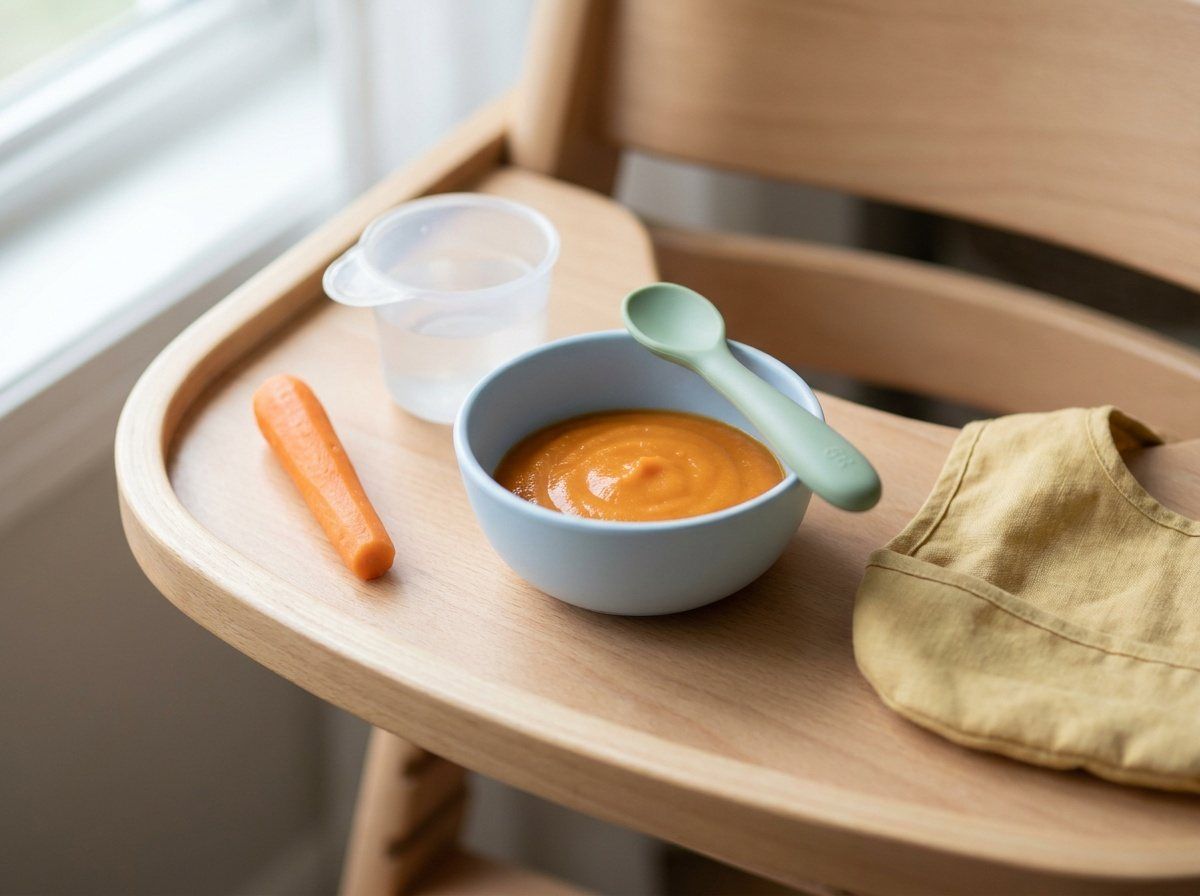
Early on, a meal is a few spoonfuls once a day, offered a little after a milk feed, and milk is not replaced yet. The first textures are smooth: thin purees for spoon feeding, or soft, well-cooked finger-length pieces if you are following baby-led weaning, sized so your baby can hold them in a fist with some sticking out the top. Mild, easy vegetables and fruits that puree well include carrot, sweet potato, butternut squash, parsnip, pear and cooked apple. Our starting solids guide covers the first weeks step by step, and vegetables for a 6 month old goes deeper on vegetables.
Whichever approach you use, the safe size, shape and texture are specific to each food and age; that guidance lives on the individual pages of the food library, and the baby-led weaning guide explains the method.
Water, Iron and Allergens
Once solids start, offer sips of water from an open or free-flow cup at meals. They will not drink much yet, and do not need to, because milk covers hydration; the point is cup practice. A baby's iron stores from birth begin running low in the second half of the first year, which is why the AAP and the NHS both recommend iron-rich foods early: well-cooked meat, iron-fortified infant cereal, lentils and beans, paired with vitamin C rich fruit or vegetables to help absorption. Our iron-rich foods for babies guide has the full list. Daily vitamin D drops continue as before.
Current guidance says common allergens such as egg, peanut, cow's milk, wheat, fish, sesame and soy should not be delayed. They still deserve a deliberate introduction: one at a time, in an age-appropriate form, on a day when you can watch your baby afterwards. The top 10 allergens for babies guide explains how, and signs of an allergic reaction tells you what to look for.
Sleep at 6 Months
Most 6 month olds sleep a total of about 12 to 15 hours in 24, roughly 10 to 12 hours at night plus 2 to 3 naps, inside the 12 to 16 hours the AAP recommends from 4 to 12 months. Wake windows between naps are typically 2 to 3 hours. Some babies now sleep 6 to 8 hours in one stretch at night, others still wake several times. Both are normal, and night feeds at 6 months are not a mistake.
Many parents notice sleep gets rockier right when a big skill like rolling or sitting arrives: the baby practices at night, wakes more often and wants more closeness. These stretches usually pass within one to three weeks.
What helps: a consistent bedtime routine (bath, pajamas, milk, a song, lights out), a dark, quiet room and naps at similar times. Safe sleep rules still apply: on the back, in a sleep sack, on a firm mattress with no pillows, bumpers or soft toys, ideally in their own crib in your room, with the mattress lowered once your baby can push up onto hands and knees.
Sample Daily Routine at 6 Months
A routine at this age is a repeating order of milk, play and sleep, plus one small meal once solids have started, not a timetable. A day can look like this:
| Time | What happens | Example |
|---|---|---|
| 6:30 AM | Wake up, milk | Breastfeed or bottle |
| 7:00 AM | Awake time | Floor play, tummy time, cuddles |
| 8:30 AM | Nap 1 | About 1 to 1.5 hours |
| 10:00 AM | Milk, awake time | Walk, play, errands |
| 11:30 AM | Solids (once the readiness signs are there) | A few spoonfuls of vegetable puree, then milk |
| 12:30 PM | Nap 2 | About 1 to 1.5 hours |
| 2:00 PM | Milk, awake time | Play, visitors, fresh air |
| 4:00 PM | Short nap 3 | 30 to 45 minutes, already dropped by some babies |
| 5:30 PM | Milk, quiet play | Books, songs, cuddles |
| 6:30 PM | Bedtime routine | Bath, pajamas, milk, song |
| 7:00 PM | Night sleep | With 1 to 2 night feeds |
For a fuller routine with variations for breastfed and formula-fed babies, see our schedule for a 6 month old baby.
A solids plan that fits your baby
A plan based on your baby's age and readiness signs, safe preparation for every food, and a tracker for introducing allergens.
Health and Safety at 6 Months
Teething
For many babies the first tooth breaks through between 4 and 7 months, usually a bottom front tooth; others get theirs close to the first birthday, which is normal too. Typical signs are extra drooling, red gums, chewing on everything and a grumpy mood. A high fever, diarrhea or a rash are not teething symptoms and should be checked by a doctor. A chilled teething ring helps most babies. As soon as the first tooth is in, brush it twice a day with a soft baby toothbrush and a rice-grain smear of fluoride toothpaste.
Checkups and Vaccines
In the US, the 6 month well visit checks growth, movement, hearing, vision and social interaction, and brings the next round of routine vaccines plus a first flu shot. In the UK the next routine vaccines come at 1 year, and the health visitor development review usually falls between 9 and 12 months.
Everyday Safety
- ▸ Changing table and sofa: A rolling baby is never left alone on a raised surface. Keep one hand on them.
- ▸ Small objects: Anything that fits through a toilet paper tube can be swallowed. Buttons, coins and batteries go out of reach.
- ▸ Eating: Always sitting upright and always supervised. Our gagging vs choking guide explains the difference.
- ▸ Hot drinks and water: No hot drink in your hand while holding the baby, and never leave them in the bath unattended.
When to Talk to Your Pediatrician or Health Visitor
Developmental windows are wide, and a single "not yet" is rarely a concern. Do check in if your 6 month old does not make eye contact or smile, does not respond to sounds or voices, does not reach for things, feels very floppy or very stiff, cannot hold their head steady, loses skills they had, drinks noticeably less or is not gaining weight. A gut feeling is also reason enough to ask.
Frequently Asked Questions About 6 Month Olds
What should a 6 month old be doing?
Many 6 month olds roll both ways, push up on their hands during tummy time, sit with support, reach for objects on purpose, babble in syllables and laugh out loud. Each of these has a window of several months.
How much should a 6 month old eat?
Milk is still the main food: breastfeeding on demand, or roughly 24 to 32 oz (700 to 950 ml) of formula a day for most babies. Solids, once started, are a few spoonfuls once a day and do not replace a milk feed yet.
Does my baby have to start solids at 6 months?
No. The right time depends on the four readiness signs, not on the calendar. If your baby is not showing them yet, wait and try again in a week or two. If they are, you can start with a few spoonfuls.
How much sleep does a 6 month old need?
Usually 12 to 15 hours in 24, split between the night and 2 to 3 naps. Some need a little less or more; the better test is whether your baby is content and alert during the day.
Why is my 6 month old suddenly waking more at night?
Big skills like rolling and sitting, teething and early separation anxiety all disturb sleep for a while. Keep the routine steady, offer comfort and give it one to three weeks.
Can a 6 month old drink water?
Yes, small sips from an open or free-flow cup with meals once solids have started. Water only becomes a regular drink once your baby eats several meals a day; before that, milk covers hydration.
The Months Ahead
The other guides in this series cover what comes next: 8 month old baby (crawling, finger foods, a second meal), 11 month old baby (first steps, moving toward family meals) and 1 year old baby (family meals, cow's milk, toddler life).
Sources
- ▸ CDC: Developmental Milestones (Learn the Signs. Act Early.)
- ▸ American Academy of Pediatrics: Starting Solid Foods
- ▸ American Academy of Pediatrics: How Many Hours of Sleep Does Your Child Need
- ▸ American Academy of Pediatrics: Teething, 4 to 7 Months
- ▸ NHS: Your Baby's First Solid Foods
- ▸ NHS: Helping Your Baby to Sleep
- ▸ NHS: Baby and Toddler Safety
- ▸ WHO: Motor Development Milestones