At 8 months, your baby is on the move. Many babies now scoot, crawl or roll their way across the room, sit without support and may already be pulling up on the sofa. Their emotional world is shifting too: the baby who beamed at everyone suddenly clings to you and eyes strangers with suspicion. The two go together: a baby who can move away needs to know where safety is.
This guide covers what is typical at 8 months, how feeding and sleep look now and what a day can look like. Everything here is a range, not a deadline: babies develop at their own pace.
Key Takeaways: Your 8 Month Old
- ✓ Movement: Most sit without support, many scoot or crawl, some pull up to standing
- ✓ Feeding: Two to three meals a day of mashed, lumpy and finger foods, plus 3 to 5 milk feeds
- ✓ Sleep: Usually 12 to 15 hours a day with 2 naps, often a bumpy stretch thanks to crawling, separation anxiety and teeth
- ✓ Communication: Strings like "mamama", first understood words, arms up to be picked up
- ✓ Health: Teething, babyproofing the home and knowing the choking hazards at mealtimes
Development at 8 Months: What Is Typical Right Now
Motor Skills: Sitting, Scooting, Crawling, Pulling Up
Most 8 month olds sit steadily without propping on their hands and twist around to reach a toy. How they get around varies: some army crawl, some crawl on hands and knees, others bottom-shuffle or roll. In the WHO motor development study, hands-and-knees crawling arrives between roughly 5 and 13 months, averaging around 8 and a half months, and some babies never crawl at all. A baby who is not moving around yet at 8 months is squarely within the normal range.
Some babies now pull up on furniture; others will not for months. The hands keep getting finer. Your baby rakes small things toward themselves with all fingers, starts using thumb and forefinger for an early pincer grasp, bangs two objects together and drops things on purpose to see what happens. That is not defiance, it is research.
Thinking and Awareness
A big leap now is object permanence: your baby understands that things keep existing out of sight. They look for the ball that rolled under the sofa and laugh at peekaboo because they anticipate the reveal. The same understanding drives separation anxiety: your baby knows you are gone when you leave the room and cannot yet judge when you will be back.
Communication and Language
Many 8 month olds babble long strings like "mamama", "bababa" or "dadada", still without fixed meaning but with growing intonation. They understand a few everyday words, respond to their name and often to a clear "no". Gestures appear: arms up to be picked up, reaching toward things, holding an object out to you. Waving and clapping follow for many between 9 and 12 months.
Social and Emotional: Stranger and Separation Anxiety
Between 7 and 9 months most babies start to get wary of unfamiliar people. New faces, sometimes even grandparents, get a skeptical stare or tears, and the baby wants to stay with the person they trust. This is a sign of secure attachment, not a parenting failure. Let your baby meet new people from your arms, say a short, reliable goodbye instead of sneaking out, and keep routines steady.
Feeding at 8 Months: Meals, Finger Foods and Still Plenty of Milk
Breast milk or formula is still an important part of the diet at 8 months, just no longer the only part. Typical is 3 to 5 milk feeds a day: morning, evening, often at night and sometimes in between. Breastfeeding stays on demand. Many formula-fed babies now take roughly 20 to 30 oz (600 to 900 ml) a day over 3 to 4 bottles, and the amount drifts down on its own as meals grow. Our how long babies drink formula guide covers that handover.
The Solids Stage: Mashed, Lumpy and Finger Foods
If your baby showed the readiness signs a while ago, 8 months is usually the stage of two to three meals a day, working toward breakfast, lunch and dinner. Texture matters most right now: NHS guidance for 7 to 9 months moves from smooth purees to mashed, lumpy and finger foods, and the AAP encourages thicker textures and soft pieces too. Lumps teach chewing, and chewing works without teeth because the gums do the job. A baby who started solids later simply continues from where they are; the calendar does not set the pace. For meal ideas, portions and food lists, see baby food at 8 months, breakfast ideas for an 8 month old and stage 2 baby foods.
Finger Foods at 8 Months
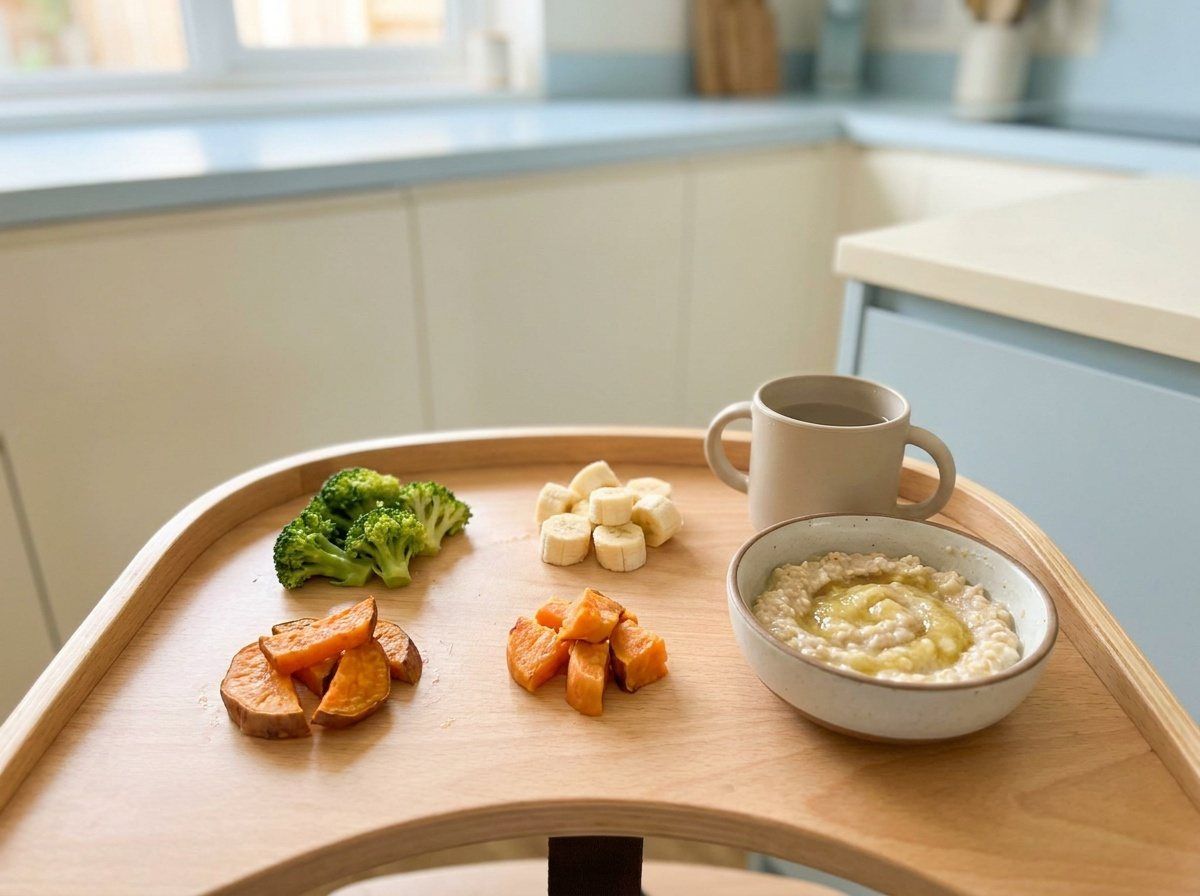
Many babies want to grab food themselves now, whether you spoon-feed, do baby-led weaning or mix both. Good candidates pass the squish test (they mash easily between thumb and forefinger) and come in finger-length pieces your baby can hold in a fist. Examples include soft-steamed broccoli florets, zucchini sticks, sweet potato wedges, ripe banana, strips of avocado and well-cooked pasta. The safe size and shape for each food at each age lives on its page in the food library; the basics are in our baby finger foods guide and how to cut food for a baby safely.
Water, Iron and Allergens
Offer water in an open or free-flow cup at every meal. It is still mostly practice, but as meals grow your baby genuinely starts needing it. Iron remains the headline nutrient: well-cooked meat, iron-fortified infant cereal, lentils and beans, paired with vitamin C rich fruit or vegetables, cover most of the need, and our iron-rich foods guide has the full list. Daily vitamin D drops continue for breastfed babies, and for formula-fed babies depending on intake; see our vitamin D guide. Common allergens such as egg, peanut, cow's milk, wheat, fish, sesame and soy should not be delayed, but they deserve a deliberate introduction: one at a time, in an age-appropriate form, on a day when you can watch your baby afterwards. See the top 10 allergens for babies for how.
Still off the menu: honey until the first birthday, added salt and sugar, cow's milk as a drink, and anything hard, round or slippery such as whole grapes, raw carrot, whole nuts, hot dogs and popcorn. The full list is in our choking hazards for babies guide.
Sleep at 8 Months
Most 8 month olds sleep a total of about 12 to 15 hours in 24: roughly 10 to 12 hours at night and two naps of 1 to 2 hours each. The move from three naps to two is usually done by now, and wake windows run about 2.5 to 3.5 hours. Some babies sleep through, many still wake once or twice to feed; both are normal.
Between 8 and 10 months, many parents report a rough patch often called the 8 month sleep regression. The reasons are plain: the baby practices crawling and pulling up in the crib, separation anxiety makes them check you are there, and teeth are often coming through. These stretches usually last two to six weeks. What helps: lots of practice during the day, an unchanged bedtime routine, short and calm responses at night, and daytime separation practice with peekaboo and brief, announced absences. As soon as your baby pulls up, lower the crib mattress to its lowest setting; a sleep sack, no pillows and a firm mattress still apply.
Sample Daily Routine at 8 Months
A day with two naps and three meals can look like this; the times are examples, the order is what counts:
| Time | What happens | Example |
|---|---|---|
| 6:30 AM | Wake up, milk | Breastfeed or bottle |
| 7:30 AM | Breakfast | Oatmeal with mashed fruit, soft toast fingers, water |
| 9:00 AM | Nap 1 | About 1 to 1.5 hours |
| 10:30 AM | Milk, awake time | Walk, floor play, errands |
| 12:00 PM | Lunch | Mashed vegetables with meat or lentils, soft finger foods, water |
| 1:00 PM | Nap 2 | About 1 to 2 hours |
| 3:00 PM | Milk, awake time | Play, visitors, fresh air |
| 5:00 PM | Dinner | Soft pasta with vegetable sauce, avocado strips, water |
| 6:30 PM | Bedtime routine | Bath, pajamas, milk, song |
| 7:00 PM | Night sleep | With 0 to 2 night feeds |
For lunch ideas that fit this stage, see our lunch recipes for an 8 month old.
Meals, finger foods and portions for every day
The app builds a daily plan with recipes, portions and a shopping list, and shows the safe shape and size of every food for your baby's age.
Health and Safety at 8 Months
Teething
Many 8 month olds have one to four teeth, usually the bottom and top front ones; some have none yet. Both are normal: the first tooth can arrive anywhere between 4 months and the first birthday. Drooling, chewing on everything and grumpiness come with it; a high fever and diarrhea do not, and should be checked. Brush any teeth twice a day with a rice-grain smear of fluoride toothpaste.
Babyproofing for a Baby on the Move
- ▸ Stairs and heights: Safety gates at the top and bottom of stairs, bookcases and dressers anchored to the wall, window guards or locks.
- ▸ Cords, outlets, heat: Outlet covers, cords and blind cords out of reach, stove knob covers, no tablecloths to pull.
- ▸ Small objects and poisons: Anything that fits through a toilet paper tube goes away. Cleaning products, medications and plants go up high and behind a lock.
- ▸ Eating: Always upright in the high chair, never while crawling or being carried, with an adult within arm's reach. An infant CPR and choking class is worth taking now; the key steps are in our infant choking first aid guide.
Checkups, and When to Talk to Your Pediatrician
In the US the next well visit is at 9 months and includes a developmental screening; in the UK the health visitor review falls between 9 and 12 months, but you do not have to wait. Check in sooner if your 8 month old does not sit with support, does not roll both ways, does not babble, does not respond to their name or to sounds, avoids eye contact, uses one side of the body much less than the other, does not bear weight on their legs when you hold them up, or loses skills they used to have. Persistent poor feeding or a stalled weight curve also belong in the office.
Frequently Asked Questions About 8 Month Olds
What should an 8 month old be doing?
Most sit without support, many scoot or crawl, some pull up to standing. They grasp on purpose, start an early pincer grasp, babble in long strings, understand a few words, look for hidden objects and often show stranger anxiety. Each of these has a window of several months.
My 8 month old is not crawling yet. Should I worry?
No. Hands-and-knees crawling arrives between roughly 5 and 13 months in the WHO data, and some babies skip it and go straight to standing. As long as your baby is interested in moving and uses both sides of the body equally, all is well.
How many meals should an 8 month old have?
Many babies eat two to three meals a day at this point, a mix of mashed food and finger foods, plus 3 to 5 milk feeds. A baby who started solids later will be at one or two meals.
How much formula should an 8 month old drink?
Many formula-fed babies take roughly 20 to 30 oz (600 to 900 ml) a day over 3 to 4 bottles, and the amount falls as meals grow. Breastfed babies feed on demand. If your baby is growing well and alert, the amount is right.
Can my baby eat finger foods without teeth?
Yes. Babies mash soft foods with their gums and tongue; teeth are not required. What matters is the right softness (the squish test) and the safe shape for that food.
Why is my 8 month old suddenly so clingy?
Because they now understand that familiar and unfamiliar people are different and that you can leave. It is a normal developmental step and a sign of secure attachment. Closeness, short honest goodbyes and slow introductions to new people help most.
How much sleep does an 8 month old need?
Usually 12 to 15 hours in 24, with 10 to 12 at night and the rest in two naps. Night waking is common in this stretch and usually settles again after a few weeks.
The Other Months
The other guides in this series: 6 month old baby (rolling, readiness signs, first foods), 11 month old baby (first steps, family meals) and 1 year old baby (family meals, cow's milk, toddler life).
Sources
- ▸ CDC: Developmental Milestones (Learn the Signs. Act Early.)
- ▸ CDC: Infant and Toddler Nutrition
- ▸ American Academy of Pediatrics: Starting Solid Foods
- ▸ American Academy of Pediatrics: How Many Hours of Sleep Does Your Child Need
- ▸ American Academy of Pediatrics: Choking Prevention
- ▸ NHS: Your Baby's First Solid Foods
- ▸ NHS: Baby and Toddler Safety
- ▸ WHO: Motor Development Milestones