Around their first birthday, many parents ask the same question: What does healthy baby nutrition at 1 year look like – and what can toddlers eat?
In the first year of life, infant nutrition was the focus: breast milk or formula plus solid foods. Now begins the phase of "nutrition from 1 year onwards" – your baby becomes a toddler and can increasingly join the family table.
For everything else that is typical around the first birthday, including development, sleep and a sample daily routine, see our overview 1 Year Old Baby: Development, Feeding, Sleep & Daily Routine.
In this article you'll learn:
- ▸ What changes from 1 year onwards in nutrition
- ▸ What appropriate food from 1 year old includes
- ▸ What a typical daily meal plan looks like
- ▸ A simple portion size chart for 1-year-olds
All recommendations are based on official guidelines (e.g., Optimized Mixed Diet/FKE, Healthy into Life, BZfE, National Nutrition Commissions) (Ernährungs Umschau).
1. From Infant to Toddler: What Changes at 1 Year?
1.1 Transition from "Baby Nutrition" to Toddler Foods
After the first birthday, for healthy children without special diagnoses:
✓ Important:
They can essentially eat at the normal family table. (Arbeiterkammer Steiermark)
Important considerations remain:
- ▸ low salt
- ▸ no added sugar
- ▸ no raw animal products (e.g., raw meat, unpasteurized milk, raw eggs)
- ▸ Foods they could easily choke on only in safe form
Thus, the focus shifts from infant nutrition (milk + puree) to toddler meals at the family table: normal foods, but prepared in a child-friendly way.
1.2 Energy Needs & Meal Structure
An average toddler aged 1–3 years needs about 1100–1200 calories per day, depending on size and activity level (Katholisches Klinikum Bochum).
The proven structure is:
- ▸ 3 main meals (breakfast, lunch, dinner)
- ▸ 2 snacks (mid-morning, afternoon)
This keeps blood sugar stable and prevents overwhelming small stomachs.
2. What Belongs in Healthy Nutrition from 1 Year Onwards?
Many guidelines for infant and toddler nutrition summarize it as follows:
Plenty of water, lots of vegetables & fruit, regular grains & potatoes, daily dairy products, small amounts of meat/fish/eggs, minimal fats & sweets. (BZfE)
2.1 Beverages
- ▸ Water (tap water, still mineral water)
- ▸ unsweetened herbal or fruit tea
Recommendation: about 600–800 ml/day – in addition to water contained in food (BZfE).
Juices only heavily diluted and as an exception, no soda, iced tea, or sweet instant teas.
2.2 Vegetables & Fruit
- ▸ Goal: daily 2–3 small portions of vegetables and 2 portions of fruit
- ▸ ideally colorfully mixed (raw and cooked)
This provides vitamins, fiber, and many protective plant compounds (BZfE).
2.3 Grains & Potatoes
- ▸ Bread, pasta, rice, potatoes, millet, oats, etc.
- ▸ preferably whole grain or mixed products to provide fiber and B vitamins
One-year-olds can fully participate in family bread – just offer nuts and seeds in a way that prevents choking hazard (e.g., finely ground in bread) (Kinderärzte im Netz).
2.4 Milk & Dairy Products
For baby nutrition at 1 year, professional organizations usually recommend: about 300 ml dairy products per day (e.g., 200 ml milk + 1 small yogurt or some cheese) (Kinderärzte im Netz).
Too much milk (e.g., >500–600 ml daily) can:
- ▸ displace appetite for other foods
- ▸ increase the long-term risk of overweight
Plant-based drinks:
Plant-based drinks (oat, almond, rice, soy) are nutritionally not adequate dairy replacements for toddlers, especially if not fortified (calcium, iodine, B12) (Kindergesundheit-info.de). If you want to use plant-based drinks, ideally discuss this with your pediatrician or nutritionist.
2.5 Meat, Fish, Eggs
Small amounts are sufficient:
- ▸ Meat/sausage: max. about 30–35 g/day or 2–3 small portions per week
- ▸ Fish: about 1–2 portions per week (e.g., salmon, pollock, cod)
- ▸ Eggs: about 1–2 eggs per week (Richtig essen von Anfang an)
⚠ Important:
- ▸ always cook thoroughly, no raw products
- ▸ sausage preferably rarely – due to salt and fat
2.6 Fats & Oils
- ▸ Prefer plant oils like rapeseed oil, olive oil, walnut oil
- ▸ Butter in small amounts is okay
- ▸ Fried and very fatty foods only rarely
Sweets, snacks, pastries should make up at most about 10% of energy intake – meaning: "sparing enjoyment," not daily main nutrition source (Kup.at).
3. Portion Size Chart for 1-Year-Olds
Portion sizes are guidelines, not requirements. Most guidelines recommend orienting to child's hand & fist as they match the body size (Ernährungsdenkwerkstatt).
3.1 Hand Measurement Rule
- ▸ 1 child's hand (cupped) ≈ 1 portion fruit or vegetables
- ▸ 1 child's fist ≈ 1 portion bread, potatoes, pasta
- ▸ 1 child's palm ≈ 1 portion meat or fish (without fingers)
3.2 Example: Portion Size Chart for 1-Year-Olds (per day)
Beverages
600–800 ml water/tea | 5–6 small cups
Vegetables
120–150 g | 2–3 child's hands
Fruit
120–150 g | 2 child's hands
Bread, Grains, Potatoes
4–5 small portions | 4–5 child's fists
Milk & Dairy Products
approx. 300 ml (incl. yogurt/cheese) | 2–3 small portions
Meat/Sausage
max. 30–35 g | 1 small palm
Fish
1–2 portions per week | 1 child's palm/week
Egg
1–2 pieces per week
Oils & Fats
approx. 15–20 g (2–3 tsp oil + some butter)
These figures are based on the Optimized Mixed Diet (optimiX) and national recommendations for 1- to 3-year-olds (Ernährungs Umschau).
Portion Sizes Matched to Your Child's Age
The app turns charts like this one into an individual daily meal plan for your toddler, with the right portion size for every meal and recipe ideas for the family table.
4. Typical Daily Plan: Food for 1-Year-Old Toddlers
Example Day (Nutrition from 1 Year)
Breakfast
- • Whole grain bread with some butter or cream cheese
- • a few cucumber or tomato pieces
- • 1 small cup of milk or unsweetened tea/water
Mid-Morning Snack
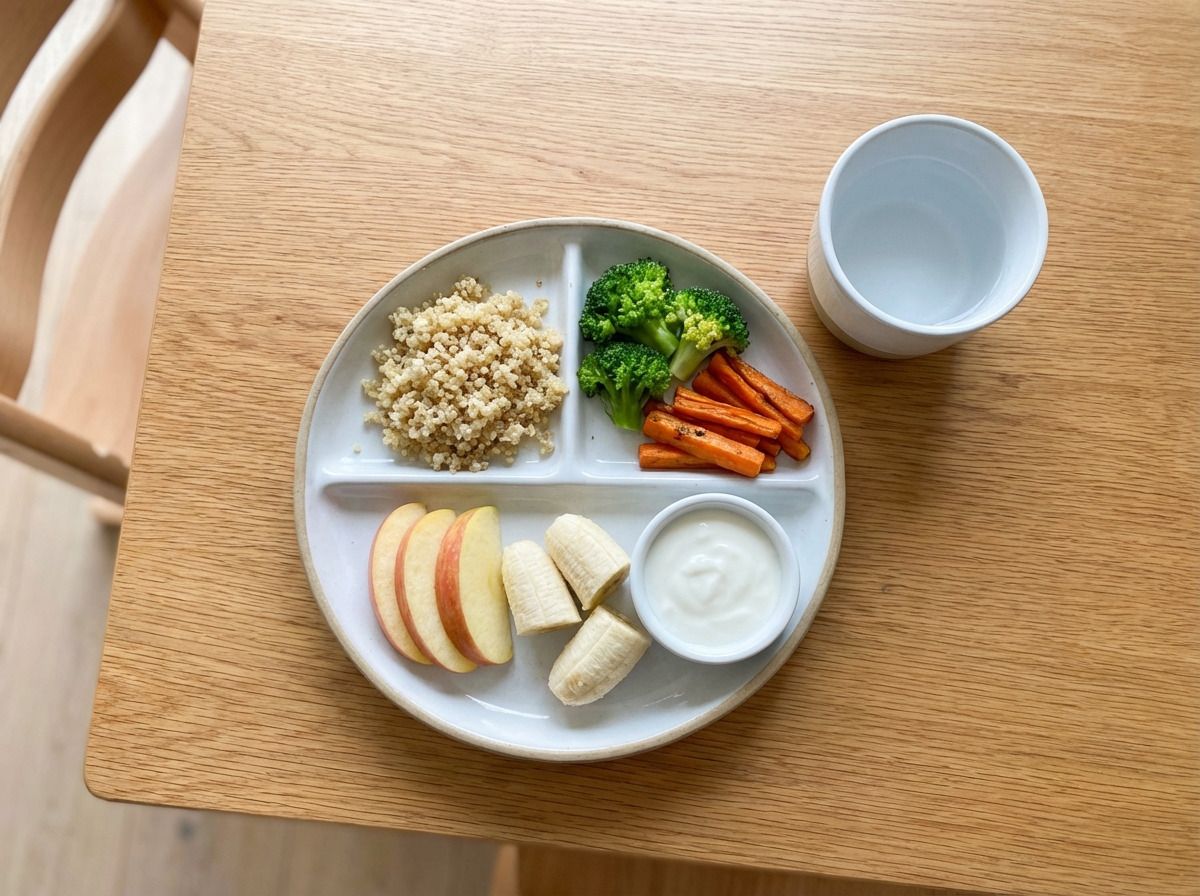
- • Piece of fruit (e.g., half a banana, some apple slices)
Lunch
- • Potatoes or pasta
- • Vegetables (e.g., broccoli, carrots)
- • small piece of lean meat or fish (or vegetarian alternative like lentil bolognese)
- • Water alongside
Afternoon Snack
- • Plain yogurt with fresh fruit (no added sugar)
- • or a small piece of whole grain pastry
Dinner
- • Bread with cheese or spread
- • alongside bell pepper, cucumber, or carrot sticks
- • Water
This is what many recommendations for toddler meals from 1 year look like: varied, colorful, with plenty of vegetables/fruit and no sugar bombs in everyday life (BZfE).
5. Safety When Eating: What 1-Year-Olds Should Not Eat Yet
Even though baby nutrition at 1 year approaches adult food closely, there are still taboos and precautions:
5.1 Choking Hazard
Avoid or modify (Kinderärzte im Netz):
- ▸ whole nuts (only ground or as nut butter)
- ▸ whole grapes, cherry tomatoes → cut lengthwise in half or quarters
- ▸ hard, raw carrots or apple pieces → offer finely grated or softly cooked
Learn more in our article about baby gagging during feeding.
5.2 Hygiene & Cooking Degree
- ▸ Meat, fish, eggs always cook thoroughly
- ▸ No unpasteurized milk, raw meat, raw sausages (salami, etc.) for toddlers
- ▸ Cool leftovers quickly and keep max. 1–2 days, then reheat thoroughly
6. Picky Eating & Toddler Meals – When Your Child "Won't Eat Anything"
Many parents know it: "Baby nutrition was easy, but now at 1 year they barely eat anything!"
Research and counseling centers agree:
- ▸ Appetite fluctuates – growth pace slows down, children need less in phases
- ▸ Neophobia (fear of new things) is normal: New foods often need to be offered 10–15 times before being accepted (Gesund ins Leben)
Helpful tips:
- ✓ repeatedly offer small amounts without pressure
- ✓ be a role model (parents eat vegetables & whole grains themselves)
- ✓ don't use food as a power struggle or reward
If you feel your child is losing weight, seems tired, or eating very one-sided, definitely discuss this with your pediatrician or a qualified nutrition professional.
7. In Short Summary
Baby nutrition at 1 year means in practice:
- ✓ Your child can eat at the family table, as long as food is prepared in a child-friendly way
- ✓ Structure: 3 meals + 2 snacks, water as main beverage
- ✓ Lots of vegetables & fruit, whole grains, potatoes, daily dairy, little meat/fish, minimal sweets & snacks
- ✓ Portion sizes best oriented to child's hand – charts are only rough guidance
- ✓ Safety remains important: no raw animal products, no "choking-hazard foods" in problematic form
Sources (Selection)
- ▸ Ernährungs Umschau – Child Nutrition & Optimized Mixed Diet
- ▸ Arbeiterkammer Steiermark – Child Nutrition
- ▸ Katholisches Klinikum Bochum – Optimized Mixed Diet Concept
- ▸ BZfE – Food for Toddlers
- ▸ Kinderärzte im Netz – The Best Food for Toddlers
- ▸ Kindergesundheit-info.de – Plant Drinks in Toddler Nutrition
- ▸ Richtig essen von Anfang an – Nutrition Recommendations for 1- to 3-Year-Olds
- ▸ Kup.at – Nutrition in Toddlers
- ▸ Ernährungsdenkwerkstatt – Portions and Portion Sizes
- ▸ Gesund ins Leben – What to Do When Toddlers Are Very Picky Eaters