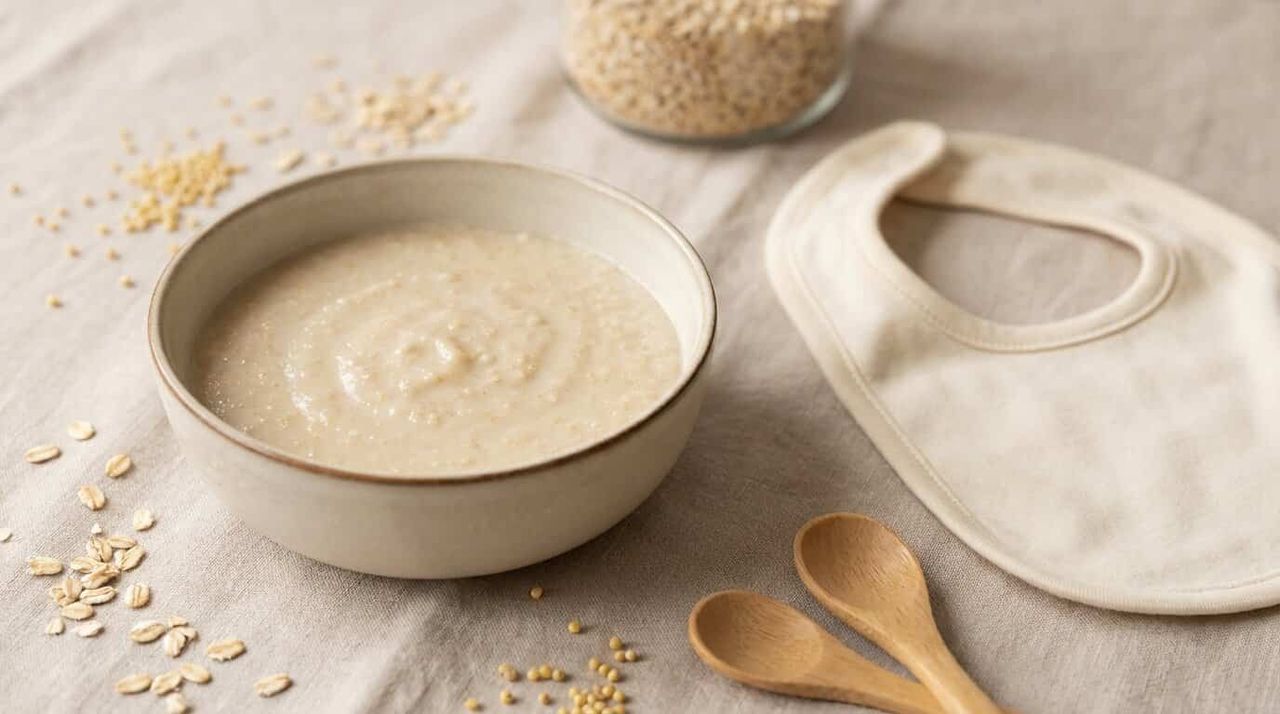
Baby cereal covers two everyday meals in the first year: a milk and cereal porridge, usually served in the evening, and a milk-free cereal and fruit porridge in the afternoon. Oats, millet and spelt are the easiest grains to start with, whole grain flakes bring iron, gluten can be introduced along with other solids, and rice is best rotated with other grains rather than served daily. Below: which grain suits which stage, what the guidelines say about iron and gluten, the cereal and fruit porridge recipe, how to use cereal flakes, and how textures and amounts change over the year.
Key Takeaways
- ▸ When: once the readiness signs are there. In the German-style plan, cereal joins as the second meal about a month after the first; in the US and UK, iron-fortified infant cereal is often among the very first foods. Both work.
- ▸ Which grains: oats, millet and spelt first, then wheat semolina, barley, buckwheat and quinoa for variety. Rice only now and then.
- ▸ Iron: whole grain flakes and iron-fortified infant cereal both count, and vitamin C from fruit helps the body absorb that iron.
- ▸ Gluten: no need to delay it. Introduce it with other solids, in small amounts at first, also in families with allergies.
- ▸ Basic recipe: 20 g flakes, 90 ml water, 100 g fruit, 1 teaspoon oil. No sugar, no milk in the afternoon porridge.
When Can Babies Have Cereal or Porridge?
Cereal follows the same rule as every other first food: your baby is ready when the four readiness signs are in place. They sit upright with support and hold their head steady, they reach for food and bring things to their mouth, they show real interest in what you eat, and the tongue-thrust reflex has gone so food is no longer pushed straight back out. Pediatric bodies add one hard limit, no solids before 4 months (17 weeks), and otherwise let the baby set the pace.
Where cereal sits in the order is a matter of tradition. In the German feeding plan that this site follows, the first meal is a vegetable, potato and meat purée at lunch, and cereal joins about a month later as the evening milk porridge, with the cereal and fruit porridge about a month after that. In the US and UK, the American Academy of Pediatrics and the NHS mention iron-fortified infant cereal among the first foods alongside meat and vegetables. Both routes are fine as long as iron-rich foods come early, cereal is served from a spoon rather than a bottle, and the first spoonfuls are followed by the usual milk feed. See our readiness signs guide and the starting solids guide.
Which Grains for Babies, and When
All the common grains work for babies as long as they are ground fine enough and come without added sugar. The differences are gluten, iron content and how they cook.
| Grain | Gluten | When | Good to know |
|---|---|---|---|
| Oats | naturally gluten-free, often with traces from processing | from the first cereal meal | Iron-rich, mild, filling. Fine rolled or quick oats, or instant baby oat cereal. |
| Millet | gluten-free | from the first cereal meal | Very iron-rich, slightly nutty. Flakes take a little longer to soak. |
| Spelt | contains gluten | from the first cereal meal, small amounts at first | Aromatic and well tolerated, as flakes or semolina. |
| Wheat and semolina | contains gluten | from the first cereal meal, small amounts at first | Soft wheat semolina makes the smoothest porridge; whole grain semolina brings more iron. |
| Rice | gluten-free | from the first cereal meal, in rotation only | Can contain inorganic arsenic. The FDA and the UK Food Standards Agency advise varying grains rather than relying on rice cereal. |
| Barley, buckwheat, quinoa | barley yes, buckwheat and quinoa no | once the first grains are tolerated | For variety. Rinse quinoa well before cooking; use buckwheat as flakes or finely ground. |
If you are wondering which grain is best for baby porridge: there is no winner. A mix of oats, millet and spelt covers the first weeks beautifully, and semolina, barley, buckwheat and quinoa add variety later, with whole grain wherever you can.
Iron and Gluten: What the Guidelines Say
Iron: why whole grain and vitamin C belong together
Iron needs jump in the second half of the first year. The US recommended intake rises from 0.27 mg a day in the first six months to 11 mg a day for 7 to 12 month olds, because the iron stores a baby is born with are largely used up and milk alone no longer covers the need. That is why the AAP asks parents to include foods with iron and zinc, such as meat and iron-fortified cereal, from the start of solids, and why home-cooked cereal meals should use whole grain flakes, which carry far more iron than refined ones.
Getting the most iron out of cereal
- ▸ Add vitamin C: fruit purée or a splash of fruit juice in the porridge noticeably improves absorption of plant iron.
- ▸ Keep the afternoon porridge milk-free: the German guideline leaves milk out of the cereal and fruit porridge precisely so the iron from the grain is absorbed better and protein intake stays moderate.
- ▸ Whole grain, not "fine": baby whole grain flakes are rolled thin and still whole grain. Look for the words on the pack.
- ▸ Prefer oats and millet: both are among the most iron-rich grains, which is why they are also the recommended meat substitute in a vegetarian lunch purée.
For the full list of foods that supply iron and how to combine them, see the iron-rich foods for babies guide.
Gluten: do not avoid it, but start small
For years parents were told to hold gluten back, or to rush it in. Both ideas are outdated. The NHS says foods containing gluten can be introduced with other solids, one at a time and in small amounts so you can spot any reaction, and the AAP finds no evidence that delaying allergenic foods prevents allergies. ESPGHAN's position paper on gluten adds one practical point: avoid large amounts of gluten in the first weeks after it is introduced. In everyday terms, spelt, wheat semolina or barley can join the cereal rotation as one grain among several, not in big portions every day. Our overview of the top 10 allergens for babies covers the rest.
Keep track of every new grain
Log which grains your baby has tried in the app, keep gluten-containing ones like spelt and wheat in the allergen tracker, and get recipes that match the stage your baby is at right now.
Cereal and Fruit Porridge Recipe (ml and oz)
This is the milk-free afternoon porridge from the German plan, the third meal in that sequence. It follows the Gesund ins Leben guideline and makes one full portion of about 215 g (7.5 oz).
Ingredients for one portion
- ▸ 20 g (about 3 tablespoons) whole grain cereal flakes or semolina: oats, millet, spelt or wheat
- ▸ 90 ml (3 fl oz) water
- ▸ 100 g (3.5 oz, about half a cup) fruit, mashed, grated or puréed, for example apple, pear, peach, apricot or banana
- ▸ 1 teaspoon (about 5 g) canola or rapeseed oil
Method in 5 steps
- Stir the flakes into 90 ml of cold water. Semolina goes into boiling water instead.
- Bring to the boil and simmer for about 3 minutes, stirring, until thick and creamy.
- Take the pan off the heat and stir in the fruit: steamed and puréed in the first weeks, later simply mashed or finely grated.
- Stir in 1 teaspoon of oil. The fat supplies energy and helps absorb fat-soluble vitamins.
- Serve lukewarm. Once this third meal is in place, offer water in a cup with meals.
Vary the fruit with the season; nectarine, plum or cooked berries all work. Which fruits suit which stage is covered in when can babies eat fruit, and more ideas are in the baby purée recipes guide.
And the milk porridge?
The evening porridge works on the same principle with milk instead of water: 200 ml (7 fl oz) breast milk, formula or whole milk, 20 g flakes and 2 tablespoons of fruit, no oil. The step by step recipe, the milk question and amounts by age are in the evening porridge guide.
How to Use Baby Cereal Flakes
Whole grain flakes, instant infant cereal, quick oats and semolina sit side by side on the shelf, and all of them work once you know how.
Whole grain flakes (fine or coarse)
The standard for both cereal meals. Fine flakes need a short boil and a few minutes to soak; coarse flakes take longer or can be pulsed in a blender before cooking.
Instant infant cereal
Pre-cooked, very fine and usually iron-fortified, which the AAP counts as a plus. Mix it with water, breast milk or formula as the label says, and choose whole grain versions with no added sugar or flavorings.
Quick oats and instant oat flakes
Rolled very thin, they dissolve almost without cooking. Handy for the first weeks and for babies who do not yet like flakes in their mouth.
Semolina
Always stir wheat, spelt or whole grain semolina into boiling liquid or it will clump. It gives the smoothest porridge of all.
- ▸ Storage: keep flakes cool and dry and use opened packs within a few weeks; whole grain goes rancid faster than refined flakes.
- ▸ With formula or breast milk: cook the flakes in water, let them cool, then stir the milk in so it is never boiled. Details in how to mix baby cereal with formula.
Grains by Stage: Types, Texture and Amounts
Cereal grows with your baby. The stages below count from the start of solids, not from the birthday, and the amounts are orientation rather than targets.
| Stage | Grains | Texture | Amount per meal |
|---|---|---|---|
| First cereal meal (about 1 month after starting solids) | fine whole grain oats, millet or spelt, instant infant cereal, semolina | smooth and creamy, fruit puréed | start with 2 to 5 spoonfuls (1 to 2 oz), reach a full portion within 2 to 4 weeks |
| Second cereal meal (about 2 months after starting) | the same grains plus wheat semolina, barley, buckwheat | creamy, fruit mashed or grated | a full portion of about 200 to 250 g (7 to 9 oz), depending on appetite |
| At 8 to 10 months | coarse flakes briefly cooked, whole millet cooked soft, soft pasta, couscous | lumpier porridge, first finger foods such as oat balls or pancake strips | a full portion, with finger foods offered alongside |
| At 10 to 12 months | whole grain bread, whole grain pasta, rice in rotation, porridge with fruit pieces | family food in soft pieces, porridge only if your baby still likes it | by appetite, watching fullness cues |
| From the first birthday | all grains, including unsweetened muesli, nuts only finely ground | family food, milk served in a cup | by appetite |
For typical portions of every meal at each stage, see how much purée for a 7 month old; the move to family food is covered in transitioning from purées to solids.
Sugar, Store-Bought Cereal and Amounts
How much sugar can go in baby cereal?
None. Babies need no added sugar, whether as table sugar, honey, syrup, glucose or fruit powder; the natural sweetness of 100 g of fruit is plenty. With store-bought cereal, read the ingredients list, because "no added sugar" does not rule out juice concentrate or maltodextrin. The sugar and babies guide explains why this matters so much in the first year.
Store-bought infant cereal or homemade?
Both are fine. Iron-fortified infant cereal is convenient and the AAP explicitly recommends it as an iron source; homemade whole grain porridge is cheaper and brings more variety of taste and texture. If you buy, choose whole grain, few ingredients and no sugar, cocoa or flavorings, and mix milk cereal powders with water rather than extra milk.
How much cereal should my baby eat?
As much as they want. A full portion works out at roughly 200 to 250 g (7 to 9 oz), but appetite swings from day to day. Your baby shows you when they are full: they close their mouth, turn their head away or start playing with the spoon. While the portion is still small, the usual milk feed follows.
Frequently Asked Questions
Can my baby have oatmeal every day?
Yes, oats can be a daily food. Variety with millet, spelt and semolina is still worth it: your baby learns different tastes and the nutrients complement each other.
Is rice cereal safe for babies?
In rotation, yes. Rice can contain inorganic arsenic, which is why the FDA set an action level for infant rice cereal and advises a variety of grains, and the FSA says rice drinks are not for children under five. Occasional rice cereal is fine; daily rice is not the goal.
Cereal and constipation: what helps?
Whole grain flakes instead of refined ones, enough fluid with meals, and fruit such as pear, peach or prune rather than banana. If stools become hard and infrequent, talk to your pediatrician.
Key Takeaways
- ✓ Oats, millet and spelt as whole grain flakes are the best start
- ✓ Cereal comes once the readiness signs are there, from a spoon, never a bottle
- ✓ Vitamin C from fruit boosts iron absorption; the afternoon porridge stays milk-free
- ✓ Do not avoid gluten, but start small; rotate rice with other grains
- ✓ No sugar, no flavorings, portions by appetite
With 20 g of flakes, a little liquid and some fruit you have a recipe that carries you from the first cereal meal all the way to family food.
Sources
- ▸ American Academy of Pediatrics (HealthyChildren.org): Starting Solid Foods (iron-fortified cereal, no cereal in bottles, allergens)
- ▸ NHS: Your baby's first solid foods (readiness signs, gluten and allergens)
- ▸ NIH Office of Dietary Supplements: Iron fact sheet (recommended intakes by age)
- ▸ ESPGHAN: Gluten Introduction and the Risk of Coeliac Disease, Position Paper (JPGN 2016)
- ▸ ESPGHAN Committee on Nutrition: Complementary Feeding, Position Paper (JPGN 2017)
- ▸ U.S. Food and Drug Administration: Arsenic in food, including infant rice cereal
- ▸ UK Food Standards Agency: Arsenic in rice
- ▸ Netzwerk Gesund ins Leben (Germany): Cereal and fruit porridge recipe (in German)
- ▸ World Health Organization: Complementary feeding