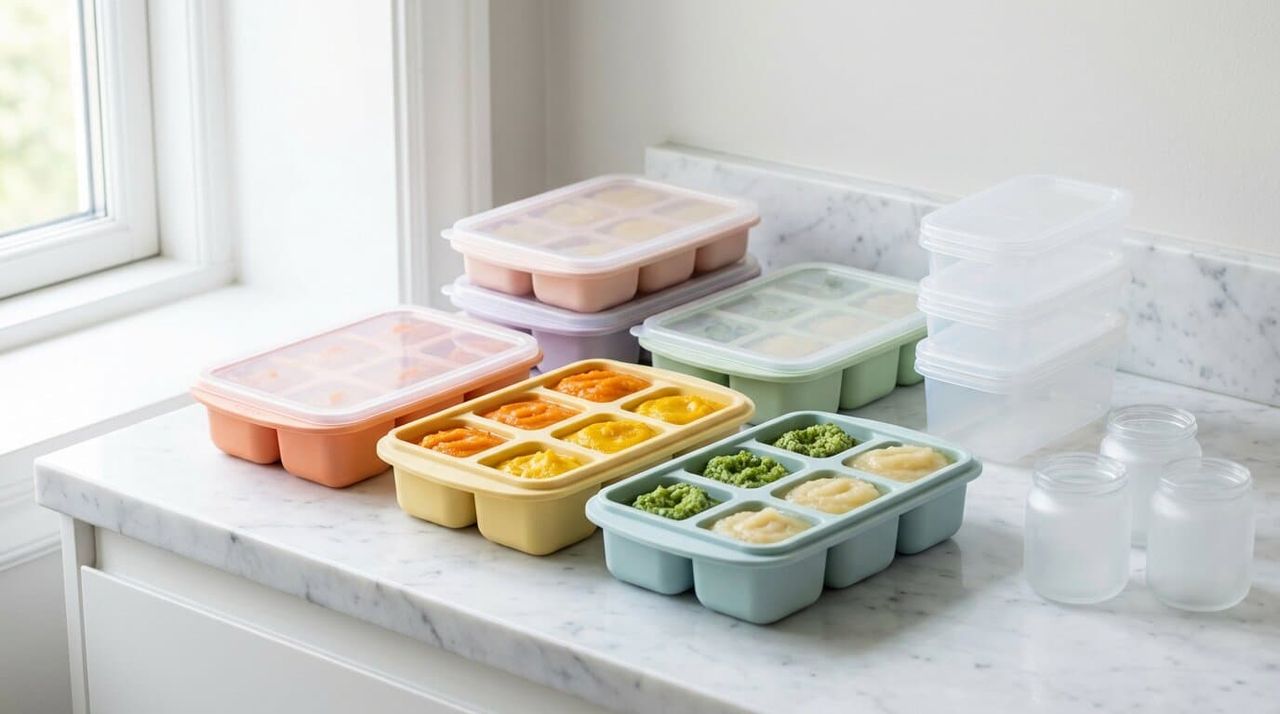
Cooking fresh every day sounds lovely, but with a baby it is rarely realistic. Freezing baby food solves the problem: you cook once in peace, freeze in portions and have a complete meal ready in minutes on hectic days. Done right, frozen puree is just as safe and nutritious as freshly cooked puree, and often better than one that sat in the fridge for two days.
This guide shows how long each kind of puree keeps, which containers have proven themselves, how to thaw and reheat safely, why potato puree sometimes turns watery after thawing and which vegetables you should rather prepare fresh. At the end you will find an FAQ with the questions parents ask most often about batch cooking.
Key Takeaways: Freezing Baby Food
- ✓ Cool quickly (within one to two hours), portion, label, into the freezer
- ✓ At 0 °F (minus 18 °C) puree stays safe, as a rule of thumb use it within two to three months
- ✓ Thaw in the fridge or heat straight from frozen, never at room temperature
- ✓ Reheat only once, throw away leftovers from the bowl, never refreeze
- ✓ Nitrate-rich vegetables such as spinach, fennel and beetroot are prepared fresh and not reheated
Why Freezing Is the Best Way to Store Baby Food
In the freezer at 0 °F (minus 18 °C) practically all microbial activity stops. The puree does not spoil as long as it stays frozen. In the fridge, by contrast, bacteria only multiply more slowly, which is why cooked puree kept there should be used within two days at most, ideally by the next day.
The freezer also does well on nutrients. Heat-sensitive vitamins such as vitamin C are lost mainly during cooking and long storage, not during freezing. A puree that is cooled and frozen straight after cooking keeps its vitamins better than one that sits in the fridge for days. The one thing that matters is speed: the faster the puree gets cold, the smaller the ice crystals and the better the texture survives.
How Long Does Frozen Baby Food Last?
Kept constantly at 0 °F, puree stays safe for a long time. What fades over time is flavor, texture and vitamin content. Hence the rule of thumb: use within two to three months, purees with meat or fish sooner rather than later. This is how the individual purees behave:
| Puree | Fridge | Freezer | Note |
|---|---|---|---|
| Vegetable puree, vegetable and potato puree | until the next day | freezes very well | Carrot, pumpkin, parsnip, zucchini and broccoli freeze without any problems |
| Vegetable, potato and meat puree | until the next day | freezes well | Add oil and fruit puree only when serving, that protects the fat and the vitamin C |
| Plain potato puree | until the next day | freezes with limitations | Turns slightly watery or gluey after thawing, hardly noticeable in mixed purees |
| Cereal and fruit porridge | until the next day | freezes well | Fruit puree can also be frozen on its own in cubes and mixed with fresh flakes later |
| Milk and cereal porridge | until the next day | not recommended | The texture suffers, and milk porridge is mixed fresh in minutes anyway |
| Spinach, fennel, beetroot, chard | do not keep | not recommended | High in nitrate, so prepare fresh and do not reheat |
How the individual purees are put together is covered in our vegetable guide for baby puree and our collection of baby food puree ideas. For every ingredient, our food library tells you from what stage it is suitable and how to prepare it.
Step by Step: How to Freeze Baby Food Properly
- 1. Cook and blend as usual, but leave out the oil and fruit puree. You stir both in when serving.
- 2. Cool quickly: Spread the puree in a shallow dish or stand the pot in cold water. It should be in the freezer within one to two hours at the latest.
- 3. Portion: Fill ice cube trays or small containers. Cubes of 20 to 30 g (about an ounce) can be combined flexibly later, larger containers suit complete meals.
- 4. Label: Contents and date on every container or bag. After two weeks all orange cubes look the same.
- 5. Freeze: Trays flat in the freezer, and once the cubes are solid, transfer them to a freezer bag and press out the air. That prevents freezer burn and saves space.
- 6. Oldest portions first. A note on the freezer door with the current stock helps you keep track.
Which Containers Are Suitable for Freezing Baby Food?
Silicone ice cube trays
The classic for portioning. Food-grade silicone, ideally with a lid. The frozen cubes pop out easily and can be transferred to bags.
Small glass jars
Taste-neutral and free of plasticizers, but heavier and breakable. Fill only three quarters full because puree expands as it freezes, and avoid jars with a narrow neck.
Plastic containers (PP)
Light, shatterproof, stackable. Look for the freezer-safe and BPA-free labels and replace scratched containers.
Freezer bags
Ideal as a second layer for finished cubes or for freezing larger portions flat. Press out the air and seal well.
Less suitable are the original store-bought jars (they can crack) and containers without a lid: puree stored open quickly gets freezer burn, dry grey patches that are not dangerous but spoil taste and texture.
Thawing and Reheating Baby Food
One thing matters most when thawing: the puree must not sit at room temperature for hours, because germs multiply fastest between roughly 40 and 140 °F (5 and 60 °C). Three methods are safe:
- ▸ In the fridge: Put the portion in the fridge the evening before and heat it the next day. Thawed puree should be used within 24 hours.
- ▸ In a pan or water bath: Warm the frozen cubes directly in a small pan over low heat, stirring as you go. Even and gentle.
- ▸ In the microwave: Fast, but with hot spots. Stir thoroughly halfway through and at the end, then let it stand briefly.
Rules for reheating:
- ➡Heat the puree until steaming hot all the way through, then let it cool to eating temperature and test it with a clean spoon
- ➡Only now stir in the rapeseed oil and fruit puree
- ➡Warm only the amount your baby is likely to eat
- ➡Throw away leftovers from the bowl the spoon went into: saliva carries germs into the puree
- ➡Never refreeze thawed puree and reheat it only once
Recipes made for batch cooking
The app gives you recipes with the right portion sizes for every stage plus a shopping list, so you cook once a week and still have variety in the freezer.
Freezing Potato Puree: Why the Texture Suffers
Many parents are surprised that plain potato puree turns watery or gluey after thawing. The reason is starch: during freezing and thawing the starch molecules rearrange and release water. It is not dangerous, just unappetizing. This is how to get around it:
- ✓Freeze potato as part of a vegetable, potato and meat puree: in the mix the effect is barely noticeable
- ✓Stir vigorously after reheating and the puree becomes even again
- ✓Do not over-blend potato, only as smooth as needed
- ✗Plain potato puree is better cooked fresh, it is quick anyway
A basic recipe that works well prepared in cubes is our potato puree recipe for the Thermomix, and a matching vegetable base is our carrot puree recipe.
Which Purees Are Better Made Fresh
Not everything belongs in the freezer. With some ingredients it is about safety, with others only about taste:
- ✗ Nitrate-rich vegetables (spinach, fennel, beetroot, chard, kohlrabi): The German Federal Institute for Risk Assessment advises against reheating spinach for infants, because nitrate can turn into nitrite, which interferes with oxygen transport in the blood. So cook these vegetables fresh, serve straight away, discard leftovers.
- ✗ Rice porridge: Cooked rice goes into the fridge quickly, is used within 24 hours and reheated only once.
- ✗ Puree made with breast milk or formula: Better to freeze the base without milk and mix the milk in fresh when serving.
- ✗ Banana and avocado: Turn brown and mushy, and both are mashed fresh in a minute anyway.
Batch Cooking: Two Weeks of Meals in One Hour
You stay most flexible if you freeze building blocks rather than finished meals. A few kinds of cubes turn into a different combination every day:
| Building block | How to prepare | Per meal |
|---|---|---|
| Vegetables | Steam two or three kinds separately, blend, freeze in cubes | about 100 g (3.5 oz), three to four cubes |
| Potato | Boil until soft, mash coarsely, freeze in cubes | about 50 g (1.8 oz), two cubes |
| Meat or fish | Cook through, blend finely with a little cooking water, freeze in small cubes | 20 to 30 g (about 1 oz), one cube |
| Fruit puree | Steam and blend apple or pear, freeze in cubes | one cube to boost iron absorption in the lunch puree |
To serve, combine the cubes, heat, and stir in rapeseed oil and fruit puree at the end. Which meats are suitable and why meat matters so much in the lunch puree is explained in our guide to meat in baby food. If you are right at the beginning, our starting solids guide shows in which order the meals are added, and our guide to making baby food puree covers tools and techniques.
FAQ: Common Questions About Freezing Baby Food
Can I freeze an opened jar of baby food?
Yes, as long as no spoon has been in the jar. Transfer the rest to a freezer-safe container, the original jar can crack in the freezer. Leftovers your baby has already been fed from go in the bin, not the freezer.
Can I refreeze thawed puree?
No. Germs become active again during thawing, and freezing a second time only pauses them, it does not kill them. Freeze small portions instead so nothing is left over.
How long can thawed puree stay in the fridge?
Puree thawed in the fridge should be heated and eaten within 24 hours. Whatever is left after that is discarded.
How do I tell that frozen puree has gone bad?
Grey, dry patches are freezer burn: not dangerous, but worse in taste, cut them away generously. If the puree smells odd after heating, tastes sour, or if the freezer was off for a while, throw it away.
Does the puree have to be completely cold before freezing?
It should at least be cooled down, but not left standing for hours. Spread out flat, puree cools within 20 to 30 minutes to a point where it can go into trays. Warm portions raise the freezer temperature and partially thaw their neighbors.
Conclusion: Freezing Baby Food Is Safe When Done Right
- ✓Cool quickly, portion, label, use within two to three months
- ✓Thaw in the fridge or heat from frozen, never at room temperature
- ✓Heat once until steaming, cool, stir in oil and fruit, discard leftovers
- ✓Potato only in mixed purees, nitrate-rich vegetables fresh, milk porridge mixed fresh
With a stock of cubes in the freezer, daily cooking becomes a five-minute job, and your baby still gets a complete, varied meal every day.
Sources & Scientific Recommendations
- ▸ NHS Start for Life: Storing and reheating food
- ▸ NHS: Your baby's first solid foods
- ▸ German Federal Institute for Risk Assessment (BfR): Questions and answers on nitrate and nitrite in food
- ▸ BZgA kindergesundheit-info.de: Introducing complementary foods
- ▸ Netzwerk Gesund ins Leben: Cooking baby food at home