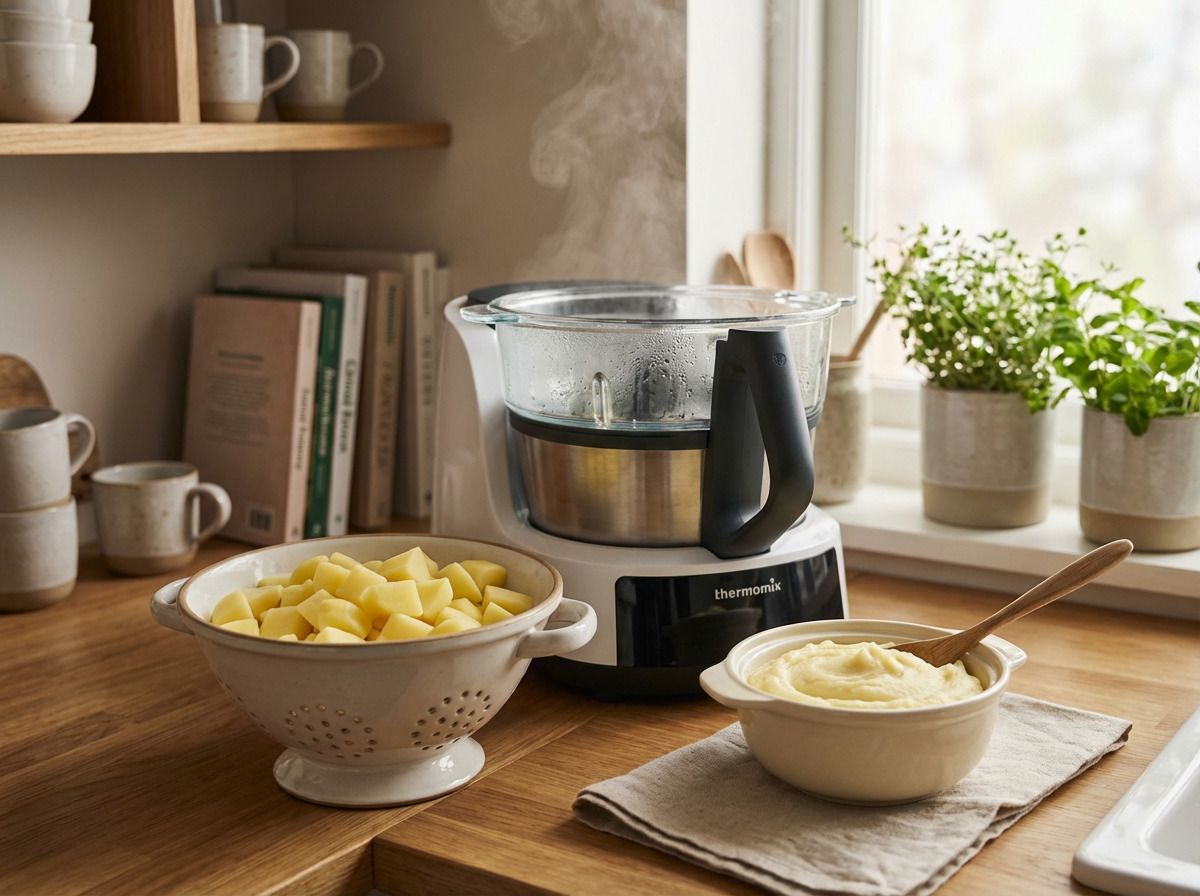
Potato is the quiet main ingredient of first foods: it is part of the classic lunch puree, makes it filling and creamy and goes with almost any vegetable. With a Thermomix, potato puree for your baby is steamed and blended in one go. To keep it from turning gluey and to make sure your baby actually benefits, a few details matter.
Here you will find the base recipe with the right Thermomix settings, the combinations that turn potato puree into a complete vegetable, potato and meat puree, tips for freezing in cubes, and answers to the most common questions.
Key Takeaways: Potato Puree for Baby in the Thermomix
- ✓ Potato belongs in the very first puree, as soon as your baby shows the readiness signs
- ✓ Steam in the Varoma, then blend only briefly at low speed, otherwise the puree turns gluey
- ✓ No salt, no sugar, no juice, but rapeseed (canola) oil when serving
- ✓ With 100 g of vegetables and 30 g of meat it becomes a complete lunch puree
- ✓ Freeze it mixed with vegetables, plain potato puree turns watery after thawing
When Can My Baby Have Potato Puree?
Potato is not a food your baby has to wait for. In the feeding plan of Germany's Gesund ins Leben network it is a fixed part of the very first puree: after a few days of plain vegetable puree, potato is added, followed shortly by oil and meat. When that first puree happens is decided by your baby, not by the calendar. Your baby is ready when they sit with support and hold the head steady, reach for food and bring it to the mouth, show interest in food, and have lost the tongue-thrust reflex. Everything else is in our starting solids guide, and the ingredient profile is in our food library.
Why Potato Belongs in Baby Food
Energy and fullness
Potato starch provides the carbohydrates that plain vegetable puree lacks. It makes the puree filling enough to replace a milk feed.
Mild and well tolerated
Potatoes taste neutral, rarely cause allergies and agree with most babies. They bind watery vegetables such as zucchini into a creamy puree.
Nutrients
Potatoes bring potassium, vitamin C and B vitamins. The vitamin C also helps your baby absorb the iron from the meat in the same puree.
Cheap and always available
Local, in season all year and inexpensive. One reason the vegetable, potato and meat puree is the classic first meal in Germany and Austria.
Base Recipe: Potato Puree in the Thermomix
The recipe makes enough potato base for about eight lunch purees. Use floury or all-purpose potatoes, they turn out creamiest.
Ingredients:
- ▸500 g (about 1 lb) potatoes, peeled, green spots and sprouts removed
- ▸500 ml (2 cups) water for steaming
- ▸Rapeseed (canola) oil for serving (1 tbsp per lunch puree)
Method:
- 1.Cut the potatoes into pieces of about 2 cm (1 inch) and place them in the simmering basket.
- 2.Pour 500 ml of water into the mixing bowl, insert the basket, close the lid and place the measuring cup on top.
- 3.Steam for 20 to 25 minutes at Varoma temperature, speed 1, until the pieces are very soft (test with the spatula).
- 4.Lift out the basket with the spatula, pour off the cooking water down to about 100 ml, and tip the potatoes into the bowl.
- 5.Blend for 10 to 15 seconds at speed 4, scrape down with the spatula, and blend another 5 seconds if needed. Never go above speed 5 or blend longer, or the starch turns gluey.
- 6.Add a little cooking water to reach the texture you want: fine and soft for the start, coarser later.
- 7.Stir the oil into each individual portion just before feeding, not into the whole batch.
Skip salt, sugar, stock and fruit juice completely. Potato puree tastes fine to a baby on its own, and juice only adds sugar your baby does not need.
From potato puree to 100+ more recipes
This base recipe is just the start: the app shows you matching vegetable and meat combinations, a personal feeding plan for every stage and a shopping list for the week.
From Potato Puree to a Complete Lunch Puree
Plain potato puree is a base, not a complete meal. The classic lunch puree combines, per portion, about 100 g of vegetables, 50 g of potato, 30 g of meat or fish, 1 tbsp of rapeseed oil and 2 tbsp of vitamin C rich fruit puree. The vegetables simply steam in the same basket, and meat is cooked through, blended finely and stirred in. These combinations have proven themselves:
| Combination | When it fits | Tip |
|---|---|---|
| Carrot + potato | The classic for the first weeks | Steam the carrots alongside, recipe in our carrot puree guide |
| Pumpkin + potato | Sweet, creamy, helpful with constipation | Hokkaido pumpkin needs no peeling, see our pumpkin puree guide |
| Parsnip + potato | Mild and nutty, a good alternative to carrot | Steam a small piece of apple with it for vitamin C |
| Zucchini + potato | Easy to digest, a watery vegetable | Add less cooking water, the potato binds |
| Broccoli + potato | For babies who already know mild vegetables | Use only the florets, details in our broccoli guide |
| Vegetable + potato + beef, poultry or salmon | The complete lunch puree with iron | Blend 30 g of cooked meat finely with a little water and stir in, see our meat guide |
Which vegetables suit the start and how to combine them step by step is covered in our vegetable guide for baby puree. Even more recipes for all three puree meals are in our collection of baby food puree ideas.
Freezing and Reheating Potato Puree
Potato starch changes when frozen: plain potato puree tends to turn watery or gluey after thawing. That is not dangerous, just unappetizing. Two approaches work well:
- ✓Freeze it mixed: Portion it as a vegetable and potato puree in ice cube trays. In the mix the effect is barely noticeable, stir vigorously after reheating.
- ✓Potato cubes as a building block: Freeze coarsely mashed and combine with vegetable and meat cubes when reheating. This is the most flexible option.
- ✗Add the oil only when serving, never refreeze thawed puree, and throw away leftovers from the bowl.
Storage times, containers and the safe thawing methods are explained in detail in our guide to freezing baby food.
Common Mistakes With Potato Puree for Babies
- ✗Blended too long or too fast: At speed 8, potatoes turn into glue. Short and at speed 4 to 5 is enough.
- ✗Green spots and sprouts left in: They contain solanine. Cut them away generously and store potatoes in the dark.
- ✗Salt, stock or juice "for flavor": Baby kidneys do not need salt, and juice is unnecessary sugar.
- ✗Forgetting the oil: Without fat, energy and the absorption of fat-soluble vitamins are missing. 1 tbsp of rapeseed oil belongs in every lunch puree.
- ✗Keeping it equally smooth for weeks: As soon as your baby swallows smooth puree confidently, the potato puree can get coarser, all the way to soft chunks as finger food.
FAQ: Common Questions About Potato Puree for Baby
Can I use sweet potato instead of potato?
Yes, alternate them. Sweet potato tastes sweeter and provides beta-carotene, regular potato is more neutral. Both steam the same way in the Thermomix, sweet potato softens a little faster.
Can my baby eat potato as finger food?
Yes. Soft steamed potato wedges, big enough to stick out of a closed fist, are a popular first finger food. They must squash easily between your thumb and index finger. How to cut them by age is shown in our guide to cutting food safely.
Which potato variety is best?
Floury varieties turn out creamiest, all-purpose potatoes work too. Waxy potatoes stay grainy and need more cooking water.
Can I add milk or butter to the potato puree?
A little butter is fine, but as the fat source rapeseed oil is the better choice because of its omega-3 fats. In the first year, whole milk belongs only in the milk and cereal porridge, not as a drink and not by the cupful in the lunch puree.
Does the recipe work without a Thermomix?
Of course. Boil or steam the potatoes in a little water until soft and mash them with a potato ricer or fork. Use a stick blender only briefly and at low speed, for the same reason as in the Thermomix.
Conclusion: Potato Puree in the Thermomix
- ✓Steam in the Varoma, blend briefly at speed 4, adjust with cooking water
- ✓No salt, sugar or juice, but rapeseed oil in each portion
- ✓With vegetables and meat the base becomes a complete lunch puree
- ✓Freeze it mixed in cubes, make plain potato puree fresh
With 25 minutes of Thermomix time you have a potato base for a whole week, and your baby gets a filling lunch puree every day that goes with any vegetable.