Blackberry for Babies
Baby Food Guide from 6 Months
Puree
6+
Months
BLW
6+
Months
Choking Hazard
Moderate (reduced by simmering, mashing, or quartering)
Allergen
No
Key Nutrients
Fiber • Vitamin C • Vitamin K
Can Babies Eat Blackberry?
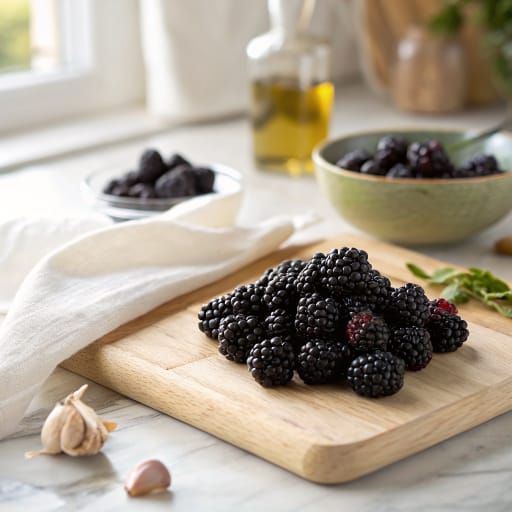
Blackberries are deep purple, glossy clusters of tiny drupelets, tart or sweet depending on ripeness, and among the more antioxidant rich fruits a baby is likely to try in the first year. They're a good source of fiber and vitamin C, and their color comes from anthocyanins, plant compounds that help protect developing cells as they grow.
Their firm, round shape is the main thing to plan around, since a whole berry is just about the size to lodge in a young airway. Simmering fresh or frozen berries until they soften and burst solves that entirely, and even a single ripe berry pressed flat between two fingers becomes safe to offer. Blackberry isn't a common allergen, though the small seeds can feel like an unfamiliar texture at first.
Compared with many fruits, blackberries carry relatively little sugar per berry, and they pair naturally with yogurt or oatmeal. Frozen berries, simmered straight from frozen, work just as well as fresh ones in season, which makes blackberries an easy fruit to keep on hand year round.
Blackberry Baby Food: How to Prepare It
Puree from 6+ Months
Simmer fresh or frozen blackberries until they soften and pop, then mash into a smooth pulp. Swirl it through porridge, yogurt, or ricotta.
BLW from 6+ Months
Simmer fresh or frozen berries until soft and burst, or press a very ripe, soft berry flat between thumb and finger. Stir it into soft foods such as porridge, yogurt, or ricotta.
BLW from 9+ Months
Cut ripe, soft berries into quarters lengthwise so they lose their round shape, then serve as a finger food to build the pincer grasp. Halved berries work well too.
BLW from 12+ Months
Many toddlers can now manage whole ripe blackberries. Choose the biggest, softest berries, no larger than half a toddler's palm, and supervise closely.
Nutritional Benefits
Blackberries deliver fiber, vitamin C, and anthocyanin antioxidants in a naturally low sugar package, making them a nutrient dense fruit once prepared safely.
Key Nutrients
Fiber
Supports healthy digestion.
Vitamin C
Supports immune function and helps the body absorb iron.
Vitamin K
Supports healthy blood clotting and bone development.
Manganese
Supports bone growth and metabolism.
Anthocyanins (Antioxidants)
Protect developing cells from oxidative stress.
Allergen & Choking Information
Not a Common Allergen
Blackberry is not a common allergen. Whole, firm berries are round enough to pose a choking risk, so simmer, mash, flatten, or quarter them until baby can safely manage a whole ripe berry.
Frequently Asked Questions
When can babies eat Blackberries?
Around 6 months (simmered soft and mashed)
How do I prepare Blackberries puree for my baby?
Simmer fresh or frozen blackberries until they soften and pop, then mash into a smooth pulp. Swirl it through porridge, yogurt, or ricotta.
What are the nutritional benefits of Blackberries?
Blackberries deliver fiber, vitamin C, and anthocyanin antioxidants in a naturally low sugar package, making them a nutrient dense fruit once prepared safely.
Sources & Related Resources
Get Personalized Guidance for Every Feeding Stage
Download the Grubsy app to track meals, get tailored recommendations, and explore foods like Blackberry plus hundreds more, all in one place.
Disclaimer: This information is for educational purposes only and does not replace professional medical advice.